


6ps Of Social Entrepreneurial Enterprise Areas Social Business Startup




Try Before you Buy Download Free Sample Product
 Impress Your
 Audience
 100%
100% Editable
 Save Hours
 of Time


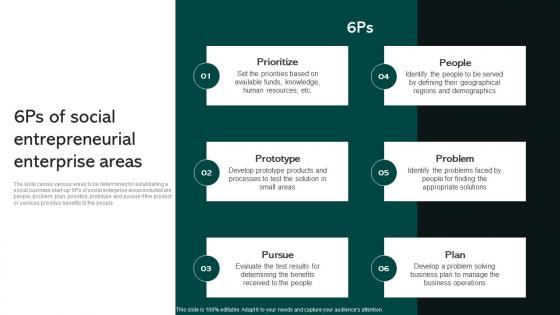
The slide carries various areas to be determined for establishing a social business start up. 6Ps of social enterprise areas included are people, problem, plan, prioritize, prototype and pursue if the product or services provides benefits to the people.
People who downloaded this PowerPoint presentation also viewed the following :
6ps Of Social Entrepreneurial Enterprise Areas Social Business Startup with all 6 slides:
Use our 6ps Of Social Entrepreneurial Enterprise Areas Social Business Startup to effectively help you save your valuable time. They are readymade to fit into any presentation structure.





FAQs for 6ps Of Social Entrepreneurial Enterprise Areas
So the 6Ps thing is just the old 4Ps marketing mix but with two extras thrown in. Product, Price, Place, Promotion - you probably know those already. Then there's People (your team, customers, all that) and Process (how stuff actually gets done). Honestly, those last two are huge for service businesses since everything revolves around human stuff. Like, your process could be amazing but if your people suck... anyway, you get it. I'd start by just looking at where you are with each one right now. See what's working, what isn't. The gaps usually jump out pretty quick once you actually write it down.
Dude, the 6Ps are honestly a game-changer for presentations. Purpose, People, Process, Product, Preparation, Performance. Most people dive straight into making slides (guilty as charged), but that's backwards. Figure out your "why" first - like write it down in one sentence before touching PowerPoint. Then really think about who's sitting in those chairs. Once you nail those two, the rest flows way better. Your content gets sharper and you'll feel less nervous up there. I learned this the hard way after bombing a client pitch last year. Trust me, spending time on Purpose and People upfront saves you so much stress later.
The 6Ps adapt to literally any presentation style you throw at them. Purpose and People always stay at the center, but everything else shifts around. A boardroom pitch needs way more prep than your weekly standup - obvious, right? Process changes the most dramatically. Sometimes you're doing formal slides, other times just sketching on a whiteboard. Pace and Performance? Those feed off whatever energy the room's giving you. Honestly, I've watched people crush informal presentations by just nailing their Purpose and reading the audience well. Figure out your presentation type first, then bend the 6Ps to fit.
Honestly, you've gotta tailor each P to match your crowd. Execs want Purpose front and center - show them ROI and strategic wins, then move fast. Tech teams? They'll want you diving deep into Process details and problem-solving stuff. I've noticed younger audiences eat up interactive Participation, but senior people usually just want you to get to the point. Oh, and cultural background matters way more than people think - some expect formal structure while others are cool with casual vibes. Do your homework on the audience beforehand, but also watch their faces during your talk. Sometimes you'll need to switch gears mid-presentation if things aren't landing right.
Ugh, the worst thing people do is jump straight into solutions before they even know what problem they're solving. Happens ALL the time and it's such a mess. Also don't get stuck overthinking everything in the planning stage - I've seen teams spend months just... planning. Definitely get input from stakeholders even if you think you've got it figured out. Oh and this isn't some one-and-done checklist thing, you gotta keep coming back to it. Most teams implement something then just walk away without checking if it actually worked. Start by getting super clear on the actual problem first.
Ok so the 6Ps basically work like story structure, which is actually genius. Start with Purpose as your main conflict - what problem are we solving? People become your characters (your audience is the hero, btw). Process is just your plot unfolding step by step. Positioning sets the whole scene - like your "here's what's happening" opener. Payoff? That's your big resolution moment where it all makes sense. And Presence is how you bring the energy when you're actually presenting. I tried this framework last month and honestly, my presentations got so much better. Way more engaging than those boring bullet-point decks everyone does.
Visual design mostly falls under "Presentation" but it bleeds into everything else. Your design choices shape how people see your brand and communicate what you're selling. Premium visuals? They let you charge premium prices - works every time. It also changes where you can sell and makes your marketing way more effective. Honestly, design isn't just about looking good (though that helps). It's strategic. You want your visuals telling the same story across all six Ps, otherwise things get messy fast. What story are your visuals actually telling right now?
Try the 6Ps framework - it's honestly a game changer. Begin with Purpose (why should anyone care?), then Problem (what needs fixing), Possibilities (solutions you looked at), your Proposal, Parameters like timeline and budget, plus Preparation for next steps. Way better than just dumping a bunch of charts on people and crossing your fingers. The framework makes you give context first, which - let's be real - most people skip entirely. Your audience can actually follow along instead of getting lost in the weeds. Next time you're prepping a presentation, just map everything to those six buckets. You'll sound way more put-together.
Honestly, start with weekly team check-ins - they're quick but tell you so much about what's actually working. After each campaign, do a retrospective on all 6 Ps. Customer surveys help too, plus tracking separate KPIs for each P so you know exactly where things are breaking down. Monthly stakeholder meetings might sound boring but they catch problems before they get messy. Oh, and don't just collect feedback once - make it routine. Data analytics will show if your product, pricing, and promotion are resonating. The retrospectives are my favorite though, teams are usually pretty honest about what sucks.
The 6Ps are actually pretty smart for presentations - way better than just throwing random slides together. Product lets you show what makes you different. With Price, you can position your value (not just costs, but worth). Place covers how you reach people, Promotion is your call-to-action moment. People? That's where you highlight why your team rocks. Process shows you've got your act together operationally. Most presentations are boring info dumps anyway, but the 6Ps give you a real story arc. Map your next one to these six elements first - I swear it'll feel way more put-together and people will actually remember it.
Look into McDonald's first - their global expansion is perfect for seeing all 6Ps work together. They're genius at adapting menus and pricing for different countries while keeping their core processes the same. Starbucks is worth checking out too, especially their store design evolution and employee training stuff. Oh and Netflix obviously - going from DVDs to streaming was such a massive process overhaul. Honestly McDonald's might be your best bet though since you can clearly see how they balance staying consistent with local adaptation. Makes the framework way easier to understand when you see it all connected.
The 6Ps are honestly a lifesaver for workshop planning. Purpose covers why you're presenting, People is about your audience, Place deals with the environment. Then you've got Process (your delivery method), Product (materials needed), and Preparation. I can't tell you how many trainers I've watched completely bomb because they just winged it – seriously painful to witness. Start with nailing down your purpose first, then work through the other Ps one by one. Room setup, timing, how you'll keep people engaged – it all fits into this framework. Your workshops will be so much smoother.
For the 6Ps, grab Canva or PowerPoint for visuals - honestly PowerPoint gets a bad rap but it's fine. Grammarly's clutch for cleaning up your messaging. Here's the weird part that actually works: record yourself practicing with your phone. Super cringey to watch back but you'll catch stuff you never noticed. Miro's solid for story mapping before you dive into slides. Maybe get a presentation remote if you're doing this a lot. Oh, and decent lighting makes a huge difference. Just pick like 2-3 tools though - otherwise you'll spend more time tool-hunting than actually prepping.
Honestly, the 6Ps are gonna change big time with all this VR/AR stuff. "Place" isn't just conference rooms anymore - you could be presenting in some virtual world or dealing with half your audience being remote. Tech rehearsals are now part of your prep because that fancy equipment *will* crash at the worst moment (trust me on this). "Performance" gets weird when you're maybe talking to holograms or AI-generated visuals. People's attention spans are getting shorter too, so you need more interactive elements. Purpose stays the same though. Try one new tech tool each quarter - don't go overboard.
Dude, you absolutely can't just copy your 6Ps strategy across different countries - learned that one the hard way! McDonald's does rice burgers in Asia for a reason. Pricing needs to match what people actually earn there, not what works here. Your ads might totally bomb if you don't get the local culture (happened to us in Germany once - they're way more direct than we expected). Distribution is weird too - like, what works in the US can completely flop somewhere else. Even your staff and processes need adjusting. Honestly, just do your homework on local customs first or you're gonna mess up.
-
SlideTeam offers so many variations of designs and topics. It’s unbelievable! Easy to create such stunning presentations now.
-
Excellent Designs.