


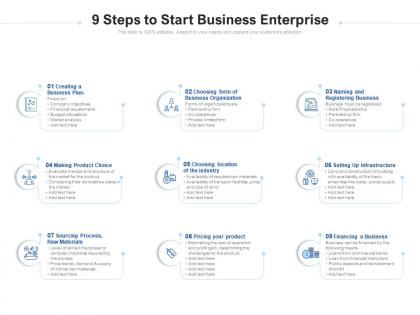
9 steps to start business enterprise




Try Before you Buy Download Free Sample Product
 Impress Your
 Audience
 100%
100% Editable
 Save Hours
 of Time


Identify acts of inefficiency with our 9 Steps To Start Business Enterprise. Focus on factors causing delay.
People who downloaded this PowerPoint presentation also viewed the following :
9 steps to start business enterprise with all 2 slides:
Focus on factors causing delay with our 9 Steps To Start Business Enterprise. It helps identify acts of inefficiency.

FAQs for 9 steps to
Essential elements include executive summary, market analysis, competitive landscape, business model, financial projections, team credentials, and funding requirements. These components work together by establishing credibility, demonstrating market opportunity, and showcasing strategic positioning, with many investors finding that presentations combining clear value propositions with realistic financial forecasting ultimately deliver stronger funding outcomes.
Entrepreneurs effectively communicate their unique value proposition by clearly defining their target audience, articulating specific problems they solve, and demonstrating measurable outcomes through concrete examples and customer testimonials. Through focused messaging across digital platforms, networking events, and investor presentations, startups streamline their communication strategy, enhance credibility with potential customers and investors, and ultimately accelerate market penetration while building competitive advantage in increasingly crowded marketplaces.
Market research plays a fundamental role in shaping startup strategy by identifying target customers, analyzing competitor landscapes, validating product-market fit, and uncovering market opportunities and potential barriers. This strategic foundation enables startups to make data-driven decisions regarding pricing, positioning, and resource allocation, while minimizing risks and maximizing growth potential in competitive markets.
Startups can differentiate through distinctive brand positioning, compelling visual identity, authentic storytelling, targeted messaging, and consistent customer experience across all touchpoints. By focusing on unique value propositions and emotional connections, many emerging companies find that strategic branding enables stronger market presence, customer loyalty, and competitive advantage in crowded sectors.
Investors prioritize revenue forecasts, cash flow projections, break-even analysis, customer acquisition costs, and projected market share when evaluating startups. These financial models demonstrate business viability by showing scalable growth potential, sustainable unit economics, and clear paths to profitability, with many investors finding that realistic projections ultimately deliver greater confidence than overly optimistic scenarios.
**INPUT**: What are the most common funding options available for new businesses? **OUTPUT**: Common funding options for new businesses include bootstrapping, angel investors, venture capital, bank loans, and crowdfunding platforms. These financing approaches enable entrepreneurs to scale operations, develop products, and enter markets strategically, with many startups finding that combining multiple funding sources delivers greater financial flexibility and reduced dependency on single investors.
Startups create compelling pitch decks by clearly articulating their problem-solution fit, market opportunity, business model, competitive advantages, and financial projections through visually engaging slides. Successful decks tell a cohesive story that demonstrates scalability and market validation, with many investors focusing on strong team credentials, realistic revenue forecasts, and clear paths to profitability that showcase strategic growth potential.
Entrepreneurs should address business structure selection, intellectual property protection, employment law compliance, contract development, and regulatory requirements during startup formation. These legal foundations streamline operations by minimizing liability risks, protecting valuable assets, and ensuring regulatory compliance, with many startups finding that early legal planning ultimately delivers competitive advantages and sustainable growth trajectories.
Founders can identify the right team by assessing skill gaps, defining cultural values, leveraging professional networks, conducting thorough interviews, and prioritizing diverse expertise over immediate costs. Through strategic hiring that balances technical competencies with cultural alignment, startups enhance innovation, accelerate product development, and build sustainable operations, with many successful ventures finding that early team decisions ultimately determine long-term competitive advantage.
Early-stage startups should track customer acquisition cost, monthly recurring revenue, user engagement rates, burn rate, and cash runway metrics. These fundamental indicators help founders optimize resource allocation, validate product-market fit, and demonstrate growth potential to investors, with many successful startups finding that focusing on these core metrics enables strategic pivots and sustainable scaling decisions.
Startups effectively leverage social media by creating consistent, value-driven content, engaging authentically with their target audience, utilizing cost-effective advertising options, and building community around their brand message. Through strategic platforms like LinkedIn for B2B connections and Instagram for visual storytelling, many emerging companies streamline customer acquisition, enhance brand recognition, and accelerate market penetration while maximizing limited marketing budgets.
Entrepreneurs can build strong networks through industry events, professional associations, mentorship programs, strategic collaborations, and digital platforms like LinkedIn. These approaches enable startups to access market insights, funding opportunities, and operational expertise, with many finding that genuine relationship-building, rather than transactional networking, ultimately delivers sustainable partnerships and accelerated business growth.
Startups can pivot effectively by analyzing customer data, reassessing value propositions, testing new revenue streams, and maintaining core team strengths while adapting operations. This strategic flexibility enables companies to respond to market demands while preserving valuable resources, with many successful startups finding that measured pivots based on concrete feedback ultimately deliver stronger market fit and sustainable growth.
Best practices for developing a go-to-market strategy include defining target customer segments, conducting competitive analysis, establishing pricing models, creating compelling value propositions, and selecting optimal distribution channels. These strategic elements work together by aligning product positioning with market needs, streamlining sales processes, and accelerating customer acquisition, ultimately delivering faster market penetration and sustainable revenue growth.
Startups can balance scalability with product quality by implementing incremental scaling phases, establishing robust quality assurance frameworks, and investing in automated testing systems early. Through strategic resource allocation and phased market expansion, many startups find that maintaining core product standards while gradually scaling operations delivers sustainable growth and competitive advantage.
No Reviews