


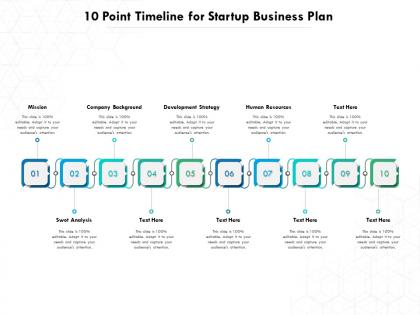
10 point timeline for startup business plan




Try Before you Buy Download Free Sample Product
 Impress Your
 Audience
 100%
100% Editable
 Save Hours
 of Time


Our 10 Point Timeline For Startup Business Plan are topically designed to provide an attractive backdrop to any subject. Use them to look like a presentation pro.
People who downloaded this PowerPoint presentation also viewed the following :
10 point timeline for startup business plan with all 2 slides:
Use our 10 Point Timeline For Startup Business Plan to effectively help you save your valuable time. They are readymade to fit into any presentation structure.
FAQs for 10 point timeline for
So you'll need the basics: executive summary, market analysis, what you're actually selling, marketing plan, operations, your team, and financial projections. Honestly, the executive summary is make-or-break - investors barely glance at the rest if that part sucks. Also throw in funding requirements and where the money's going. Don't get stuck perfecting the format though. Just grab a template and focus on telling a good story with numbers that actually make sense. Oh, and avoid those crazy optimistic projections - nobody believes you'll capture 10% of a billion-dollar market in year two.
Honestly? Plan on about 4-6 weeks if you're actually staying consistent with it. Market research and checking out competitors will eat up like 1-2 weeks. Financial projections take another week (I know, super exciting stuff lol). Then you've got 1-2 weeks for writing everything up and making it not suck. Don't get trapped trying to make it perfect though - that's where people get stuck forever. Your first draft just needs to explain what you're doing, why people will pay for it, and how you'll make money. Start with one page first. Way less overwhelming that way, then build it out once you know your idea actually works.
Focus on stuff investors can actually measure - product milestones like prototype done, beta testing, launch date. Revenue targets by quarter, fundraising rounds, hitting your first 100 customers. Oh, and don't ignore the boring legal stuff like permits and partnerships (seriously, I've seen people get burned by this). Hiring key players matters too. Each milestone needs a real date and clear metrics so you know if you're winning or need to change course. Keep it simple but comprehensive - you want everything trackable.
Honestly, monthly is probably your best bet in the beginning - everything changes so fast with startups. I do a quick review each month, then go deeper every quarter to actually update numbers and strategy. Your original plan? Don't get too attached to it lol. Customer feedback and market stuff will totally shift your assumptions anyway. The trick is staying flexible but not losing sight of your main goal. Oh and actually put it in your calendar or you'll forget (speaking from experience here). Early stage is just pure chaos so you gotta stay on top of things.
Do your market research super early - like weeks 2-4 of planning, honestly. Don't be one of those people who skips it and kicks themselves later (I've watched this happen so many times). Your research basically shapes everything else - who you're targeting, how much to charge, all that stuff. Surveys, competitor analysis, customer interviews - give yourself at least 2-3 weeks for the good stuff. Then you can build your actual plan on real data instead of just winging it with guesswork.
Hit the stuff that makes money first - product dev and getting your first customers. Honestly, I wasted so much cash on a nice office early on, don't be me lol. Start bare bones to test if people actually want what you're building. Once you hit milestones like 100 users, then add things like proper customer support. Keep 20% extra for when things go sideways (they will). Track your burn rate every week - you need to know exactly how long your money lasts. Scale up slow as you prove each piece works.
Okay so you need three main things: income statements, cash flow forecasts, and balance sheets for about 3-5 years. Do monthly projections for the first year, then quarterly after that. Cash flow is honestly the big one here - that's what'll kill your startup if you mess it up. Don't be overly optimistic with revenue (I know, easier said than done). If your business has seasonal ups and downs, factor that in. Split your costs into fixed vs variable so investors can see you get the unit economics. Oh and keep it detailed enough to look legit without going overboard on the spreadsheet madness.
Honestly, just go through your timeline and think about what could totally screw you over at each step. Funding getting delayed, your best developer bailing, supply chain going haywire - you know, all that fun stuff. For each nightmare scenario, come up with like 2-3 backup plans. So if your lead dev might quit, maybe scout some freelancers now or get someone else trained up. Build extra time into your schedule for the stuff that'll probably happen (because something always does). I'd start with your worst 5 risks and go from there.
Honestly, just grab a template from LivePlan or Bizplan - they've got all the financial stuff built in so you're not starting with a blank page. Use Canva for charts and visuals (seriously, don't torture yourself with Word). IBISWorld's solid for industry research, though it can get pricey. Your local SCORE chapter does free mentoring which is clutch. Oh, and if you want something way simpler, try Lean Canvas instead of a full business plan. Pick whatever template fits your industry best, then just tweak it. You'll save yourself like 20 hours of headaches.
For tech startups, plan on 6-12 months because you're constantly tweaking your product and testing with users. Retail's way simpler - maybe 3-6 months tops since it's just inventory, location, suppliers. Pretty straightforward stuff. Here's the thing though: tech plans never stay put. You'll be rewriting chunks every few weeks as you figure out what actually resonates with customers. Retail plans? Once you've got your supply chain sorted and picked your spot, they don't change much. Honestly, I'd give yourself extra buffer time for tech. Trust me, you'll end up redoing sections more than you think.
Dude, start fundraising way earlier than feels logical - like 6-9 months before you'd actually run out of cash. The whole process drags on forever (learned this the hard way), and investors get weird when they smell desperation. You don't want to be that founder scrambling at the last second. Honestly, having those deadlines pushes you to hit milestones that actually make your pitch better anyway. Map out your timeline backwards from when you need money sitting in your account. Oh, and they always want to see you're thinking ahead, not just panicking about runway.
Honestly, work backwards from your revenue targets - makes everything way clearer. Your next 3-6 months should be laser-focused on getting customers and proving your product works. Save the big expansion stuff for year two. Too many founders I know get obsessed with follower counts and other BS metrics early on. Keep your short-term goals super tight - like 3-5 things max. Long-term planning? Build in wiggle room because you're gonna pivot at least once (probably twice if I'm being real). Write it all down and actually look at it monthly. Sounds boring but it works.
Dude, the classic mistake is being stupidly optimistic about timelines. Like, assuming everything goes perfectly and you'll hit every single milestone. Product dev always takes longer than expected. Plus you're forgetting about boring stuff like regulatory approvals and legal hoops. Funding rounds? Yeah, those drag on forever - I swear investors move in slow motion. Most people don't plan for pivots either, which is kinda nuts since that's basically guaranteed. Just tack on 50% more time to whatever you think it'll take. Make three versions: best case, realistic, and total disaster mode.
Set monthly or quarterly checkpoints instead of just staring at your end goal the whole time. Track stuff like revenue, customer numbers, product milestones - whatever matters most to your business. Most startups mess up their original timeline anyway (honestly it's almost guaranteed), but catching problems early is what saves you. Make a simple spreadsheet with green/yellow/red status for your big objectives. I know it sounds boring but trust me, you'll thank yourself later. Review it monthly and don't get too attached to your original plan. Sometimes reality has other ideas and you've gotta roll with it.
Pick 3-6 big milestones spanning about 18-24 months. Revenue targets, product drops, hiring spurts - that kind of stuff. Skip the tiny details because investors will tune out. Honestly, everyone's timelines are way too ambitious anyway, so pad yours a bit. Specific dates matter more than you'd think. A simple visual beats walls of text every time - try a basic timeline or Gantt chart. Connect each milestone to their money and potential returns. Oh, and define what "winning" looks like at each stage. They'll want to track your progress later, and you don't want awkward conversations about missed goals you never clearly defined.
-
Appreciate the research and its presentable format.
-
Really like the color and design of the presentation.
-
Innovative and Colorful designs.
-
The content is very helpful from business point of view.
-
Excellent Designs.
-
Illustrative design with editable content. Exceptional value for money. Highly pleased with the product.
-
Unique and attractive product design.
-
Very unique and reliable designs.