


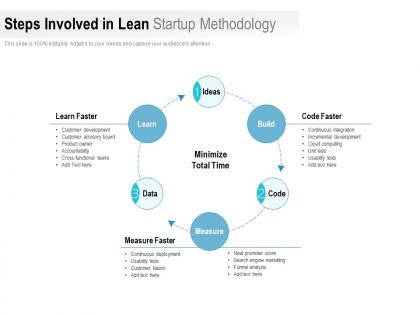
Steps involved in lean startup methodology




Try Before you Buy Download Free Sample Product
 Impress Your
 Audience
 100%
100% Editable
 Save Hours
 of Time


Give them a glimpse of the glory ahead with our Steps Involved In Lean Startup Methodology. They help heighten anticipation.
People who downloaded this PowerPoint presentation also viewed the following :
Steps involved in lean startup methodology with all 2 slides:
Generate heightened effort with our Steps Involved In Lean Startup Methodology. Get folks to go harder at it.
FAQs for Steps involved in
Lean Startup methodology centers on validated learning, build-measure-learn cycles, minimum viable products (MVPs), innovation accounting, and pivot-or-persevere decisions. These principles enable startups to minimize waste by testing hypotheses quickly, gathering customer feedback early, and iterating based on real market data, ultimately reducing time-to-market and increasing chances of sustainable business success.
The Build-Measure-Learn feedback loop functions by creating minimum viable products, testing them with real customers, and using data insights to iterate quickly. Through rapid prototyping, startups can validate assumptions, pivot when necessary, and refine their offerings based on actual market feedback, ultimately reducing waste and accelerating product-market fit while minimizing development costs and time-to-market risks.
An MVP enables entrepreneurs to test core business assumptions with minimal resources by delivering essential features to early customers, gathering real market feedback, and measuring actual user behavior. This approach helps startups validate demand before significant investment, with many companies like Dropbox and Airbnb using MVPs to refine their offerings, minimize development costs, and accelerate time-to-market while reducing business risk.
Startups can effectively pivot by systematically analyzing customer feedback patterns, identifying core problems worth solving, and testing new hypotheses through rapid experimentation. Successful pivots often involve changing target markets, revenue models, or product features while preserving validated learnings, with many technology companies finding that customer-driven pivots ultimately deliver stronger market fit and sustainable growth advantages.
Essential Lean Startup metrics include customer acquisition cost, lifetime value, monthly recurring revenue, churn rate, and product-market fit indicators like Net Promoter Score. These metrics enable startups to validate assumptions, optimize resource allocation, and pivot strategically, with many entrepreneurs finding that focusing on actionable metrics rather than vanity metrics ultimately delivers sustainable growth and competitive advantage.
Teams can foster experimentation culture by encouraging hypothesis-driven testing, celebrating learning from failures, allocating dedicated resources for experiments, and establishing clear metrics for evaluation. Through structured frameworks like A/B testing and rapid prototyping, organizations streamline innovation processes while minimizing risks, with many companies finding that regular experimentation cycles ultimately deliver faster market adaptation and sustainable competitive advantage.
Common pitfalls include misinterpreting MVP as a low-quality product, over-pivoting without sufficient data analysis, ignoring customer feedback, and focusing too heavily on metrics without strategic context. These missteps can derail growth by wasting resources, confusing market positioning, and delaying product-market fit, with many startups finding that balanced execution ultimately delivers sustainable competitive advantage.
Lean Startup methodology applies across industries by emphasizing rapid prototyping, customer validation, and iterative improvement regardless of sector. Manufacturing companies test product concepts with minimal viable prototypes, healthcare organizations pilot service delivery models, and retail businesses experiment with store formats, ultimately delivering faster market entry, reduced development costs, and enhanced customer satisfaction through continuous learning cycles.
Lean Startup principles enhance cross-functional collaboration by establishing shared metrics, rapid feedback cycles, iterative development processes, and collective hypothesis testing. These approaches streamline communication between departments like product, engineering, marketing, and sales, while enabling teams to pivot quickly based on customer insights, ultimately delivering faster innovation and reduced development costs across organizations.
Customer development is fundamental to Lean Startup methodology, enabling entrepreneurs to validate assumptions, understand market needs, gather direct feedback, and iterate based on real customer insights. Through systematic customer interviews, surveys, and testing, startups minimize product-market fit risks, reduce development costs, and accelerate time-to-market, with many successful companies finding that early customer engagement ultimately delivers stronger products and sustainable competitive advantage.
Lean Startup practices influence funding by emphasizing validated learning and customer feedback before seeking major investment, reducing risk for both entrepreneurs and investors. Through MVP testing and iterative development, startups demonstrate market traction and product-market fit, enabling more strategic fundraising conversations with venture capitalists, ultimately securing better terms and higher valuations.
**INPUT**: What tools and resources are recommended for Lean Startup practitioners? **OUTPUT**: Lean Startup practitioners benefit from customer development platforms like Typeform and SurveyMonkey, analytics tools such as Google Analytics and Mixpanel, prototyping software like Figma, and A/B testing platforms including Optimizely. These resources streamline hypothesis testing, accelerate feedback loops, and enable data-driven pivots, with many startups finding that strategic tool combinations ultimately deliver faster validation cycles and reduced development costs. **Word count: 60 words**
Startups can scale sustainably through Lean methodologies by maintaining validated learning cycles, implementing scalable systems early, and preserving customer-centric feedback loops throughout growth phases. This approach enables companies to expand operations while minimizing waste and maintaining product-market fit, with many tech startups finding that systematic experimentation and iterative development ultimately deliver sustainable growth and competitive advantage.
Successful Lean Startup implementations include Dropbox's video MVP validating demand before building, Airbnb's initial focus on photography services, Buffer's landing page testing market interest, and Zappos' inventory-free shoe validation approach. These companies streamlined product development by testing assumptions early, pivoting based on customer feedback, and minimizing resource waste, ultimately delivering faster market entry and sustainable competitive advantages.
Lean Startup methodology helps entrepreneurs balance innovation and risk through validated learning, rapid prototyping, and iterative testing before major investments. By building minimum viable products, gathering customer feedback early, and pivoting based on data rather than assumptions, startups minimize financial exposure while maximizing learning, ultimately delivering market-fit solutions with reduced uncertainty and strategic competitive advantage.
No Reviews