

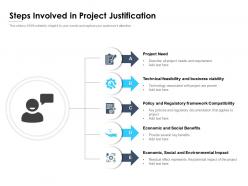
Steps involved in project justification





Try Before you Buy Download Free Sample Product
 Impress Your
 Audience
 100%
100% Editable
 Save Hours
 of Time


Our Steps Involved In Project Justification are explicit and effective. They combine clarity and concise expression.
People who downloaded this PowerPoint presentation also viewed the following :
Steps involved in project justification with all 2 slides:
Give your audience a fulfilling experience. They will find our Steps Involved In Project Justification elevating.
FAQs for Steps involved
So you need to nail the basics first - problem statement, your solution with actual deliverables, and a solid cost-benefit breakdown. Timeline with milestones is crucial too. Don't skip the risks section because honestly, execs eat that stuff up when you show you've thought ahead. Budget and team requirements obviously matter. The real trick though? Connect everything back to whatever strategic goals your company's obsessing over this quarter. That connection makes or breaks approval. Keep it under 3 pages - nobody's reading a dissertation. Short and punchy wins every time.
So you'll want to estimate all your project benefits minus costs, then divide by initial investment and times 100 for percentage. Honestly the hardest part is getting realistic benefit numbers - people always get way too optimistic here lol. Don't forget hidden costs like training and ongoing maintenance, not just the obvious labor and materials stuff. Benefits could be revenue bumps, cost savings, efficiency gains, whatever fits. Formula is: (Total Benefits - Total Costs) / Initial Investment × 100. I'd start conservative though since projects never go as smoothly as you think they will.
Honestly, I'd start with the basic money stuff - NPV and ROI calculations. Gotta make sure the numbers actually work before you get too excited about it. Technical feasibility is huge too (learned this the hard way on my last project lol). Your team needs to actually be able to build whatever you're pitching. Market research will tell you if people even want this thing. Risk assessment is boring but necessary. Maybe throw in some stakeholder analysis if you have time? Pick like 2-3 of these depending on how big your project is. Running them at the same time gives you a way better picture than doing one at a time.
So basically you figure out who's got the power to greenlight your project and what they actually care about. Finance people want to see ROI numbers. Operations folks worry about risks and disruptions. Then you pitch your idea using their language and priorities - honestly it's just smart psychology. Map out their influence levels first, then hit their specific pain points when you present. Kind of like tailoring your argument to whatever your audience values most. Makes way more sense than doing some generic pitch that doesn't connect with anyone, you know?
Honestly, I'd track both the money stuff and everything else. ROI and payback period are no-brainers - did you actually hit what you promised? But also look at stakeholder satisfaction, whether you stayed on schedule, and if you delivered those specific benefits from your business case. Customer feedback matters too if that was part of it. Team morale can be tricky to measure but it's real. Maybe set up like 4-5 key things to check quarterly? That way you can pivot if something's going sideways instead of waiting till the end.
Honestly, you've got to spell it out for leadership - they won't connect the dots between your project and their big strategic goals. Find which company priorities your work actually supports, then put real numbers on it. I can't tell you how many solid projects I've watched die because execs couldn't see the connection to what they care about. Steal their exact wording from whatever strategic plan they're obsessed with this quarter. Show metrics wherever you can. Make it obvious that your project isn't just some nice idea - it's critical for hitting the targets they're already on the hook for.
Honestly, the worst thing you can do is be super vague about what people actually get out of this. Don't promise crazy ROI timelines either - I've watched so many good projects die because someone oversold it. Be upfront about costs and risks from day one. Oh, and definitely explain why your approach beats doing nothing at all (sounds obvious but people forget). Try to put actual numbers on benefits when you can. Getting key people on board early saves you tons of headaches later. Really though, just stay realistic and always show how it connects to what the business actually cares about.
Honestly, including risk assessment actually makes your project look way more solid. Stakeholders love seeing that you've already thought about what could go wrong - shows you're not just winging it. I always tell people to list out their biggest 3-5 risks upfront with how they'd handle each one. Nobody wants to get blindsided later when budgets start ballooning, you know? When you quantify the potential damage and have backup plans ready, it proves the project's still worth doing even if stuff hits the fan. Makes your whole business case feel more legit.
Honestly, data is your best friend here. Skip the "we think this might work" approach - stakeholders shut down fast when you can't back things up. Pull historical metrics that show clear patterns. Customer feedback is pure gold too, especially when people are complaining about the same issues over and over. Cost-benefit analysis with actual numbers always wins over vague promises. Market research helps too if you're trying to prove there's real demand. Just make sure whatever data you grab actually connects to the problem you're solving - don't just throw random stats at them.
Look, market research is basically your proof there's actual demand for whatever you're pitching. Executives love seeing data - even when something seems obvious, they want those numbers. You're showing stakeholders that real people want this and will actually pay for it. Start with customer surveys, check out your competitors, grab some industry reports. That shifts your whole project from "we think this might work" to "here's solid evidence this'll make money." Plus you'll figure out your audience size and pricing sweet spots. Honestly beats going in blind and hoping for the best.
Honestly, you've gotta speak their language. Executives? Hit them with ROI numbers and how this fits the bigger picture. End users just want to know it'll actually make their jobs suck less. IT teams are already mentally listing everything that could break, so give them the technical specs upfront. Middle managers are stressing about timelines and whether their team can handle it - address that directly. I'd make separate one-pagers for each group instead of some boring generic presentation. Way more effective than trying to make one size fit all, and it shows you actually get what keeps them up at night.
Okay so basically you gotta think about who gets screwed over vs who benefits from your project. Workers getting displaced? Communities getting hurt? Some groups getting unfair advantages while others don't? That stuff matters. Environmental impact too if it applies. Oh and data privacy - forgot about that one but it's huge now. Honestly, leadership always gets tunnel vision about the business case. But you'll get grilled later if you didn't think through the downsides. Be upfront about potential problems and have some kind of plan to fix them. Document everything early - trust me on this.
Start with the problem you're solving - that's what people actually care about. Skip the jargon unless you want blank stares from everyone in the room. I'd go: what's broken, why it matters, your fix, then what winning looks like. Bullet points beat walls of text every time, trust me on this. Oh, and definitely have someone outside your team read it first. They'll catch the confusing parts you're totally blind to. Here's the thing though - if you can't explain it simply, you probably need to think it through more yourself.
Honestly, PowerPoint or Google Slides will do the job fine - everyone already knows them anyway. Canva's where it's at though if you want something that doesn't look like corporate death. Got heavy data? Throw in some Tableau visuals or even Excel charts to make those numbers actually mean something. Miro's solid for process flows too. But here's the thing - I always mess around with fonts way too long when I should focus on the actual story first. Map out your problem, solution, and ROI before you even think about which tool to use. The presentation software honestly doesn't matter if your narrative sucks.
First thing - actually listen to what they're worried about. Don't just wait for your turn to talk. Once they feel heard, hit them with your best numbers tied to stuff they actually care about (revenue, costs, whatever keeps them up at night). Honestly, the biggest skeptics usually flip and become your champions once they see real ROI potential. Don't just repeat your pitch though - tackle their specific concerns. Got examples from similar projects? Use them. Here's what really works: ask them to find flaws in your analysis. Sounds counterintuitive but collaboration wins over being defensive. What info would make them feel better about this?
No Reviews