


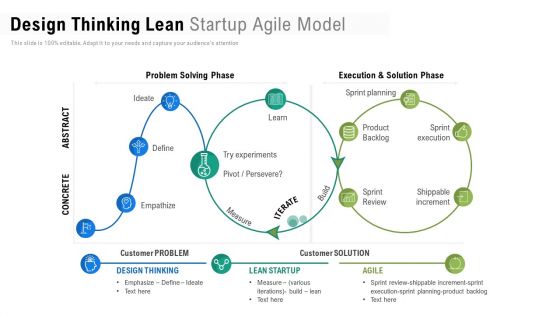
Design thinking lean startup agile model





Try Before you Buy Download Free Sample Product
 Impress Your
 Audience
 100%
100% Editable
 Save Hours
 of Time


Cut down the chances of failure with our Design Thinking Lean Startup Agile Model. They ensure you don't have to hedge your bets.
People who downloaded this PowerPoint presentation also viewed the following :
Design thinking lean startup agile model with all 2 slides:
Give direct answers with our Design Thinking Lean Startup Agile Model. Avoid having to hedge around.

FAQs for Design thinking lean
Look, innovation is what keeps you ahead of the game. Your customers' needs keep changing, and if you're not evolving with them, competitors will eat your lunch. Blockbuster learned that the hard way, right? Plus it opens up totally new ways to make money and cuts costs through better processes. Don't just sit around waiting for brilliant ideas to hit you though - that's not how it works. You gotta actually budget for trying new stuff, even the things that might bomb. Make experimentation part of your regular routine instead of treating it like some luxury.
Look, people won't innovate if they're terrified of screwing up. Psychology 101, right? Give them actual time to experiment - even 10% works. I've watched so many companies talk about wanting creativity but then lose their minds when something doesn't pan out. Listen to ideas from everyone, not just the executives. Brainstorming sessions help, maybe throw in some small rewards for trying stuff. Honestly, failing while attempting something beats playing it safe every time. Start with one pilot project to get the ball rolling.
Honestly, it comes down to three things: timing, actually solving something people care about, and not screwing up the execution. Hit the market too early or late and you're toast. Your solution needs to fix a real problem that customers will actually pay money for - not just some cool tech that's searching for a purpose. The idea itself? Maybe 10% of success. Everything else is nailing the execution, getting feedback super fast, and pivoting when needed. Most failures happen because they botched one of these basics. Oh, and validate that people actually want this stuff before you build some elaborate product. Save yourself the headache.
Honestly, these new techs are total game-changers for innovation. AI, blockchain, IoT - they don't just speed things up, they let you tackle problems that were impossible before. The best part? You don't need some massive R&D budget anymore to experiment (though yeah, the learning curve can be rough). But here's the thing - customers expect way more now because they know what's possible. Your timelines have to match that energy. I'd probably just pick one tech that fits what you're already working on and mess around with it. Start small, see what happens.
Look, customer feedback is everything - it shows you if you're actually solving a problem people give a damn about. Without it? You're just guessing and hoping things work out. People will tell you about bugs you missed, features you forgot, or totally different ways they want to use your stuff. I learned this the hard way on my last project, honestly. The trick is getting feedback super early in development, not after you've already built everything. Quick surveys work great. So do user interviews before you've wasted months building the wrong thing.
So mixing different teams together is honestly where the best ideas come from. Engineers think totally different from marketing people, and when they're all in the same room arguing about stuff, that's when cool solutions happen. I've watched this work before - it's pretty wild actually. You can't just wait for it though. Set up workshops or brainstorming sessions where everyone's mixed together. Finance guy worried about costs? That weird constraint might actually lead to your next big product idea. Different questions from different people = way better solutions than any team working alone.
Honestly, you need both the hard numbers and the softer stuff to really know what's working. Revenue from new products is obvious, plus ROI on whatever you're spending on innovation. But customer satisfaction scores matter just as much - maybe more? Employee engagement tells you if people actually care about your innovation programs. Time-to-market improvements are huge too. Oh, and track how many ideas you're generating versus what actually gets implemented. That ratio can be pretty eye-opening. Set your baselines first though, otherwise you're just guessing. Start with like 3-4 metrics max.
Look, innovation keeps you ahead because you're solving problems faster than everyone else. Tesla completely flipped the car industry on its head. Netflix? They straight up murdered Blockbuster (those late fees were brutal anyway). Here's the thing - when you innovate with new products or processes, competitors can't copy you right away. You get to charge more and build loyalty first. But honestly, it can't be a one-time deal. Make it ongoing. Start by spotting those annoying industry problems everyone just accepts as normal. That's where the magic happens.
Honestly, you're looking at three big headaches: job displacement, data privacy, and who actually gets to benefit. Look at Uber - totally screwed over taxi drivers. AI's doing the same thing to office workers now. Plus there's all the sketchy data collection stuff to think about. My advice? Don't wait until you're already causing problems. Do some kind of impact assessment early on - sounds boring but it's worth it. Actually go talk to people who'll be affected most. That part's crucial but everyone skips it. The whole thing's pretty messy territory, but being upfront about potential damage is way better than dealing with backlash later.
Hey! So big companies are honestly their own worst enemy here. They're drowning in meetings and approvals while you can just... do stuff. That's your advantage right there. Get close to your customers - like actually talk to them, not through some survey monkey thing. Pick one problem and nail it instead of building some swiss army knife nobody wants. Be willing to try weird stuff they'd never risk. I swear half the time they're too scared of their own lawyers to innovate. Find that one feature that makes people think "how did Google not build this already?"
You can't just ignore what's happening globally anymore - it'll bite you eventually. AI totally scrambled everyone's product plans, no matter where they were based. So you gotta scan for new tech, changing customer habits, and regulations that might hit your market later. The hard part? Figuring out what actually matters vs random noise. Set up some kind of trend tracking for your industry (honestly, even Google alerts help). Then do quarterly check-ins to see which global changes mean you need to pivot locally. It's like... global awareness, local action, you know?
So open innovation is basically when companies realize they can't do everything themselves anymore. You've gotta team up with outside partners, customers, maybe even competitors to keep up. Honestly, it's pretty crazy how much this flipped the whole R&D world upside down! The cool part? You get access to tons more expertise and can move way faster. Downside is you're sharing IP and dealing with messy partnerships - which can get complicated real quick. My advice: pick one area that isn't your core business and test it out there first.
Honestly, design thinking just gives you a solid process so you don't overthink everything to death. First, you empathize - actually figure out what users want. Define the real problem you're tackling. Then comes ideation where your team can go wild with ideas (this part's genuinely fun). Build quick prototypes and test them with real people constantly. The whole iterative thing stops you from wasting months on something nobody wants. Oh, and try a week-long design sprint sometime - it'll totally focus your team's energy. Way better than endless meetings about meetings.
Honestly? Your team needs to feel safe screwing up - that's where all the good stuff comes from. I've watched so many brilliant ideas get crushed because someone's manager had zero chill about failure. Instead of immediately saying "nah, that won't work," try flipping it to "what if we actually tried this crazy thing?" Give people permission to experiment, even if it bombs spectacularly. The funny thing is, celebrating the attempts (not just wins) totally changes how creative people get. Next meeting, just switch up your language and see what happens.
Look, treat innovation like investing - don't put everything into one crazy idea. Start with small pilots that won't kill your budget if they flop. Scale up what actually works. Honestly, I've watched so many teams get stuck trying to map out every possible scenario (spoiler: you can't). Pick your success metrics early and axe projects that aren't hitting them. Make sure people can pitch weird ideas without getting roasted later. Run some safe, boring improvements while you're swinging for the fences. Fail quick, learn quicker - that's really it.
No Reviews