

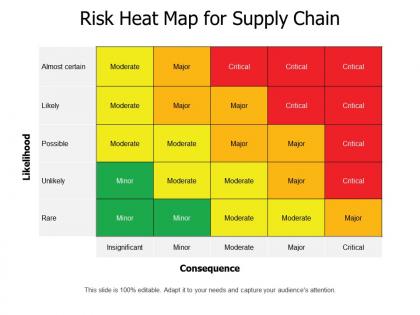
Risk heat map for supply chain




Try Before you Buy Download Free Sample Product
 Impress Your
 Audience
 100%
100% Editable
 Save Hours
 of Time


Earn the gratitude of generations to come due to our Risk Heat Map For Supply Chain. Get folks to invest in eco-friendly endeavors.
People who downloaded this PowerPoint presentation also viewed the following :
Risk heat map for supply chain with all 5 slides:
Our Risk Heat Map For Supply Chain enable you to exert influence. Be an inspiring force for faster development.




FAQs for Risk heat map
Supplier disruptions are probably the biggest headache - natural disasters, companies going under, production crashes. Quality issues can absolutely destroy your reputation overnight. Price swings will kill your margins, and shipping delays are just constant now. Oh, and cyber attacks are scary real when you're sharing data with suppliers. Here's what really gets companies though: putting all their suppliers in one area. I've watched businesses get completely screwed when their whole supply chain was in one region and something went wrong. Map out your risks by supplier and have backups ready. Something's gonna break eventually.
First thing - you gotta map out your whole supply chain, not just the obvious suppliers but their suppliers too. Send out detailed questionnaires about finances, location risks, cybersecurity, all that stuff. Look at the data you already have sitting around - delivery delays and quality problems are huge red flags. Site visits are honestly worth it if you can swing them, you'll spot things that never make it into reports. Oh and this isn't a one-and-done thing, you'll need regular check-ins since everything changes so fast these days.
Think of data analytics as your crystal ball for supply chain headaches. You can track supplier performance, delivery times, and even spot when vendors are having money troubles. Weather patterns screwing with shipping routes? Predictive analytics catches that stuff months out. Really beats scrambling when everything's already on fire. Start with your most critical data - don't try to analyze everything at once, you'll go crazy. Short sentences work. But the real game-changer is moving from reactive to proactive mode, honestly it's night and day difference once you get the right tools processing all that messy information.
Start with a risk matrix - plot probability against impact for each risk. Score them honestly: how likely is this to happen vs how badly would it mess things up? Obviously the high-probability, high-impact stuff needs immediate attention. But here's the thing - those rare but catastrophic scenarios can bite you hard too, so don't ignore them completely. Context matters a ton. A supplier hiccup during slow season? Whatever. Same thing during your busy period? Total nightmare. Set up clear tiers and make sure someone actually owns each risk level.
Track supplier performance first - on-time delivery, defect rates, lead times. Financial stuff matters too like credit scores and payment delays. Don't cluster all your suppliers in one region, that's risky. Alternative suppliers for key parts are clutch. Honestly, most people go overboard with dashboards. Pick maybe 5-7 metrics you'll actually check monthly instead of building some monster spreadsheet nobody looks at. Set thresholds that make you take action when things go sideways. The monthly review thing is key - otherwise you're just collecting data for no reason.
Honestly, spread your suppliers around different countries - learned that one the hard way during all that trade war chaos. Don't get stuck with everything coming from one place. Stock up on the really critical stuff too, because waiting weeks for parts when things go sideways is brutal. I'd start by figuring out which suppliers would screw you over the most if they disappeared tomorrow. Keep tabs on the news (I know, I know, it's depressing). Maybe run through some worst-case scenarios with your team. Having backup plans ready beats panicking later.
Honestly, diversifying suppliers saved my butt during COVID - we had way too many concentrated in Asia. Start by mapping your top 10 critical suppliers this quarter and create risk profiles for each. Don't wait until you're desperate to find backup options either. Build those relationships now while things are smooth. Regular financial health checks are crucial too, plus you gotta factor in geopolitical stuff. I'd seriously consider nearshoring for anything mission-critical. Oh, and audit regularly - sounds boring but it's worth it when supply chains go sideways.
So AI can crunch through massive amounts of data - supplier info, weather patterns, political stuff - way faster than we ever could. It spots trends and predicts when things might go sideways. Blockchain's the other piece though, giving you this bulletproof trail of where everything actually came from. No more guessing games when issues pop up. Honestly, the two work really well together since AI catches the red flags while blockchain keeps your data clean. I'd probably test it out with just your most critical suppliers first. You don't want to bite off more than you can chew right away.
Oh man, natural disasters absolutely wreck supply chains if you're not ready for them. Look at what happened in Japan in 2011 - that tsunami screwed over companies worldwide who didn't even realize they had suppliers there. Honestly, most businesses have no clue about their tier-2 and tier-3 suppliers until it's too late. You've gotta map out your whole network, not just the obvious ones. Find backup suppliers in different regions before you need them. Start by getting your procurement folks to show you where everything actually comes from - might surprise you.
Honestly, you've got to map out your whole supply chain - not just who you buy from directly, but their suppliers too. Most companies have no clue how connected everything really is until they start digging. I'd focus on the critical stuff first and work backwards from there. Figure out which suppliers would totally screw you over if they went under, then check their financial health, location risks, all that. The tricky part is getting visibility past your direct contacts. Oh and definitely have backup plans for the suppliers that'd hurt most - learned that one the hard way at my last job.
You can't spot every risk from where you're sitting - your suppliers know way more about their own weak spots and what could go wrong upstream. When everyone shares info openly, you'll catch those domino-effect problems before they hit. Supply chains are basically huge webs now, honestly pretty crazy how connected everything is. Set up regular check-ins with your main suppliers and push for real transparency. Both ways though - you gotta share too. More visibility means fewer nasty surprises when stuff breaks down.
Honestly, you've gotta map out your suppliers before disaster strikes - figure out where you're vulnerable. COVID taught me this lesson the expensive way. Get backup suppliers lined up, especially in different regions so you're not screwed if one area gets hit. Keep tabs on your suppliers' financial health and watch for weather or political stuff that might mess with your shipping routes. Oh, and when things go sideways (they will), just be straight with customers about delays. Don't sugarcoat it. Start with an audit of what you've got now - probably scarier than you think but worth knowing.
Regulatory requirements are basically your non-negotiable checklist - SOX, GDPR, whatever applies to your industry. You don't get to skip these assessments. But honestly? They're kind of helpful because executives can't argue with "the law says we have to do this" when you need budget. Plus they give you a standard framework for documenting everything, which makes audits less painful. My advice: map out your regs first, then build your risk assessments around those. Way easier than trying to retrofit compliance later - trust me on that one.
Track both leading and lagging indicators to see what's actually working. I'd start with supplier performance scores, inventory turnover, and recovery times after stuff goes wrong. Cost of disruptions is huge too. Geographic concentration and supplier diversification ratios show if you're still putting all your eggs in one basket - which honestly most companies do way too long. Don't ignore the softer stuff either like relationship strength and how fast suppliers respond during crises. Pick 3-4 metrics that match your biggest headaches first, then add more later.
So basically you create like 3-5 realistic "what if" scenarios - best case, worst case, couple in between. Map out how each one would mess with your supply chain. What if your main supplier crashes? Port shuts down? Demand goes crazy? It's honestly like war-gaming but for logistics. You want scenarios specific enough that you can actually do something about them, but not so narrow they only cover one tiny risk. I'd start with your biggest weak spots first, then build scenarios around those. Oh, and don't forget to actually make response plans for each one - that's the whole point.
No Reviews