


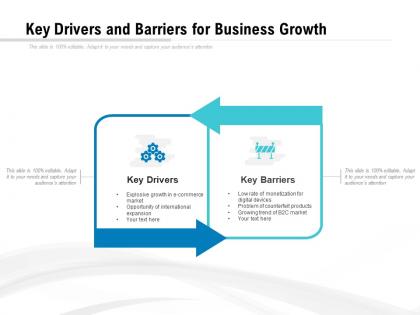
Key drivers and barriers for business growth




Try Before you Buy Download Free Sample Product
 Impress Your
 Audience
 100%
100% Editable
 Save Hours
 of Time


Assist the inefficient with our Key Drivers And Barriers For Business Growth. Guide them on how to function faster.
People who downloaded this PowerPoint presentation also viewed the following :
Key drivers and barriers for business growth with all 2 slides:
Guide folks on how to function faster with our Key Drivers And Barriers For Business Growth. It will also assist the inefficient.

FAQs for Key drivers and barriers
Focus on these five: revenue growth, customer acquisition cost, lifetime value, profit margins, and cash flow. Growth rate shows if you're actually moving forward. CAC vs LTV tells you whether customers are worth the investment long-term. Too many people get caught up tracking Instagram likes instead of what actually matters – total waste of time. Profit margins show how efficiently you're running things. Cash flow? That's literally whether your business is breathing or not. Don't overwhelm yourself though. Pick maybe 2-3 to check weekly first, then add more once you've got the habit down.
Honestly, data analytics is a game-changer for figuring out what your customers actually want. Track metrics that matter - customer lifetime value, conversion rates - not just vanity stuff like page views. You'll spot patterns in buying behavior and see which products are your real money-makers. Plus you can test different approaches instead of just winging it (which I've definitely done before and regretted). Pick maybe 3-4 KPIs that directly connect to revenue. Then set up weekly dashboards to watch them. It's way better than guessing what works.
Honestly, customer feedback is like having a cheat sheet for growing your business. You'll know exactly what's broken and what people actually want more of. Listen to what they're saying and you can catch problems early, find new opportunities, and make your stuff way more appealing. Happy customers basically turn into your marketing team for free - which is pretty sweet if you ask me. The trick is setting up easy ways to collect feedback regularly. Maybe surveys, reviews, or just talking to people directly. I'd probably check in on what you're hearing at least weekly, though sometimes I forget to do that myself.
Honestly, document everything first - that's your lifeline when things get crazy. Write down exactly how you do the work so new people can actually replicate your results. Don't cheap out on tools and training either (trust me on this one, I've been there). When hiring, find people who actually give a damn about quality work, not just whoever's cheapest. Here's the thing though - you'll still need to keep your hands in quality control even after you start delegating. Baby steps: pick one process and document it this week.
Here's the thing - digital marketing puts you right where people are scrolling anyway. Social media, Google searches, their email. Way better than those old billboards nobody looks at anymore (honestly, do those even work?). You can actually target who sees your stuff instead of just throwing money around. SEO helps people find you naturally. Paid ads work faster if you need quick results. Good content makes people trust you more. Social platforms let you build a real community. Best part? You'll see what's working immediately and can change things up. Just pick one thing you get and start there.
Look, the big killers are cash flow disasters, quality going to hell, and your company vibe just... disappearing when you scale fast. I swear, it's wild how many businesses implode from their own growth. Keep your finances super tight - like, obsessively tight. Don't panic-hire just because you're drowning; bad hires will make everything worse. Document your processes NOW before everything becomes total chaos. Oh, and do regular team check-ins to spot problems early. Basically, grow smart instead of just growing fast. Build the foundation first or you'll regret it later.
Start with your existing customer data - see who's actually buying and where the gaps are. Check out what your competitors are doing wrong too, that's where opportunities hide. Surveys are honestly your best friend here, people love complaining about what they can't find lol. Industry reports show you the bigger trends coming down the pipeline. Social media listening tools? Super useful for catching what people are griping about. Don't put all your eggs in one basket though - mix different data sources together. Oh, and set up some kind of simple system to track this stuff regularly or you'll forget.
First thing - dig into what your current customers actually need that you're not giving them yet. Do some real market research though, don't just guess. We totally bombed once launching something nobody wanted! Check out what competitors are doing well for ideas. Just make sure you can actually pull it off with your current team and budget. Partnerships might be smarter than building everything yourself, honestly. Whatever you pick, test it small first - pilot programs are your friend before you dump a ton of money into it.
Honestly, employee engagement might be your biggest growth driver. Engaged workers are way more productive, give better customer service, and don't quit nearly as often - which saves you crazy money on hiring. They also catch problems early and come up with better ideas. Compare that to disengaged people who are basically just collecting paychecks. Companies with high engagement actually grow revenue 2.3x faster than their competitors, which is pretty wild when you think about it. I'd say start doing quarterly engagement surveys and - this is key - actually do something with the results you get back.
Honestly, you've got a bunch of routes here. Bootstrapping's the obvious one if you have cash lying around. Angel investors and VCs are great but they'll want equity. Bank loans are still a thing too, surprisingly. Crowdfunding works well if your product's sexy enough for Kickstarter. But here's what people sleep on - grants. There's actually tons of free money floating around, especially for tech stuff or anything with social impact. Each option comes with different strings attached though. I'd figure out exactly how much you need first and when you need it, then work backwards from there to pick the right fit.
Honestly, partnerships are a game changer for growth. You get instant access to their customer base instead of grinding for years to build your own. Split the costs on marketing and development too, which helps when money's tight. Plus you're tapping into expertise you probably don't have - like if you're great at product but suck at sales, find someone who crushes it there. The collaboration thing is real too; bouncing ideas off each other usually leads to better stuff. Just make sure you're complementing each other's skills, not stepping on toes. Figure out what you're missing first, then hunt for businesses that nail those areas.
Honestly, you've gotta be really deliberate about who you're bringing in and how. Write down what your company actually stands for - not just buzzwords on a wall. Your current team should be interviewing new people alongside you, since they'll spot culture mismatches way better than HR will. Don't rush the onboarding either. I've watched companies hire fast and then act shocked when everything feels off a year later. Speed kills culture if you're not careful. Regular team meetings help too, but make sure they're not just status updates - actually talk about how things are going as you grow.
Dude, seriously - stop trying to be on every platform. Pick like 2-3 where your people actually are and focus there. The key is posting stuff that solves their problems, not just "buy our thing!" all the time. I swear, half the businesses I see are just throwing random content at the wall. Listen to what people are talking about, jump into conversations, show some behind-the-scenes stuff. Makes you feel more real, you know? Start with 3-4 posts a week, then see what gets people responding. Oh, and actually reply to comments - can't believe how many don't do that basic thing.
Look, you've gotta keep innovating or you'll get left behind. Markets change constantly and if you're not evolving with them, competitors will eat your lunch. Remember Blockbuster? They thought they had it made until Netflix crushed them. New ideas create fresh revenue streams and give you advantages that others can't easily steal. Innovation also helps you spot disruptions coming - honestly, that's probably the most valuable part. Don't treat it like some special project though. Build it into your regular routine. Maybe set aside time each quarter to brainstorm or test something different.
Look, good leadership literally makes or breaks how fast you can grow. Leaders who communicate well and make smart calls? Their teams just perform better. They create that safe space where people actually take risks - and that's honestly where the magic happens. Bad leaders do the opposite and kill momentum. Resource allocation becomes way smoother too when you've got solid decision-makers. Oh, and here's the thing most people miss - don't just focus on executives. You need strong leaders at every level because growth happens everywhere, not just at the top. That middle management stuff matters more than you'd think.
No Reviews