

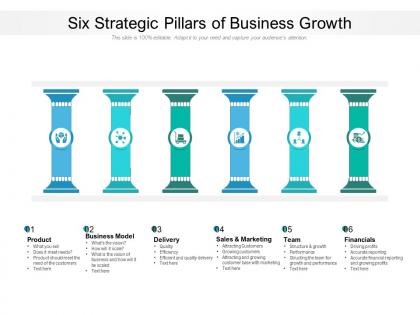
Six strategic pillars of business growth




Try Before you Buy Download Free Sample Product
 Impress Your
 Audience
 100%
100% Editable
 Save Hours
 of Time


Inculcate a better attitude with our Six Strategic Pillars Of Business Growth. Identify the causes of an inferiority complex.
People who downloaded this PowerPoint presentation also viewed the following :
Six strategic pillars of business growth with all 2 slides:
Bring feelings of inferiority to an end with our Six Strategic Pillars Of Business Growth. Get folks to develop a confident attitude.

FAQs for Six strategic pillars
Honestly? Just pick whatever you'll actually do consistently - that's half the battle right there. Social media and email newsletters are your best bet since they're cheap and you can actually connect with people. If you've got a storefront or office, definitely get your local SEO sorted out first. Word-of-mouth is still unbeatable though, so maybe set up some kind of referral thing for existing customers. You could try paid ads but start tiny - budgets suck when you're small. Don't spread yourself too thin either. Pick like 2 channels, get good at those, then expand. Give it a few months before you decide what's actually working.
Honestly, pick ONE platform where your customers actually are and just commit to it for like 30 days. Don't try to be everywhere at once - I made that mistake and it's exhausting. Post consistently and actually reply to everyone who comments or messages you. Share real stuff about your business, not just sales pitches. Customer reviews work great, or even just showing how you make things. Oh, and respond fast when people reach out - that makes a huge difference. The whole "authentic over salesy" thing is so true though. Social media really can grow your business if you treat it like building actual relationships instead of just broadcasting ads.
Dude, customer feedback is like having a cheat code for growth. It shows you exactly what's broken and what people actually want (versus what you think they want). I'd start by grouping all that feedback into themes - you'll probably see patterns jump out pretty quick. Then just match those patterns to stuff you could actually build or fix. The messaging part is huge too since you get to see how customers describe problems in their own words. Honestly, it beats the hell out of guessing and wasting money on features nobody cares about.
Honestly, your existing customer data is probably sitting on a goldmine you haven't noticed yet. Dig into those patterns and see what needs aren't being met. Your competitors are definitely missing something obvious - they always are. Sure, market research helps, but I've found that just having real conversations with current customers about their other headaches tells you way more than those expensive surveys ever will. Oh, and don't sleep on checking what's happening in similar industries. The magic happens when you mix all these different insights together instead of just relying on one source. Set up some basic way to track this stuff regularly.
Honestly, diversifying is smart because you're not screwed if one product fails. Having multiple revenue streams means other products can carry you through rough patches. You'll reach different customer types too, which is pretty cool for growth. My cousin learned this the hard way when his single-product business tanked during COVID. Anyway, diversification also smooths out those annoying seasonal dips and makes investors way more interested. Just don't go crazy with it though - stick with stuff that makes sense with what you already know and your current customers first.
Dude, partnerships are honestly a game-changer for growth. You get instant access to new customers and markets without burning through cash upfront. Look for companies where your strengths cover their weak spots - like if you've got an amazing product but suck at sales, find someone with a killer sales team who needs what you're offering. Could be joint ventures, referral deals, or just basic cross-promotion stuff. I'd start by figuring out where you're struggling, then hunt for businesses that could help fill those gaps. It's basically smart borrowing of other people's networks and expertise.
Here's what I'd do - diversify your income so you're not banking on just one source. Cash flow management is huge too, way more important than people think. Most businesses mess this up even when they're profitable on paper. Build up 3-6 months of expenses as a safety net before going crazy with growth. Also, don't pull out every dollar you make - reinvest some back into the business. Oh, and track how long it takes to convert sales into actual cash in your account. That cycle time matters more than you'd expect.
Honestly, data analytics is a game changer for figuring out customer patterns and which marketing channels actually bring in money. Focus on stuff that matters - customer acquisition cost, lifetime value, churn rates. I used to obsess over every metric (huge mistake), but now I stick to 3-5 KPIs max. Set up tracking in Google Analytics or whatever CRM you're using. Check it weekly and tweak things as you go instead of waiting around for months. Oh, and definitely look at where people drop off in your sales funnel - that's usually where the money is.
Track your revenue growth vs what you're spending on resources - that gap should keep widening. Profit margins need to improve as you scale, not stay flat. Customer acquisition costs should drop over time (honestly this one's huge but people miss it). Your systems can't crash when volume spikes - I've watched companies lose thousands because their checkout page died during a busy week. Monitor customer retention monthly and make sure your team isn't sacrificing quality just to keep up. Start measuring this stuff now so you'll catch problems early instead of scrambling later.
Dude, culture is huge for growth - like, way more than most people realize. Your team moves faster when everyone's actually on the same page about values and where you're headed. Customers pick up on it too, which is kinda wild but totally true. You'll notice better retention, more innovation, all that good stuff. Honestly? If your culture doesn't match your growth goals, that's your starting point right there. Survey your people about what's broken and what's not. I've seen companies totally stall out because they skipped this step.
Focus on making current customers feel special - that's where the real money is. Good customer service is obvious, but also send personalized messages and create loyalty programs that don't suck. Most companies literally ignore people after they buy something, which is insane to me. Check in with customers regularly, give them exclusive deals, and actually fix problems fast when they come up. Oh, and ask for their opinions - people love feeling heard. I'd start by looking at every place you interact with customers and figure out where you can be more personal about it.
Honestly, tech integration is a game-changer because it handles all those boring repetitive tasks nobody wants to do anyway. Your team gets freed up for actually interesting work while errors drop way down. Data moves faster, you understand customers better, and departments actually talk to each other properly. Here's the thing though - your competitors are probably already doing this stuff, so you're kinda behind if you're not. The magic happens when you can grow without hiring tons more people. I'd say pick whatever's your biggest pain point right now and start there. Once it's working, expand to other areas.
Dude, training your team is seriously underrated. Better skills = better work and way fewer screw-ups that cost you money. People actually stay when they're learning new stuff too - makes sense, nobody wants to feel stuck doing the same thing forever. Your best employees will start coming up with ideas that actually make you money once they know their stuff better. I'd start by figuring out where your team's weakest (honestly just ask them) and build some focused training around that. It's one of those things that pays for itself pretty quickly.
Look, you've gotta get way ahead of this stuff - forecast like crazy and grab credit lines before you're desperate. Track how long it takes from spending cash to getting it back. Send invoices immediately, throw in early payment discounts, and honestly? Bug people about overdue payments. Growing fast is genuinely scary cash-wise! Factor some receivables or snag a business line of credit for the rough patches. I'd make weekly cash projections a religion so you catch problems weeks out, not when you're panicking. Trust me on this one.
Dude, aggressive growth will bite you in two ways: cash flow hell and everything falling apart. Companies burn money way faster than they make it - I've watched profitable businesses die this way. Your team gets crushed, customer service goes to shit, and you'll literally take any client just to hit targets. Systems break down when they can't handle the volume. Honestly, half these startups think growth fixes everything but it just magnifies problems. Make sure you've got serious cash reserves first and can actually deliver what you're selling at scale.
No Reviews