


Various business growth levers strategy




Try Before you Buy Download Free Sample Product
 Impress Your
 Audience
 100%
100% Editable
 Save Hours
 of Time


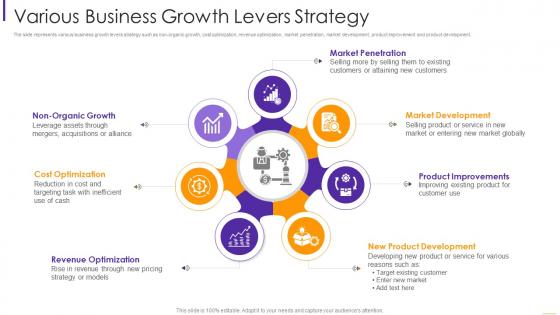
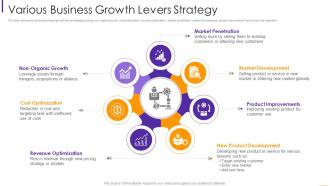
The slide represents various business growth levers strategy such as non-organic growth, cost optimization, revenue optimization, market penetration, market development, product improvement and product development.
People who downloaded this PowerPoint presentation also viewed the following :
Various business growth levers strategy with all 6 slides:
Use our Various Business Growth Levers Strategy to effectively help you save your valuable time. They are readymade to fit into any presentation structure.





FAQs for Various business
Key components of a successful business growth strategy include market expansion, product diversification, strategic partnerships, operational efficiency improvements, and customer retention optimization. These elements work synergistically by identifying new revenue streams, reducing costs, and enhancing competitive positioning, with many organizations finding that combining organic growth with strategic acquisitions delivers sustainable long-term advantage.
Leveraging customer feedback drives business growth by identifying improvement opportunities, enhancing product development, and strengthening customer relationships through targeted responses to their needs. Companies across retail, hospitality, and financial services find that systematically collecting and acting on feedback increases customer retention, reduces churn rates, and ultimately delivers competitive advantage through superior customer experiences.
Digital marketing plays a pivotal role in scaling businesses by enabling targeted reach, cost-effective customer acquisition, and measurable campaign optimization across multiple channels. Through social media advertising, search engine optimization, and email marketing, companies streamline their growth efforts while reducing traditional marketing costs, with many organizations finding that digital strategies deliver faster market penetration and enhanced customer engagement.
Market expansion requires analyzing demographics, competitive landscapes, regulatory environments, market size, and growth potential through comprehensive research and data analysis. Organizations typically prioritize markets with strong purchasing power, minimal barriers to entry, and strategic alignment with their capabilities, with many companies finding that phased expansion into adjacent markets delivers sustainable growth while minimizing risk and resource allocation challenges.
Businesses should track revenue growth rate, customer acquisition cost, customer lifetime value, market share expansion, and profit margins to measure growth success. These metrics enable organizations to assess operational efficiency, customer retention effectiveness, and competitive positioning across sectors, with many companies finding that balanced tracking ultimately delivers strategic insights and sustainable scaling advantages.
Partnerships and alliances enhance growth opportunities by expanding market reach, sharing resources and expertise, reducing operational costs, and accelerating innovation cycles. Through strategic collaborations, companies access new customer bases, distribution channels, and technological capabilities while minimizing risks, with many organizations finding that well-structured partnerships deliver faster market penetration and sustainable competitive advantages.
Small businesses can compete with larger firms through agile decision-making, personalized customer service, niche market specialization, strategic partnerships, and digital marketing optimization. These approaches enable smaller organizations to respond faster to market changes, deliver tailored experiences that large corporations struggle to match, and ultimately build stronger customer loyalty while minimizing operational costs.
Innovation is crucial for sustainable growth, enabling companies to differentiate products, enter new markets, improve operational efficiency, and respond to changing customer needs. Organizations that prioritize innovation consistently outperform competitors by developing breakthrough solutions, streamlining processes, and creating compelling value propositions, ultimately delivering enhanced market positioning and long-term competitive advantage.
Effective diversification strategies include expanding into complementary markets, developing product variations for different customer segments, acquiring strategic businesses, forming strategic partnerships, and leveraging existing capabilities in new industries. These approaches enable organizations to reduce risk, access new revenue streams, and enhance market resilience, with many companies finding that systematic diversification ultimately delivers sustainable growth and competitive advantage.
Employee engagement drives business growth by boosting productivity, reducing turnover costs, and enhancing customer experiences through motivated service delivery. Engaged employees deliver higher innovation rates, stronger problem-solving capabilities, and improved operational efficiency, with many organizations finding that companies with highly engaged workforces achieve 23% higher profitability and significantly faster revenue growth.
Aggressive growth strategies present both market expansion opportunities and significant operational challenges, including cash flow strain, quality control issues, cultural dilution, and overextension of resources. While rapid scaling can deliver competitive advantage, many organizations find that balancing growth speed with operational stability, strategic planning, and risk management ultimately ensures sustainable success and long-term viability.
Businesses can utilize data analytics to inform growth strategies by identifying market trends, analyzing customer behavior patterns, optimizing operational efficiency, and predicting future demand cycles. Through advanced analytics tools, organizations streamline decision-making processes, enhance resource allocation, and minimize strategic risks, with many companies finding that data-driven approaches ultimately deliver competitive advantages and accelerated market expansion.
Customer retention drives sustainable growth by reducing acquisition costs, increasing lifetime value, and generating predictable revenue streams through repeat purchases and loyalty. Retained customers typically spend more over time, provide valuable referrals, and offer lower-cost expansion opportunities, with many organizations finding that improving retention rates by just 5% can increase profits by 25-95%, ultimately delivering competitive advantage in increasingly crowded markets.
Companies ensure scalability by building flexible operational frameworks, investing in adaptable technology infrastructure, establishing standardized processes, and creating modular service offerings that can expand efficiently. Through cloud-based systems and automated workflows, organizations streamline resource allocation, minimize bottlenecks, and maintain consistent quality across markets, ultimately delivering sustainable growth while reducing per-unit costs as operations scale.
Business expansion financing options include venture capital, bank loans, equipment financing, revenue-based financing, and crowdfunding platforms. These funding sources enable organizations to scale operations, enter new markets, and upgrade infrastructure, with many growing companies finding that strategic combinations of debt and equity financing deliver faster growth while maintaining operational control and competitive positioning.
-
Top Quality presentations that are easily editable.
-
Easily Editable.