


Business growth drivers powerpoint templates





Try Before you Buy Download Free Sample Product
 Impress Your
 Audience
 100%
100% Editable
 Save Hours
 of Time


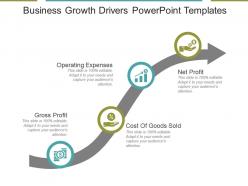
Identify the growth prospects for your company with our business growth drivers PowerPoint design. You can design the roadmap of continuous business success with this key business drivers PPT diagram. Define the significance of each and every driver such as gross profit, operating expenses, COGS, Net profit and more with this growth drivers PPT template. It also helps in improving as well as managing the analytics of your business success. It also helps in providing you the map to achieve your long term company goals and objectives. Further, you can easily identify the other growth factors with this market forces PowerPoint slide template. It helps in generating more business profits by keeping the sustainability of your company resources. You can also describe the other concepts of business growth and success through this innovative graphical PPT design. Thus, simply click on the download link now to start working over this professional PowerPoint design. Our Business Growth Drivers Powerpoint Templates help convergence emerge. Get everyone to think alike.
People who downloaded this PowerPoint presentation also viewed the following :
Business growth drivers powerpoint templates with all 5 slides:
Our Business Growth Drivers Powerpoint Templates find challenges exciting. They enjoy a good contest.

FAQs for Business growth
Track your revenue growth rate and customer acquisition cost first - that's the real stuff that matters. If you're SaaS, monthly recurring revenue is everything. Customer lifetime value shows whether your business model actually works or you're just burning money. Honestly? Most people get obsessed with vanity metrics like app downloads. Boring financial stuff first. Watch your burn rate too - I've seen companies with great growth run out of cash because they forgot basic math. Once you nail those, add cohort retention and maybe net promoter scores.
Honestly, good market research is what separates companies that actually grow from ones that just burn cash. Instead of guessing what people want, you're working with real data - surveys, focus groups, whatever fits your budget. I'd start super small though, maybe just talk to 10 customers first. The best part? You'll catch problems before they become expensive disasters. So many businesses I know launched stuff that totally flopped because they skipped this step. Oh, and don't treat it like a one-time thing - keep checking in as things change. Your competitors are probably missing something obvious that research could help you find.
Honestly, you can't scale without innovation - it's what keeps you from hitting a wall. You need to innovate in three spots: your actual product (to stay competitive), your internal processes (so you don't collapse under the volume), and your business model to grab new opportunities. Companies that just do "more of the same" get stuck fast. The ones that actually grow? They're constantly tweaking and experimenting. Oh, and don't wait until something's broken to start innovating - build it into your regular planning from the start.
Honestly, customer feedback is like getting free market research handed to you on a silver platter. It shows you exactly what to build next, which features actually matter, and how to talk about your product better. The crazy part? When people see you actually use their suggestions, they become super loyal customers - like they're personally invested in seeing you win. I learned this the hard way though: don't just collect feedback and dump it in some Google Sheet. You've got to close the loop. Respond to people, show them their input made a difference. That's where the magic happens.
Look, you've got two huge advantages - you can change direction fast and actually know your customers' names. Big companies take forever to make decisions while you're already three steps ahead. Focus on whatever you do differently than the giants. Maybe it's how you customize stuff or just pick up the phone when people call? Social media and cloud tools won't break the bank either. Honestly, most people are so tired of dealing with corporate phone trees that personal service feels revolutionary now. Pick one thing you're genuinely better at and go all-in on it.
Look, engaged employees are just way more productive and creative - they actually give a damn about the work. You'll see better quality, happier customers, and people won't keep quitting on you. Honestly, I've seen this firsthand and it's crazy how different engaged teams are. These employees become your best recruiters too, bringing in solid people. Companies with engaged workers see 23% higher profits on average, which is pretty solid proof. My advice? Start doing regular check-ins and surveys to figure out what's actually motivating your people versus what's driving them nuts.
Oh totally, digital marketing is like the best bang for your buck right now. You can target people way outside your local area and build awareness super fast - costs way less than traditional ads too. The data you get back is honestly amazing for figuring out what your customers actually want. Plus you can test different messages in real-time and switch things up instantly, which is pretty cool. Just don't try to be everywhere at once though. Pick maybe two platforms where your people actually are and focus there. Being consistent with posting and actually talking back to people matters way more than just throwing content out there.
Partnerships are huge for getting access to customers and resources you don't have yet. Way faster than trying to build everything yourself. Like when Spotify teamed up with Uber so passengers could pick the music - genius move, honestly. You want partners where your strengths fill their gaps and vice versa. Maybe they've got the distribution network you're missing, or you have some tech they need. The trick is making sure it's actually beneficial for both sides. Nobody wants those fake networking relationships that go nowhere.
Honestly, it all starts with hiring curious people who aren't scared to mess around and try stuff. Build an environment where your team can take risks without getting their heads chopped off - I've watched so many places claim they want innovation then freak out over every mistake. Celebrate the attempts, not just the successes. Run brainstorming sessions regularly and actually use some of the ideas (this part's crucial). Oh, and give people real ownership over their work. Let them experiment with different approaches. Once they see their wild ideas actually come to life, that's when things get interesting.
Look, economic conditions basically make or break your ability to scale up. Good times mean people spend more freely and you can actually get loans without selling your soul. But when things go south? Your customers get picky about prices and banks suddenly act like you're asking for their firstborn. I learned this the hard way during 2020 - scaling costs hit different when money's tight. You've got to build some wiggle room into your business model from day one. That way you're not scrambling when the economy decides to throw a curveball.
Honestly, start with cloud ERP systems - they'll handle your core ops without the headache. Workflow automation is a game changer for cutting out busy work. Then there's data analytics platforms that actually show you what's happening (instead of just guessing). CRM integration is non-negotiable at this point. Project management software keeps everyone from going in circles, and good communication tools are clutch when you're growing fast. My advice? Pick whatever's driving you crazy right now and fix that first. Don't try to do everything at once - I've seen that backfire too many times. Get one thing working smoothly, then move to the next.
Honestly, forget what customers wanted six months ago - that's ancient history now. You've gotta figure out where people are actually spending money today and shift everything there. Maybe that's cheaper options, different service bundles, or going completely digital. Companies that move fast during rough patches often end up way stronger afterward. Kill products that aren't working anymore, even your favorites (I know, it sucks). But here's the thing - your current customers will tell you exactly what they need if you just ask them. Send out a quick survey this week about their new problems. Don't overthink it.
So basically, scalable means you can grow without everything becoming a nightmare cost-wise. Like, if you get 10x more customers, you're not hiring 10x more people or blowing up your budget proportionally. Netflix is perfect for this - they add millions of users but don't need new buildings like old Blockbuster did. Your profit margins actually get better as you grow bigger, which is honestly pretty sweet. Look at what you're doing now and figure out which parts could handle way more volume without you having to invest a ton more money or resources.
Loyal customers spend 67% more than new ones - that stat still blows my mind. Your repeat customers will buy more often and drop more cash per visit, which is honestly the easiest way to grow without burning through marketing budgets. Plus they're way cheaper to keep around than constantly chasing fresh faces. The best part? They'll actually recommend you to friends without you asking. I'd start with something basic like a points system and just watch your repeat purchase rates. Nothing fancy needed at first.
Cash flow is everything - seriously, don't let that dry up. Track your customer acquisition cost against lifetime value too, that ratio tells you if you're actually making money per customer. Monthly recurring revenue is huge if you've got subscriptions. Growth rate and margins are pretty obvious ones. Burn rate matters a ton when you're scaling fast (learned that one the hard way lol). Pick like 4-5 metrics max that actually help you make decisions. Way too many people get caught up tracking stuff that just looks impressive. Check these weekly and you'll catch opportunities way sooner.
-
Understandable and informative presentation.
-
Excellent Designs.