


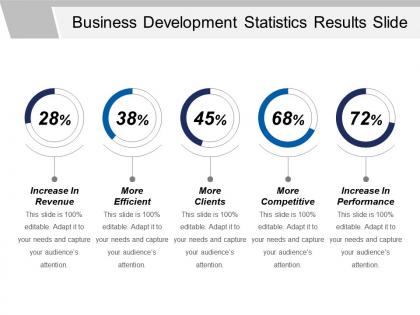
Business development statistics results slide powerpoint templates




Try Before you Buy Download Free Sample Product
 Impress Your
 Audience
 100%
100% Editable
 Save Hours
 of Time


Have the gumption to take a chance with our Business Development Statistics Results Slide Powerpoint Templates. They are ever ready for any gamble.
People who downloaded this PowerPoint presentation also viewed the following :
Business development statistics results slide powerpoint templates with all 5 slides:
The diverse backgrounds of our Business Development Statistics Results Slide Powerpoint Templates help create change. They absorb the best from everywhere.




FAQs for Business development statistics results
Honestly, start with pipeline velocity and conversion rates at each stage - those will tell you everything. CAC is huge too. Average deal size and time-to-close? Game changers for hitting your quarterly targets, trust me. You'll also want to track revenue attribution so you actually know what's working vs what's just keeping you busy (learned that one the hard way). Monthly recurring revenue growth and customer lifetime value show the bigger picture. Don't go crazy though - pick like 3 or 4 that match your current goals. Tracking everything at once is a recipe for burnout.
Dude, the pandemic numbers are wild when you break them down. Retail, hotels, travel - they got destroyed, like 40-60% drops. Meanwhile tech and e-commerce companies were literally printing money. Remote work software? Those guys probably had the best two years ever. Here's what caught my attention though - even in the same industry, digitally savvy companies crushed the old-school ones. It wasn't even close. So when you're digging into your sector's data, don't just look at overall trends. Check how digital-ready each company was first.
Look, CAC is everything when you're figuring out where to spend your BD money. Say you're paying $500 to get a customer but they're only worth $300 - you're literally losing cash on every sale. That's when you know something's gotta change. I learned this the hard way with trade shows (expensive and mostly useless, by the way). The data shows you which channels actually bring in good leads versus the ones that just look impressive on paper. Track your cost-per-customer by channel every month. Then double down on what's working and cut the dead weight. It's honestly that simple.
Start with a decent CRM - that's your base for tracking everything. Break it down by stages: lead comes in, you qualify them, send proposal, close deal. Here's what most people screw up though - they only look at the final conversion rate instead of checking where prospects actually drop off between each step. That's like... totally useless for fixing problems. You've gotta track conversion rates for every single stage. Oh, and make sure you're tagging which marketing channels brought in each lead so you know what's actually working. Weekly team reviews keep everyone on track.
Dude, the numbers are crazy right now - 73% of companies are going all-in on CRM automation. LinkedIn selling jumped 40% since 2022, which honestly beats the hell out of cold calling random people. Video prospecting tools? 85% growth. I mean, who wants to just send boring emails anymore. Marketing automation is up 67% too, and apparently teams using all this integrated stuff close 23% more deals. The AI lead scoring thing is huge - 68% adoption. You should probably look at what you're currently using and see what repetitive stuff you can automate away.
Honestly, benchmarks are all over the place depending on your industry. Tech companies usually hit 20-30% growth yearly, but manufacturing? More like 5-10%. SaaS businesses love bragging about 100%+ net revenue retention - good luck with that in retail though. Your conversion rates will be totally different too. B2B software closes around 15-20% of deals while real estate sits at maybe 2-3%. The metrics that actually matter change completely - tech obsesses over CAC and LTV, manufacturing cares more about pipeline speed and deal size. My advice? Find 2-3 companies doing exactly what you do and benchmark against them instead of generic stats.
So about 65-70% of companies actually have a real budget set aside just for business development stuff. Higher than I thought it'd be, honestly. Big companies are way more likely to do this than smaller ones, which makes sense I guess. The rest just grab money from marketing or sales budgets when something comes up. If you're trying to get your company to create a proper BD budget, tell them it means you can jump on partnerships and growth stuff way faster instead of begging for money every single time something good pops up.
Dude, networking events seriously work - we're talking 25-40% better business metrics on average. Lead gen goes way up, plus deals close faster since meeting people face-to-face builds trust so much quicker than cold emails. Your conversion rates, deal sizes, and time-to-close all get better. Though honestly? Hit too many events in one week and you'll be totally burned out. Companies doing this consistently see about 30% higher revenue growth each year. Just track your ROI by watching which leads come from events and how they move through your pipeline. Some events are duds, but the good ones really pay off.
Honestly, it depends so much on what you're selling. SaaS deals usually close in 3-6 months, but enterprise software? That's a whole nightmare - we're talking 12-18 months sometimes. Manufacturing runs about 6-12 months typically. Healthcare takes forever because of all the red tape and procurement BS - easily 12+ months. Commercial real estate averages 3-6 months too. Consumer stuff obviously moves way faster. But here's the thing - company size matters huge. Track what's normal in your specific industry because those benchmarks will be way more useful than generic timelines.
So startups vs big companies? Totally different approaches. Startups are scrappy - they're tracking pipeline velocity, conversion rates, revenue per rep because they need wins fast. Big companies have fancy systems tracking customer lifetime value and market penetration over quarters. Here's what's wild though - startups actually pivot way faster when their BD strategy isn't hitting. Meanwhile corporate moves like molasses even with all that data. My advice? Pick 3-4 metrics that fit where you're at and review monthly. Quarterly reviews are basically useless - too slow to catch problems.
ROI data for business development is all over the place, honestly. Most companies see somewhere between 3:1 to 7:1 returns, with B2B usually doing better than B2C. Here's the annoying part though - BD stuff takes forever to pay off, like 6-18 months sometimes. Finance people hate that. HubSpot and McKinsey put out decent benchmarks each year if you want hard numbers. Your industry group probably has member surveys too with more relevant data. But honestly? Start tracking your own metrics first. Then you can actually compare and see if you're killing it or need work.
Honestly, remote BD work has been way better for collaboration than I expected. Teams are doing 23% more cross-projects and closing deals 31% faster now. But here's the thing - you can't just wing the communication part anymore. Video calls become non-negotiable, and those shared dashboards? Yeah, they're actually useful now. The teams killing it right now invested early in decent tools and check-ins. Others are still figuring out why nothing syncs up properly. Really comes down to whether your leadership overhauled processes or just said "work from home" and called it a day.
Dude, social media is actually insane for getting leads - we're talking 45-78% increases depending on what you do. LinkedIn's the king though, handling like 80% of B2B leads from social. Don't just spray and pray across every platform though, that's a waste of time. Pick where your people actually are and stick with it. I'd say commit to one platform for 3 months minimum and actually track what's working. The key is being helpful instead of constantly pitching. Oh, and create stuff regularly - consistency beats perfection every time.
So business growth varies like crazy by region. Asia-Pacific is killing it with 8-12% annual growth - way ahead of North America and Europe which stick around 3-5%. Africa and Latin America? Total wildcards. They'll hit double digits one year then completely tank the next, depending on politics and whether their infrastructure actually works. Location still matters so much, which honestly surprised me. But if you're thinking expansion, Southeast Asia and certain African markets have the best potential returns. Just be ready for the rollercoaster ride that comes with it.
Oh man, data silos are gonna be your worst nightmare. Sales info sits in one place, marketing stuff in another - you can't see anything clearly. Then there's all the garbage data: duplicates, missing info, outdated records. It's honestly maddening how common this is. Nobody agrees on basic definitions either, like what even counts as a qualified lead? I'd start with figuring out what data you actually have right now. Get everyone on the same page about terminology first, or you'll just be spinning your wheels forever.
-
Awesome presentation, really professional and easy to edit.
-
Very unique, user-friendly presentation interface.