


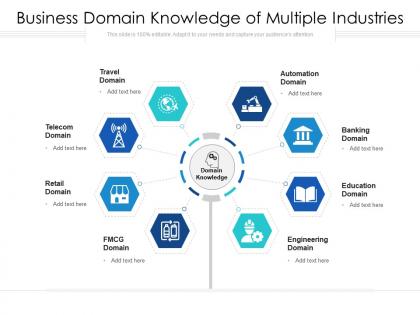
Business domain knowledge of multiple industries




Try Before you Buy Download Free Sample Product
 Impress Your
 Audience
 100%
100% Editable
 Save Hours
 of Time


Our Business Domain Knowledge Of Multiple Industries are topically designed to provide an attractive backdrop to any subject. Use them to look like a presentation pro.
People who downloaded this PowerPoint presentation also viewed the following :
Business domain knowledge of multiple industries with all 2 slides:
Use our Business Domain Knowledge Of Multiple Industries to effectively help you save your valuable time. They are readymade to fit into any presentation structure.
FAQs for Business domain knowledge
Honestly? Fresh eyes are everything. Someone from healthcare looking at your manufacturing mess won't have all our baggage about "how things work." They'll ask annoying questions like "wait, why can't you just..." - and sometimes those dumb questions crack problems you've been banging your head against forever. Plus they bring solutions that already work in their world, just need some tweaking for yours. I'd start by writing down your worst recurring headaches, then find industries that somehow figured out similar stuff. Gaming people are weirdly good at finance UX problems, btw.
Honestly, you gotta force yourself to hang out with people from totally different industries. Coffee with someone in manufacturing when you're in tech? Do it. Those cross-industry workshops are gold too - I've watched software teams steal ideas from how factories handle logistics and it actually worked. Pick a problem you're stuck on right now and google how three random industries deal with something similar. Manufacturing, healthcare, whatever. The connections are weird but they're there. Sometimes the best solutions come from places you'd never think to look. Start asking "wait, how do restaurants handle this?" instead of only talking to people in your field.
Dude, working across industries is where the magic happens for sustainability stuff. Tech companies teaming up with fashion brands? Energy firms partnering with farmers? That's when you get those "why didn't we think of this before" moments. Each sector brings something totally different to the table - like how car manufacturers figured out lean production and now everyone uses it to cut waste. Plus you can actually afford those massive green projects when you're splitting costs. Honestly, the automotive example is kind of overused but it really did change everything. My take? Don't just network within your industry. The weird partnerships are where breakthroughs happen.
Look at both the obvious stuff and the harder metrics. Count who's actually showing up to cross-industry events or working on joint projects - that's your baseline. But here's the thing: participation doesn't mean squat if nothing changes. Track whether teams are implementing ideas from other sectors. Innovation pipeline shifts, faster problem-solving, new revenue streams. Some impacts take forever to surface though, which is annoying. Quarterly team surveys work great - just ask what outside insights they've used lately. Way better than waiting years to see results.
Honestly, the communication thing is brutal - everyone speaks their own language and timelines are all over the place. Healthcare moves like molasses while tech wants everything yesterday. Different sectors have completely opposite risk tolerance too, which gets messy fast. Oh, and don't even get me started on the egos - so many "experts" think their way is gospel. I'd focus on building some kind of translation system upfront. Find stuff everyone actually agrees on instead of arguing about methods all day. The regulatory differences will probably drive you crazy, but that's just how it goes.
Cross-industry partnerships can totally speed up your digital transformation - you're getting fresh ideas from sectors that have already figured stuff out. Healthcare borrowed gaming techniques for patient engagement, which is pretty smart if you ask me. Retailers jumped on banking's mobile payment tech instead of building their own. Why reinvent the wheel, right? You'll want partners who've tackled similar challenges in different industries. Their experience saves you from making the same mistakes they already learned from. It's like getting a cheat code for transformation.
Here's the thing - outside experts should boost what you're already good at, not completely reinvent you. Before bringing anyone in, write down your non-negotiables. What makes your brand YOU? Your values, what sets you apart, all that core stuff that can't change. I've watched so many businesses chase the latest trends and totally lose their identity (it's painful to see honestly). Give consultants clear boundaries about what's off-limits, then let them go wild within those limits. Think of it like... you're the house foundation, they're just redesigning the rooms. Makes sense?
Dude, healthcare and fintech are where the money is right now. Healthcare companies are scrambling for AI help with diagnostics and patient data - they're basically clueless about tech. Meanwhile, fintech startups are teaming up with old-school banks because navigating financial regulations is a nightmare. Sustainability's huge too. Energy companies need tech partners for smart grids, and manufacturers are going crazy for green tech partnerships. Honestly, it's pretty obvious when you think about it - regulated industries desperately need innovation, but tech companies can't figure out these complex industries alone. The sweet spot? One side brings the technical skills, the other brings years of industry experience.
Mix up your project teams first - throw engineers in with marketers, designers with data people. Honestly, the magic happens when you rotate folks through different departments for like a month or two. Set up casual lunch sessions where teams show off what they're building. Make it totally cool to ask questions that might sound basic across departments (this part's huge). Oh, and try doing monthly "help us figure this out" sessions where one team brings their messy problems to everyone else. Works way better than you'd think.
LinkedIn groups are solid, but check out Discord communities too - tons of professionals from different fields just chatting there. Clubhouse isn't dead either if you're into the audio thing. Honestly, Twitter spaces can be hit or miss but when they're good, they're really good. Online conferences make it super easy to network outside your industry now. Reddit has some decent professional subreddits if you dig around. My take? Don't spread yourself thin across every platform. Pick maybe two or three and actually participate instead of just scrolling. Building real connections beats having a huge follower count any day.
Working across different industries is honestly a game changer for spotting risks. You start seeing patterns everywhere - like how retail and healthcare both struggle with data breaches but handle them totally differently. I've noticed single-industry people miss obvious vulnerabilities because they're too close to it. Short sentences hit different too. What's cool is you can steal solutions from one field and drop them into another. The airline industry's safety protocols? They work great in manufacturing. Plus you'll actually understand when some random industry shake-up might mess with your business in ways nobody saw coming. Worth studying other sectors' risk playbooks for sure.
Apple and Nike did that Apple Watch collab - totally genius move since Apple had the tech but Nike knew athletes. SpaceX basically saved NASA's ass by bringing fresh innovation to space programs. Tesla's battery partnership with Panasonic was smart too, though honestly Tesla gets most of the credit these days. Starbucks + Spotify completely changed how we think about coffee shops. The pattern here? Best partnerships happen when companies bring totally different strengths to fix the same problem. Don't look for someone who does what you already do - find someone whose expertise fills your gaps.
Dude, regulatory stuff will seriously make or break these cross-industry deals. You've got two different sets of rules to deal with - like if healthcare teams up with fintech, now you're juggling HIPAA plus all the financial compliance mess. My advice? Get your lawyers involved from day one to figure out where the rules clash. I learned this the hard way on a project last year. Don't make the mistake of waiting until you're halfway through negotiations to realize something's actually impossible under current regs. Map out the compliance overlap early and save yourself the headache.
Honestly, cross-industry knowledge is huge when you're dealing with stuff your field hasn't cracked yet. Digital transformation, major crises, breakthrough innovations - other industries have probably faced similar messes and figured it out already. I can't tell you how many times the perfect solution comes from some random sector you'd never think to look at. New markets? Organizational changes? Emerging tech that spans everywhere? That's when you really need it. My advice - and I learned this the hard way - start building connections outside your usual crowd. Study how completely different industries tackle big problems. You'll be surprised what you find.
Honestly, you've gotta start documenting this stuff NOW while it's still fresh in everyone's heads. I've watched companies lose incredible insights the second a partnership wraps up - such a waste. Get your teams writing down lessons learned and best practices as you go, not just at the very end. Also rotate people through different partnership projects so the knowledge actually spreads around instead of getting stuck with one person. Oh, and those regular debrief sessions? Gold. Don't let all that learning walk out the door when partnerships end.
-
Visually stunning presentation, love the content.
-
Enough space for editing and adding your own content.