


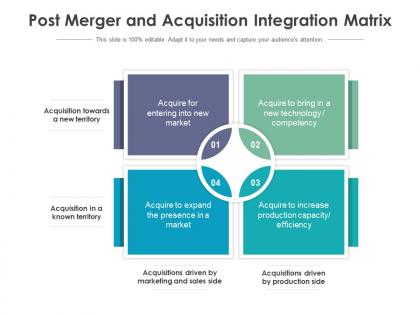
Post merger and acquisition integration matrix




Try Before you Buy Download Free Sample Product
 Impress Your
 Audience
 100%
100% Editable
 Save Hours
 of Time


Our Post Merger And Acquisition Integration Matrix are topically designed to provide an attractive backdrop to any subject. Use them to look like a presentation pro.
People who downloaded this PowerPoint presentation also viewed the following :
Post merger and acquisition integration matrix with all 2 slides:
Use our Post Merger And Acquisition Integration Matrix to effectively help you save your valuable time. They are readymade to fit into any presentation structure.
FAQs for Post merger and
Key components of a successful integration strategy include cultural alignment, clear communication protocols, technology harmonization, talent retention plans, and phased implementation timelines. These elements work together by minimizing operational disruptions, preserving institutional knowledge, and maintaining customer relationships, with many organizations finding that strategic sequencing of these components ultimately delivers faster synergy realization and competitive advantage.
Organizations can assess integration readiness by evaluating system compatibility, data quality, security protocols, scalability requirements, and existing API capabilities. Through comprehensive audits, companies identify technical gaps, streamline resource allocation, and prioritize integration phases, with many financial services and healthcare institutions finding that structured assessments accelerate deployment timelines while minimizing operational disruptions.
Companies typically face challenges including legacy system incompatibilities, data silos, cultural resistance to change, resource constraints, and complex vendor coordination when implementing integration strategies. While these obstacles can slow initial progress, organizations increasingly find that strategic planning, phased rollouts, and cross-functional collaboration streamline implementation, ultimately delivering enhanced operational efficiency and competitive advantage.
Integration strategies enhance data consistency and quality by establishing unified data standards, implementing real-time synchronization protocols, and creating centralized validation processes across all connected platforms. These approaches streamline data governance through automated cleansing, duplicate elimination, and standardized formatting, with many organizations finding that strategic integration ultimately delivers improved analytics accuracy and enhanced decision-making capabilities.
Cloud technology serves as the backbone of modern integration strategies, providing scalable infrastructure, real-time data synchronization, API management platforms, and hybrid connectivity solutions. Through cloud-based integration platforms, organizations streamline operations across multiple systems, enhance data accessibility, and reduce infrastructure costs, while enabling seamless collaboration between on-premise and cloud applications, ultimately delivering greater operational efficiency and competitive advantage.
Businesses should prioritize integration initiatives by assessing data criticality, system interdependencies, compliance requirements, and potential ROI impact. Starting with customer-facing systems and core operational processes, organizations can streamline workflows, enhance data accuracy, and reduce manual errors, ultimately delivering improved service delivery and competitive advantage in increasingly connected markets.
Organizations should measure integration success through performance metrics like data accuracy rates, system uptime percentages, transaction processing speeds, error reduction levels, and user adoption rates. Through comprehensive monitoring dashboards, companies in sectors like banking and healthcare track operational efficiency gains, cost savings, and improved customer response times, ultimately delivering measurable ROI and competitive advantage.
Integration strategies facilitate better customer experiences by unifying data sources, streamlining workflows, and creating seamless touchpoints across all channels. Through strategic integration, organizations enhance response times, personalize interactions, and eliminate service gaps, with many financial services and retail companies finding that integrated systems ultimately deliver faster resolutions and significantly improved customer satisfaction.
To ensure stakeholder buy-in for integration projects, establish clear communication channels, demonstrate tangible ROI through pilot programs, involve key stakeholders in planning phases, and provide comprehensive training schedules. These practices streamline adoption by addressing concerns proactively, showcasing measurable benefits, and creating ownership among teams, with many organizations finding that early engagement and transparent progress reporting ultimately deliver smoother implementations and sustained support.
Organizations leverage APIs to support integration strategy by enabling seamless data exchange, automating workflows, facilitating real-time connectivity, and creating scalable system architectures. Through RESTful APIs and microservices approaches, companies in healthcare, finance, and retail streamline operations, reduce manual processes, and enhance customer experiences, ultimately delivering faster innovation cycles and competitive advantage in increasingly connected business environments.
Inadequate integration planning creates significant risks including data silos, operational disruptions, cost overruns, employee resistance, and technology incompatibilities. These challenges often result in decreased productivity, compromised customer experiences, and failed strategic objectives, with many organizations finding that poor planning ultimately leads to project delays, budget escalations, and competitive disadvantages in increasingly complex business environments.
An effective integration strategy aligns with business objectives by streamlining operations, enhancing data visibility, and enabling scalable growth across departments and systems. Through strategic API connections and unified platforms, organizations achieve faster decision-making, reduced operational costs, and improved customer experiences, while eliminating data silos that hinder competitive advantage in increasingly complex business environments.
Emerging integration technologies include API management platforms, iPaaS solutions, microservices architectures, event-driven integration, and AI-powered data mapping tools. These technologies streamline processes by automating data transformation, enabling real-time connectivity, and reducing manual configuration, with many organizations finding that strategic combinations deliver faster deployment times and enhanced operational efficiency.
Employee training enhances integration success by addressing skill gaps, cultural alignment, and process standardization across merged organizations. Through comprehensive onboarding programs, cross-functional workshops, and leadership development initiatives, companies streamline knowledge transfer, minimize resistance to change, and accelerate operational efficiency, with many organizations finding that strategic training investments ultimately deliver faster integration timelines and improved employee retention.
A well-executed integration strategy delivers enhanced operational efficiency, improved data visibility, reduced costs, streamlined workflows, and greater competitive advantage over time. These strategic combinations enable organizations to scale more effectively, respond faster to market changes, and create seamless customer experiences, with many enterprises finding that integrated systems ultimately drive sustainable growth and innovation.
-
Understandable and informative presentation.
-
Innovative and attractive designs.