


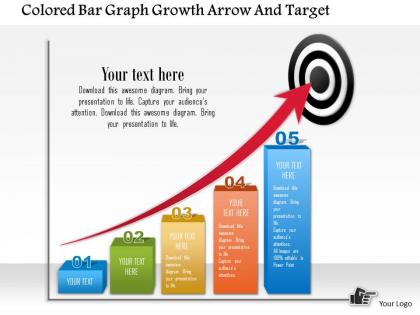
0115 colored bar graph growth arrow and target powerpoint template




Try Before you Buy Download Free Sample Product
 Impress Your
 Audience
 100%
100% Editable
 Save Hours
 of Time


Performing and shining in the competitive world is controlled by our will to innovate and come up with fresh concepts to keep ourselves or our business moving ahead. Without positive change, progress of any business can be impeded resulting in the loss of position in the long run. Whether it be for profit or for reorganizing the society, a business can exist if it continues to find better ways to improve. Team members or colleagues are an important component of this process. They need to be aware of new steps taken by the company in terms of idea creation. A robust tool is therefore needed for that purpose. We have just the right tool needed to attain your objectives. Our colored bar graph growth arrow and target Presentation deck is custom built to perform presentation tasks for you. It’s aesthetically designed PPT images and PPT infographics bring a welcome change to PPT samples slide. Download PPT slide for maximum benefits.
People who downloaded this PowerPoint presentation also viewed the following :
0115 colored bar graph growth arrow and target powerpoint template with all 5 slides:
Our 0115 Colored Bar Graph Growth Arrow And Target Powerpoint Template allow you boundless freedom. Feel happy to break away from curbs.


FAQs for 0115 colored bar graph growth arrow and
You know you're growing when scary challenges don't make you want to hide anymore. People start asking for your advice (which is honestly still weird to me sometimes). Your brain gets better at solving problems, and you build solid relationships with different teams. Those lightbulb moments happen way more often - like when something complicated finally makes sense. Here's the kicker: you get more confident but also realize how much you still don't know. Sounds backwards, right? It's actually a good thing. Just compare what stressed you out six months ago to now.
Dude, design actually matters way more than you'd think for growth stuff. People zone out when your slides are a mess - I've watched so many good ideas die because nobody could read the charts. Use clean colors, lots of white space, and don't cram everything onto one slide. One insight per slide, that's it. Honestly, looking professional gets you halfway there with stakeholders before you even start talking. They take polished presentations seriously. Grab a simple template and stick with it. Your data's probably solid, but if it looks like garbage, nobody's gonna listen anyway.
Honestly, emotional intelligence is like having a superpower on teams. You can actually tell when someone's about to lose it and step in before things get messy. It's wild how much better meetings go when you're really listening instead of just waiting for your turn to talk. The best part? You stop taking everything personally and start seeing where your teammates are coming from. Those heated debates become way more productive - like, you're actually building on ideas instead of tearing each other down. Oh, and giving feedback without crushing someone's soul is definitely a skill worth having. Try really tuning in during your next team meeting and see what happens.
Honestly, keep it simple or people will just ignore the whole thing. I'd start with pulse surveys every month or two, then track stuff like goal completion and maybe some 360 feedback. Internal promotion rates are huge - shows if you're actually developing people. Oh, and employee net promoter scores work well too. The trick is making dashboards that managers will actually use instead of letting them collect dust. Performance metrics matter, but don't go crazy with like 20 different things to measure. Pick 3-5 core ones first, then build from there once you've got a system that actually works.
Honestly, try throwing failure parties when stuff doesn't work out - sounds weird but it actually helps people see mistakes as learning moments. Give teams small budgets to test crazy ideas without jumping through approval hoops. Monthly "pivot pitches" are pretty genius too, where anyone can suggest changing course on projects. Oh, and rotate people between departments more often. Fresh perspectives and all that. Track learning goals alongside revenue in reviews - makes growth feel less scary. The whole thing is about removing that fear of trying new stuff. Just pick one small experiment to try next week and see what happens.
Here's what I'd do - map out where customers get stuck or annoyed in their journey with you. Then just test small fixes one at a time. Maybe A/B test your sign-up process or try different ways to help people. Track satisfaction scores and see what actually moves the needle. Honestly? Most companies make this way too complicated when basic stuff works best. I'd pick one thing to test each week and review how it's going. The measurement part is crucial though - you can't improve what you don't track. Oh, and retention rates tell you more than survey scores sometimes.
Line charts are perfect for growth trends over time. For comparing different segments or periods, go with bar charts. Seriously avoid pie charts in growth presentations - they're everywhere and they don't work! Your y-axis should start at zero so you're not making tiny changes look huge. Keep colors consistent and call out the big growth moments with annotations. Oh, and definitely throw in some context like industry benchmarks. Otherwise your audience won't know if 15% growth is amazing or just meh.
Look, continuous learning stops you from getting left behind while helping your whole team level up. You'll become way more adaptable when you're always picking up new skills - honestly feels like career compound interest or whatever. Problems get solved differently when you bring fresh ideas to the mix, which obviously helps everyone. Companies love this stuff because their people can actually roll with changes instead of freaking out. But here's the thing - it works best when your whole team makes it a habit, not just you grinding alone. I'd say start tiny though. Maybe just one new thing each week?
Honestly, the worst part is usually your own team fighting you on changes - plus you'll hit resource limits way faster than expected. Market saturation sucks too, obviously. Get leadership on board first, that's like step zero. Scale up your systems before you actually need them (learned this the hard way). Don't try to do everything at once - pick one growth channel and nail it. Oh, and set your success metrics early so you can bail on stuff that's not working. Test small batches, see what sticks, then go all-in on whatever's actually moving the needle.
Honestly, stories just hit different than spreadsheets. People zone out when you dump metrics on them, but throw in a real customer example? Suddenly everyone's paying attention. Frame it like a journey - where you started, what went wrong, where you're going. I've watched executives literally perk up when presentations switch from data dumps to actual narratives. Your audience will remember that customer success story way longer than your KPIs (which is kinda wild when you think about it). Paint the before and after picture. Show how real people were affected. Trust me, lead with story next time.
Honestly, most growth barriers come down to fear - people are terrified of failing or looking stupid. Then there's that annoying "this is how we've always done it" mindset that kills innovation before it starts. First thing? Make your team feel safe to mess up. I've seen too many places where one mistake ends careers. Celebrate the small wins instead of waiting for perfection. Figure out what's actually scaring people, then tackle those fears through real conversations. Gradually throw new challenges their way - don't dump everything at once. Takes time, but it works way better than forcing change.
Honestly, you can't fix what you don't even realize is broken. Regular 1:1s with your manager are gold - way better than those generic 360 reviews that tell you nothing useful. I always ask specific people about particular skills rather than just fishing for random compliments. After wrapping up projects, try asking "what's one thing I could've done better?" Most people will actually give you solid input if you're direct about it. Oh, and schedule monthly check-ins with folks whose judgment you respect. Makes a huge difference when feedback is timely instead of remembering stuff from six months ago.
Tech breakthroughs are honestly crazy - they don't just make things better, they completely flip what's possible. New markets pop up overnight. Business models that seemed impossible suddenly work. One innovation can reshape entire industries, which is pretty insane when you think about it. Companies that pay attention early usually grab the best opportunities before competitors even realize what's happening. My advice? Stay curious about what's coming down the pipeline in your field - though I know that's easier said than done sometimes. The ripple effects from tech changes create growth chances you wouldn't expect.
Build up your content in layers - basic stuff first, then get more complex. I do that "here's what we're covering" preview thing so newbies can prep and experts know what's coming. Recap slides are clutch (plus they bail me out when I blank mid-presentation lol). Mix high-level concepts with specific examples so people can jump in wherever. Honestly, the real trick is ending each section with actionable next steps that work for everyone - doesn't matter if someone's a total beginner or already knows their stuff. That way nobody leaves empty-handed.
Honestly, mentorship makes such a huge difference for new leaders. Having someone who's been there before - not just reading about it in books - is game-changing. You get real feedback without worrying about your boss judging you. Plus (and this might sound cynical) but understanding office politics from someone who actually knows the players? Priceless. The good mentors don't just check boxes either. They'll invest actual time helping you work through messy situations and build confidence you can't get from training modules. Short answer: if you want to develop leaders, find mentors who genuinely care about helping, not just the title.
-
Content of slide is easy to understand and edit.
-
Commendable slides with attractive designs. Extremely pleased with the fact that they are easy to modify. Great work!