


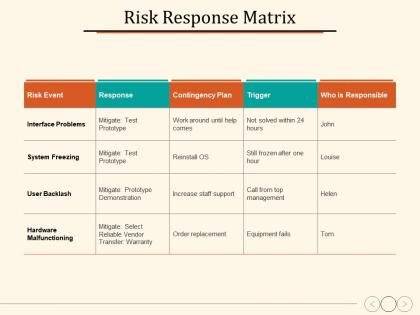
Risk response matrix response risk event contingency plan trigger




Try Before you Buy Download Free Sample Product
 Impress Your
 Audience
 100%
100% Editable
 Save Hours
 of Time


Give a call with our Risk Response Matrix Response Risk Event Contingency Plan Trigger. Set the lines crackling with your views.
People who downloaded this PowerPoint presentation also viewed the following :
Risk response matrix response risk event contingency plan trigger with all 5 slides:
Our Risk Response Matrix Response Risk Event Contingency Plan Trigger guarantee great action. They encourage glorious feats.





FAQs for Risk response matrix response risk event
So there's basically five things you need to nail down: figuring out what could go wrong, assessing how bad/likely each risk is, deciding what to do about them, keeping an eye on everything, and making sure people actually talk about this stuff. Honestly, the identification part is kind of a pain at first - feels like you're just listing every possible disaster. But once you get the hang of it, it's not so bad. You can avoid risks, reduce them, pass them off to someone else, or just accept them. I'd start small though - pick your worst 10 risks and work from there.
Start by mapping out everything that could go sideways - your processes, systems, people, outside stuff. Talk to key people, dig into past incidents, run some "what if" scenarios. A risk matrix helps you rank things by how likely they are vs. how bad they'd be. Cyber threats and regulatory changes are sneaky ones that people miss. I'd probably do quarterly reviews because honestly, most companies do this once and then forget it exists. Oh, and don't just focus on the obvious risks - sometimes the weird edge cases are what actually bite you.
Risk tolerance is basically your company's comfort level with different types of risk. It's like setting boundaries - if you're super cautious, you'll dump money into controls and insurance even when it's pricey. Companies that are more chill about risk might skip some protections to move quicker or cut costs. Honestly, I've seen too many places where leadership says one thing but then freaks out when anything goes wrong. The whole thing falls apart if your actual risk activities don't match what the executives claim they can handle.
Tech can help you catch problems way before they blow up. Machine learning spots patterns in huge amounts of data that you'd never notice manually. Real-time monitoring systems alert you instantly when something's off. Honestly, predictive analytics feels almost magical - it's like seeing problems coming before they hit. Risk platforms pull everything into one place too, which makes coordinating with your team so much easier. I'd start by figuring out where you're most vulnerable right now, then find tools that tackle those specific issues first.
Honestly? Most companies treat risk management like some boring paperwork drill. They build these huge risk registers that just sit there collecting dust - basically useless. Then they spend forever documenting every tiny risk instead of actually doing something about the big ones. Plus they obsess over financial stuff but totally miss things like reputation hits or operational screwups. Here's what actually works: grab your top 5-10 real risks, put someone in charge of each one, and talk about them every month. Make actual decisions, not just more documents.
Track the basics first - how often bad stuff happens, what it costs you, and how fast you catch problems. Time to detection is huge. Near-misses are actually more valuable than you'd think since they show where your systems almost failed. I'd start with just three metrics you can actually control, maybe monthly tracking against whatever your current baseline is. The real test though? Whether you're stopping fires before they start instead of just being really good at putting them out. Dashboard helps but don't go overboard initially.
Think of risk management as building a safety net before you actually need it. Map out what could go wrong in your business – the big stuff that'd really hurt. Then create backup plans for each scenario. Honestly, most companies skip this until something bad happens, which is backwards. Your team gets way better at making quick decisions when they've already thought through potential problems. It builds confidence with investors and customers too. Short version: identify your weak spots, plan for them, and you'll recover faster when things inevitably get messy. Plus your people won't panic as much.
Yeah, culture totally impacts how teams handle risk. Some cultures hate uncertainty - they'll avoid anything that feels unpredictable. Others? They're fine with ambiguity and will take bigger chances without blinking. Your team's backgrounds shape everything - whether people actually voice concerns about risks, how they read data, what feels "acceptable." I've watched this happen with mixed teams where one person's "no way" is another's "sure, why not." Honestly, you can't build good risk processes without getting this. Map out who's from where on your team, then just talk openly about how that might color your discussions.
Look, you absolutely need different people weighing in on this stuff. Finance sees cash problems that ops totally misses. Meanwhile, the people actually doing the work catch things management is completely blind to - happens all the time. But here's the thing that really matters: when people help build the plan, they'll actually stick to it. Otherwise you just end up with some document nobody looks at. Different perspectives fill in your blind spots, and getting everyone involved means your mitigation strategies won't just collect dust. Map out who's affected by each risk first.
So basically you map out different "what if" scenarios that could mess with your business, then figure out how you'd handle each one. Pick your biggest 3-5 risks and brainstorm realistic situations around them - worst case, best case, and what'll probably actually happen. Document the warning signs you'd watch for and your game plan for each scenario. It's kinda like playing chess but for your business lol. The whole point is so you're not panicking when something goes sideways because you've already thought through your moves. Way better than winging it.
Qualitative is basically your gut check - you throw risks into buckets like "high" or "medium" based on what feels right. Way faster but obviously pretty subjective. Quantitative actually crunches numbers and spits out real percentages and dollar figures. Takes forever though, and honestly gets expensive if you're doing it right. I'd probably start qualitative just to see what you're dealing with, then get serious with the math on whatever scares you most. Numbers don't lie, but sometimes you don't need that level of precision for every little thing.
Don't just slap compliance on top of everything else - it needs to be baked into your risk framework from day one. Map out which regs actually hit your business (btw, copying what your competitor does is usually a mistake). Build monitoring into your regular risk checks so you're not scrambling when things change. Someone on your team needs to own each regulatory area - can't be everyone's job and no one's job, you know? Set up alerts for updates and train people to flag compliance stuff during normal work. Way better than those painful annual compliance marathons nobody wants to do.
Honestly, the biggest shifts right now are AI risk detection and real-time monitoring dashboards - way better than those painful quarterly reviews we used to sit through. Climate risk is huge now too, plus everyone's obsessing over supply chain resilience after COVID messed everything up. Zero-trust cyber frameworks are basically the new standard. Most companies are finally ditching the reactive approach for predictive analytics and continuous monitoring, which makes so much more sense. I'd start by figuring out where your biggest gaps are in these areas - probably supply chain or cyber if I had to guess.
Honestly, you've got to actually close the loop on your risk stuff - most companies are terrible at this. Schedule quarterly reviews where you dig into what went wrong, what you totally missed, and whether your fixes actually worked. Track your response times and how well things got handled. Here's the thing though - people need to feel safe reporting close calls without getting thrown under the bus. Otherwise you'll never hear about problems until it's too late. Oh, and make sure someone's actually accountable for following through on these reviews. Book your first one this month before you forget about it.
Honestly, communication is everything when shit hits the fan - figure out who's calling who and how. Back up your critical stuff somewhere you can actually reach it (learned that one the hard way last year during our server meltdown). Set up response teams but don't just leave it on paper - run through scenarios every few months or you'll be scrambling. Alternative suppliers are clutch too. Oh, and realistic timelines matter more than you think. I'd probably start by writing down your worst-case scenarios first. Review everything quarterly since things change constantly.
No Reviews