


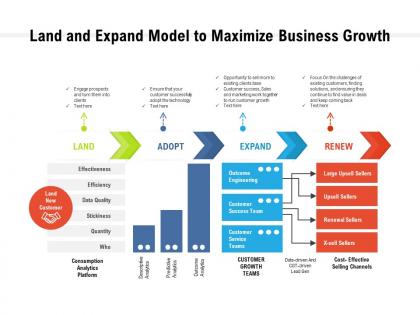
Land and expand model to maximize business growth




Try Before you Buy Download Free Sample Product
 Impress Your
 Audience
 100%
100% Editable
 Save Hours
 of Time


Expose dubious inclinations with our Land And Expand Model To Maximize Business Growth. It helps foil hidden agendas.
People who downloaded this PowerPoint presentation also viewed the following :
Land and expand model to maximize business growth with all 2 slides:
Identify hidden agendas with our Land And Expand Model To Maximize Business Growth. Foil any attempt at deceit.

FAQs for Land and expand model to
Get your product-market fit locked down first - that's your foundation. Pick one specific use case or department to start with. Quick wins and clear ROI are everything here. Your early champions? They're literally worth their weight in gold, so treat them that way. They'll sell for you internally better than any pitch deck ever could. After you've got some momentum, map out where else you can expand within that same company. Don't jump too early on upsells, but honestly don't wait forever either - competitors will swoop in. Timing's tricky but you'll figure it out.
Honestly, presentation templates are clutch for visualizing your land and expand process. I'd map out each stage from first contact to full expansion - like a customer growth roadmap but way more visual. Flowcharts work great, or just do a simple timeline format. Include your conversion rates between stages, revenue targets, all that good stuff. Activities like upsells and cross-sells should be in there too. Makes it dead simple to find where things are getting stuck and explain what's happening to your team or leadership. Oh, and build one solid master template first - you can tweak it for different accounts later.
Focus on these three: Net Revenue Retention (NRR), account expansion rate, and time-to-expand. NRR's honestly the most important one - if you're hitting 110% or higher, you're golden. Account expansion rate shows what percentage of customers actually buy more stuff after they land. Time-to-expand tracks how fast you're upselling them. Oh, and don't ignore customer health scores because pissed off customers won't expand no matter what. I'd start with dashboards for those three metrics, then figure out what's driving the numbers. NRR will probably tell you everything you need to know.
Honestly, your customers are basically telling you exactly how to make more money if you just listen. Track what they're complaining about or always asking for - those are your next product features right there. Half the time they'll straight up say "I'd totally pay extra if this thing could do X." It's wild how obvious it gets when you start paying attention to patterns. Their workflows and pain points show you natural upsell opportunities way better than trying to guess what might work. I started mapping feedback themes to potential add-ons and it's like having a cheat sheet for expansion. Way easier than shooting in the dark with random features nobody wants.
Think of segmentation as your treasure map for finding untapped money in current accounts. Break down each customer by department, geography, team size - whatever fits your product. Honestly, I'm obsessed with drawing out org charts because they reveal so much. You'll start seeing patterns everywhere: marketing teams that love you while their sales counterparts have no clue you exist, or entire offices that haven't heard about you yet. These gaps become your goldmine. Instead of randomly pitching features, you can craft targeted campaigns for specific segments. Way more effective than crossing your fingers and hoping someone discovers your other stuff.
Honestly, most companies totally botch their comp plans - they'll reward the initial sale but then give reps zero incentive to grow accounts after that. Train your team to spot expansion signals early, like during the original sales process. Usage data is your best friend here - get your reps access to that stuff so they can see growth opportunities before customers even realize they need more. Set up solid handoffs between new business and account management (trust me, things get dropped otherwise). Regular account reviews are clutch, and celebrate those expansion wins just as hard as landing new logos. It's way easier to grow existing accounts than hunt for new ones.
So I'd probably go with ChurnZero, Gainsight, or Totango since they're built specifically for this stuff. Salesforce and HubSpot are solid options too if you're already using them. Map out your customer touchpoints first though - that's actually more important than the tool itself. These platforms track usage patterns and help spot upsell opportunities, plus you can monitor expansion revenue over time. Honestly? Pick one and stick with it. I've seen too many teams waste months switching between tools instead of just committing to whatever fits their workflow best.
For your case studies, hit these three beats: tiny first contract, what made them expand, and the final numbers. I'd start each one with their original problem and your small solution - honestly the humble start makes everything look better. Show what convinced them to grow with you next. Maybe it was ROI, new problems popped up, or they just started trusting you more. Always end with the revenue jump like "3x growth in 2 years" because execs eat that stuff up. Keep it tight - 2-3 slides tops. Focus on whatever metrics matter to your specific audience.
Don't rush expansion before checking if they're actually happy with what you've already delivered - that's like building on quicksand. Going around your main contact is career suicide, trust me on that one. Each department has totally different problems, so what killed it in sales might flop hard in marketing. Political mapping comes first - figure out who holds real influence. Find one solid pain point in a new area and focus there instead of throwing every solution at the wall. Your champion should know what you're doing every step of the way. Baby steps win over trying to transform their entire company overnight.
Look at what they're already using a ton - that's where you'll find the easiest wins for expansion. Pay attention to their complaints too, even the random stuff they mention during calls. I swear some of my best upsells came from someone casually bitching about a workflow issue. Then there's the growth angle - where's their business headed? What'll they need when they're bigger? The magic happens when you find something that fixes their current headache AND sets them up for what's coming next. Oh, and actually listen during those check-ins instead of just going through the motions.
Dude, you absolutely need CRM for land and expand - like, don't even think about doing it manually because that's just asking for chaos. It tracks all your touchpoints and shows you exactly when accounts are ready to buy more stuff. Plus you can see who's actually using your product and when contracts are up for renewal. The whole team gets visibility into which accounts are healthy vs. risky (honestly saved my butt so many times). Oh, and set up those automated alerts for expansion triggers - increased usage, renewal windows, all that good stuff. Game changer.
Templates are seriously a game-changer for Land and Expand training. Your whole team stays on the same page instead of everyone doing their own random thing (which honestly never works well). Build one solid master deck covering the basics - spotting expansion opportunities, positioning upsells that don't feel pushy, ROI demos, all that good stuff. Throw in some real customer wins and common objections people face. The best part? You can tweak versions for different segments later. Way better than letting people wing it and hope for the best.
So basically, Land and Expand totally flips normal sales on its head. You start tiny - just get your foot in the door with something small instead of going for those huge enterprise deals right away. Traditional sales wants the biggest contract possible from day one. But this approach? You prove yourself first with a limited rollout, then grow from there once they trust you. Way less risky for everyone involved, honestly. Plus expanding existing accounts is so much easier than constantly chasing new prospects - like, why make it harder on yourself?
Honestly, market research is your best friend here. It shows you which customers are ready to spend more and what they actually want (not what you think they want). Surveys and customer interviews are gold - I've watched teams waste forever building stuff nobody cares about because they just assumed. Look at your competitors too, see how they're growing. But here's the thing - start with your current customers first. What other problems do they have that you're not solving yet? That's usually the easiest win. Usage data helps spot patterns you'd miss otherwise. Don't overcomplicate it though.
Content marketing is honestly your best bet for getting existing customers to buy more. Map out what problems they hit as they grow, then make stuff that actually helps - case studies, tutorials, industry deep dives. I've seen too many companies just spam product pitches instead of being useful. Educational content keeps you in their back pocket when they're ready to expand. The trick is staying top of mind without being annoying about it. Focus on their evolving pain points, not just what you're trying to sell. Trust me, it works way better than constant sales pitches.
No Reviews