


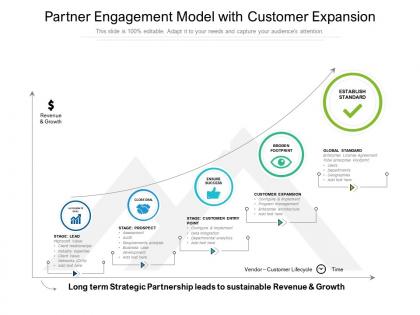
Partner engagement model with customer expansion




Try Before you Buy Download Free Sample Product
 Impress Your
 Audience
 100%
100% Editable
 Save Hours
 of Time


Our Partner Engagement Model With Customer Expansion are topically designed to provide an attractive backdrop to any subject. Use them to look like a presentation pro.
People who downloaded this PowerPoint presentation also viewed the following :
Partner engagement model with customer expansion with all 2 slides:
Use our Partner Engagement Model With Customer Expansion to effectively help you save your valuable time. They are readymade to fit into any presentation structure.


FAQs for Partner engagement model
Effective partnership expansion strategies include strategic alliance development, joint venture formation, cross-industry collaborations, technology integration partnerships, and geographic market partnerships. These approaches streamline market entry, enhance competitive positioning, and accelerate growth by leveraging complementary strengths, shared resources, and combined expertise, with many organizations finding that strategic partnerships ultimately deliver faster scalability and reduced operational risks.
Identifying aligned partners involves evaluating strategic compatibility, complementary capabilities, shared market vision, cultural fit, and mutual growth objectives. Companies should assess potential partners' customer bases, technological strengths, geographic reach, and operational values, with many organizations finding that successful partnerships emerge when both parties offer distinct yet synergistic resources, ultimately delivering expanded market access and enhanced competitive positioning.
Market research identifies potential partners' market position, customer base, financial stability, reputation, and strategic alignment with your business objectives. Through comprehensive analysis, organizations can evaluate partner compatibility, assess market overlap or complementarity, and predict partnership success rates, with many companies finding that thorough research significantly reduces partnership risks while maximizing collaborative opportunities and competitive advantage.
Businesses can measure partnership expansion success through revenue growth from new partnerships, increased market reach, customer acquisition rates, operational efficiency improvements, and partner satisfaction scores. These metrics enable organizations to assess strategic value by tracking joint venture performance, cross-referral rates, and cost reductions, with many companies finding that comprehensive partner scorecards ultimately deliver measurable competitive advantage.
Common pitfalls include inadequate due diligence, misaligned strategic goals, poor communication frameworks, unclear performance metrics, and insufficient cultural compatibility assessment. While these challenges can derail expansion efforts, organizations that establish comprehensive vetting processes, define mutual objectives early, and create structured integration plans ultimately deliver stronger partnerships and sustainable competitive advantage.
Cultural compatibility is essential for successful partnerships, as it influences communication styles, decision-making processes, operational approaches, and conflict resolution methods. Organizations with aligned values and work cultures experience smoother integration, reduced misunderstandings, and enhanced trust, with many international joint ventures finding that cultural synergy ultimately drives better collaboration outcomes and sustainable growth.
Partnership negotiations require careful attention to liability allocation, intellectual property rights, decision-making authority, profit-sharing mechanisms, and exit clauses. These legal frameworks streamline operations by establishing clear governance structures, protecting assets, and defining dispute resolution processes, with many organizations finding that comprehensive agreements ultimately deliver reduced conflicts and stronger strategic alignment.
Collaboration tools enhance partnership communication by centralizing messaging, enabling real-time document sharing, facilitating video conferencing across time zones, and providing project tracking dashboards. These platforms streamline workflows between organizations, with many multinational partnerships finding that integrated communication systems reduce response times, minimize miscommunication, and ultimately deliver stronger strategic alignment and faster project execution.
Technology significantly enhances partnership expansion by streamlining communication, enabling real-time collaboration, and providing data analytics for strategic decision-making. Through digital platforms and cloud-based solutions, organizations can seamlessly integrate operations, automate workflows, and maintain transparency across partnerships, ultimately delivering faster market entry, reduced operational costs, and competitive advantages in increasingly global business environments.
Businesses can leverage social media for partnership discovery by identifying complementary companies through industry hashtags, engaging with potential partners' content, participating in professional groups, and showcasing their own capabilities to attract collaboration interest. Platforms like LinkedIn enable direct outreach to decision-makers, while Twitter and Instagram facilitate relationship-building through consistent engagement, ultimately creating organic partnership opportunities that drive mutual growth and expanded market reach.
Strategic alliances involve companies collaborating while maintaining separate ownership structures, sharing resources, expertise, and market access through contractual agreements. Joint ventures create new, jointly-owned entities where partners contribute capital, assets, and management, sharing both risks and profits equally, with many financial institutions and technology firms finding joint ventures enable deeper market penetration and shared innovation investments.
Companies ensure mutual benefits by establishing clear value propositions, defining shared objectives, implementing transparent communication channels, and creating balanced resource allocation frameworks. These strategic approaches enable partners to leverage complementary strengths while maintaining operational independence, with many organizations finding that regular performance reviews and flexible agreement structures ultimately deliver sustained competitive advantages and scalable growth opportunities.
Customer feedback serves as a strategic compass for partnership development, identifying service gaps, market opportunities, unmet needs, and preferred collaboration models that guide alliance decisions. Through systematic feedback analysis, organizations can prioritize partnerships that address specific customer pain points, enhance service delivery, and expand market reach, ultimately delivering improved customer experiences and competitive advantage in increasingly customer-centric markets.
Small businesses can effectively compete for partnerships by demonstrating specialized expertise, agility, and niche market knowledge that larger organizations often lack. They should leverage their ability to provide personalized service, faster decision-making, and innovative solutions, while showcasing proven results and unique value propositions that complement rather than duplicate larger partners' capabilities, ultimately delivering strategic advantages through focused specialization.
Successful partnership expansion stories include Starbucks-Spotify's music integration, Microsoft-Adobe's cloud collaboration, and Amazon-Whole Foods' retail transformation, demonstrating strategic alignment and shared value creation. These partnerships succeeded by establishing clear governance structures, maintaining consistent communication protocols, and leveraging complementary strengths, ultimately delivering enhanced customer experiences and significant market expansion for both entities.
-
Excellent work done on template design and graphics.
-
Excellent products for quick understanding.
-
Enough space for editing and adding your own content.
-
Great product with effective design. Helped a lot in our corporate presentations. Easy to edit and stunning visuals.