

 0 Comment
 Customer Reviews

Every business has parties that need to integrate and collaborate closely to create value over time. An engagement model is an effective way to outline the terms and methods for engagement, often involving a clear definition of roles and responsibilities.
The engagement models—be it client engagement, employee engagement, or even customer engagement—help the company engage directly with employees and clients to have seamless, long-term, effective collaboration. The managers and leaders, using comprehensive engagement channels, help align the company's values and goals.
Better clarity around expectations and alignment between the various parties involved help create a sustainable, beneficial relationship. If you are on the lookout for templates around engagement models, you are at the right place. Continue reading to check such templates!
Template 1: Six months customer engagement model development roadmap
This template helps in planning a customer engagement roadmap spreading across six months. Phase 2 would be analysis and preparation, which includes analysis of the situation - gathering information on competition, collecting individual user information, and analysis of data for benchmarking. Phase 2 is the development of strategy, identifying areas for improvement, and cost-benefit analysis for technological support. Phase 3 would be pilot testing - development of prototype parameters and finalizing operational requirements. Phase 4 would be the rolling out and transfer stage, followed by the two other phases in which you plan to divide the task map.

Template 2: Customer digital engagement model
This template helps in showing the customer engagement model. It covers the key engagement channels, production and delivery services, content and engagement management, and customer data platforms. The engagement channels can range from social platforms, email, websites, and mobiles. Production, interaction, and production delivery would include content delivery network, speed digital delivery, optimization customer analytics, page layout, and content center. Content & Engagement Management would include social engagement, marketing automation, Web content management, and digital asset management. The customer data platform includes business intelligence, analytics, product information management, mobile device management, enterprise resource planning, and customer relationship building.

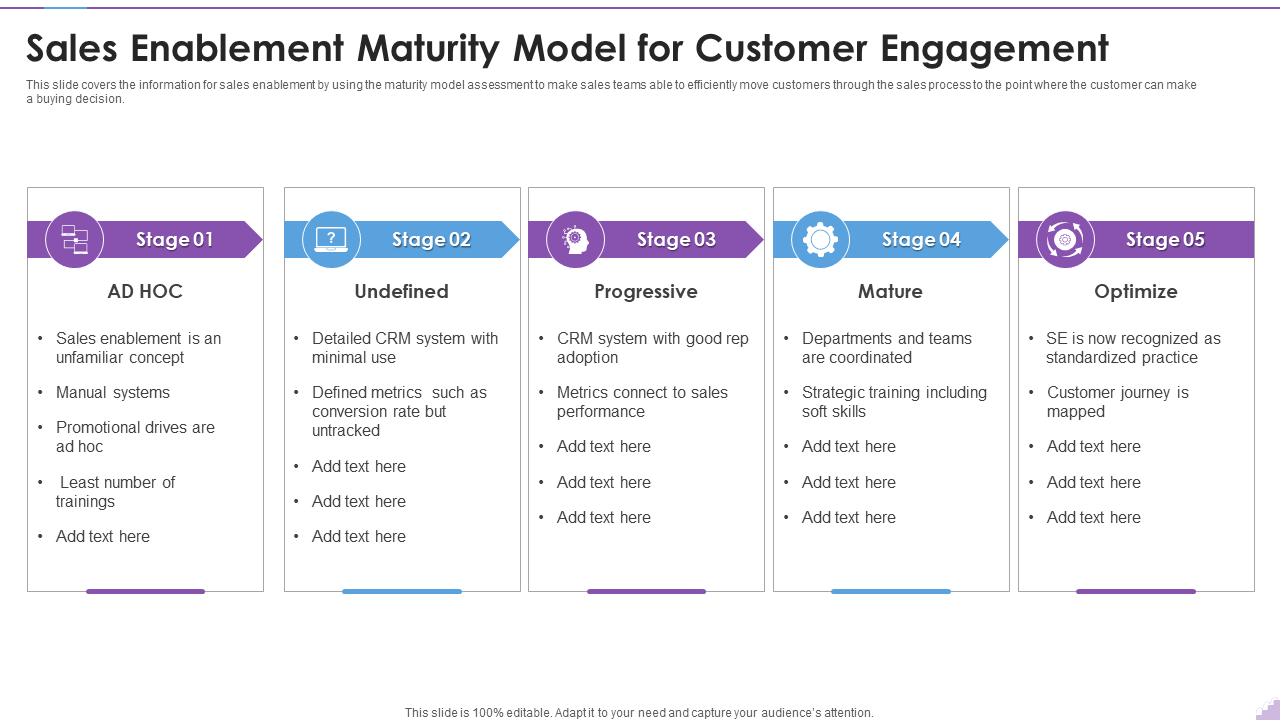
Template 3: Sales Enablement maturity model for customer engagement
This template covers the information for sales enablement by using the maturity model assessment to make sales teams effectively move customers through the sales process to the point where the customer can make a buying decision. Stage 1 would be sales enablement, which is an unfamiliar concept, and promotional drives; stage 2 can be around a detailed CRM system with minimal use, defining metrics such as conversion rate. Stage 3 is progressive, which is a CRM system with good rep adoption; stage 4 is departments and teams are coordinated, strategic training includes soft skills; stage 5 is optimization, which is recognizing the standardized practice, and customer journey mapping is also a part of this.
Template 4: Customer Acquisition and engagement funnel model
This template shows the customer acquisition and engagement funnel model. Registered users are the first stage of garnering customers, which usually comes from marketing expenditure. Commitment is the second stage, in which the free users enter the free subscriber zone. The engagement is paying subscribers, who are categorized into two buying groups - one who buys add-on products and the other who buys additional products. The purchase group has either new customers or repeat customers. Once the customer enters into the working stream, engagement is a crucial step in holding onto the customer base.

Template 5: 9 Step model of community engagement
This template comprises 9 steps - the first step is reflecting and strategizing, the second step is identifying and engaging stakeholders, the third step is defining the community, the fourth step is collecting and analyzing data, the fifth step is prioritizing community health issues, the sixth step is documenting and communicating results, the seventh step is planning the implementation strategies, the eight steps is the implementation of the planning strategies, the last step is evaluating the progress. This implementation of an engagement strategy, from planning and thinking to finally implementing and evaluating continuously, leads to better customer inclusion.

Template 6: Client Engagement strategy implementation model
This template helps in checking the client engagement strategy model. The engagement stages would be step 1 - analyzing client expectations; step 2- prioritizing client expectations; step 3- engagement strategy; and the fourth step- performance analysis. These stages are part of buyer relevancy. The client intimacy steps would be progress reporting, and the final step would be taking action and starting from gathering and understanding client objectives to interpreting client objectives, devising strategies based on expectations, and assessing KPIs. The client intimacy steps would be developing internal reporting metrics for decision-making and aligning results with business.

Template 7: Client Engagement journey model with channels and initiatives
This template would show the stages of the journey - Idea conception and development, environment shaping, legitimacy and approval, commissioning and tendering, client availability, project availability and usage, and outcomes. The objectives of each stage are requirement gathering, launch relationship building, obtaining regulatory approvals, allocating tenders to contractors, and sharing project progress. Engagement channels would be telephonic conversation and social media campaigns; key initiatives would be project character analysis, building a communication plan, legitimacy, and approval by having a business analytic mindset and a culture of integrity.

Template 8: Client Engagement model with status and approach
This template helps you see the client's details. The engagement methods would include gift hampers, recreation activities, a client appreciation program, and a client safety program; the objectives would be enhancing brand equity and developing a client support system; the key account manager name can be mentioned; communication methods can be stated, and with engagement tools and the frequency too is mentioned. Engagement status can be high, medium, and low, depending on how the engagement efforts are directed.

Template 9: Value co-creation customer engagement model
This template helps in seeing a customer engagement model that showcases dependencies of business relationships and customer engagement communication channels to create value. It also illustrated the outcomes of loyalty, CX, etc. The business relationship and customer engagement run parallel. The first one has a planned business enhancement journey over time and the latter talks about the customer journey over time. The knowledge is applied across terms that are further driven to create value. The results of both relationships are carefully studied, and they could be related to lifetime value, referrals, etc.

Template 10: Staff engagement model
This template helps to see the growth and opportunities that the organization has to offer to its working members. People and culture are such a crucial part of the business environment that influencers work to further idea generation. Corporate reputation and practice are major parameters for users to engage with and support the company. The work ethics and how the company presents its workforce in front of the public and where its industrial policies and practices stand also influence how staff and further customers would engage with the company and its services/ products.

Engagement models turn out to be really useful in creating a better working ecosystem and user experience. When done properly, this will lead to better alignment and growth of all parties involved. It has larger implications—growth and better sales. We hope these templates turn out to be handy for you. We will be back with more such templates. Until next!