


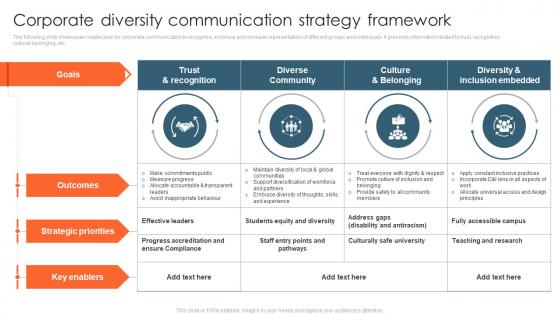
Corporate Diversity Communication Strategy Framework




Try Before you Buy Download Free Sample Product
 Impress Your
 Audience
 100%
100% Editable
 Save Hours
 of Time


The following slide showcases master plan for corporate communication to recognise, embrace and increase representation of different groups and individuals. It presents information related to trust, recognition, cultural belonging, etc.
People who downloaded this PowerPoint presentation also viewed the following :
Corporate Diversity Communication Strategy Framework with all 6 slides:
Use our Corporate Diversity Communication Strategy Framework to effectively help you save your valuable time. They are readymade to fit into any presentation structure.





FAQs for Corporate Diversity
Honestly, start with making people feel safe to actually speak up - that's the foundation for everything else. I'd set up regular check-ins where folks can share without getting judged, and really listen instead of just waiting to jump in. Training's fine I guess, but those casual hallway conversations usually do more than formal workshops anyway. Get people telling stories about their experiences rather than just talking policy stuff. Oh, and definitely model good language yourself - when someone says something off, call it out gently. Build trust in one-on-ones first before trying to fix the whole group dynamic.
Oh man, cultural stuff at work is huge! Like your German colleague will just straight-up tell you your presentation sucked, while someone from Japan might hint around it to avoid conflict. Some cultures think speaking up in meetings shows engagement - others see it as disrespectful interrupting. Personal space is wild too... I learned that one the hard way. Even eye contact means different things! Honestly, the biggest thing is just not assuming everyone communicates like you do. Watch how people interact and try to meet them halfway. Makes everything way less awkward.
Honestly, active listening is huge for these conversations. You're showing people you actually want to understand their perspective instead of just waiting to jump in with your own take. When you really focus on what someone's saying, you catch cultural stuff and experiences that might be completely foreign to you. Trust me, that builds serious trust - which is kind of rare in diversity talks since people feel pretty exposed. Oh, and here's something that works: repeat back what you heard before you respond. Sounds weird but it totally changes the whole dynamic.
Oh man, this stuff is so tricky! Like, making eye contact shows confidence here in the West, but I found out it can actually be disrespectful in a lot of Asian cultures - learned that one the awkward way on a Zoom call with my Japanese colleagues. Personal space is another weird one. Even something as simple as nodding means different things depending on where you are. Hand gestures too - don't even get me started on that minefield. Honestly, when you're dealing with people from different cultures, just pay attention and don't assume everyone reads body language the same way you do.
Ugh, so many things get in the way honestly. Unconscious bias is huge, plus everyone has different communication styles. And don't even get me started on how confusing it is to know what language is okay these days - like, we're all just trying not to mess up! People make assumptions about backgrounds instead of actually asking. Or they avoid diversity conversations completely because they're terrified of saying something wrong. But here's what actually works: listen more, ask questions instead of assuming stuff. Make it safe for people to screw up and learn from it. Don't wait for some perfect moment to start these conversations - just jump in. Gets less weird with practice, I promise.
Translation apps are honestly game-changers for breaking down language barriers. Video calls help too, especially when you're dealing with different time zones. Those AI tools that catch potentially offensive language before you send? Total lifesavers - I've avoided so many cringe moments with those. Slack or Teams work great for setting up inclusive channels where your employee resource groups can actually share what they're thinking. The trick is finding tools that genuinely connect people instead of just making your old processes digital. Oh, and definitely ask your global teams what's actually blocking their communication first.
So basically these biases work like sneaky mental shortcuts that mess with how you see people. Like you might think someone's less smart because of their accent, or cut off certain people more in meetings. Cultural differences get misread as being rude too - happens all the time. It's crazy how your brain just does this automatically! You end up missing good ideas or making people feel left out without even realizing. Best thing? Just pause and think "wait, what am I assuming about this person right now?" Works better than you'd think.
Use person-first language and skip the jargon that makes people feel left out. Pick examples from different backgrounds too. I used to roll my eyes at this stuff, but honestly? It works. High contrast colors and readable fonts are clutch for visual accessibility. When you're presenting, speak clearly and give people a sec to process. Oh, and definitely run your content by someone who's not like you first - they'll spot the blind spots you totally missed. Makes such a huge difference.
Honestly, stories are like magic for diversity conversations. People connect emotionally instead of just hearing facts and checking out mentally. When you share real examples, suddenly abstract concepts become something they can actually picture. It's wild how much more engaged people get - way better than just rattling off statistics (though those have their place too, I guess). Data tells you what happened, but stories make you feel why it matters. Next time you're having one of these talks, try opening with a quick story that fits the situation. Trust me, you'll watch the whole energy shift from people just nodding along to actually getting it.
Dude, when leaders actually care about diversity (not just talk about it), everything changes. People start thinking before they speak. Meetings get better because everyone's included. Your boss calls out weird comments? Suddenly the whole team watches their language. It's wild how fast it spreads - like, even how people give feedback shifts. I've seen workplaces where it's just empty corporate speak vs places where leaders walk the walk. Total difference. Watch what your managers DO, not their diversity emails. That tells you if communication will actually improve or stay the same mess.
Honestly, you gotta track both the numbers and the actual results. Check participation rates in your diversity programs and survey responses about inclusion. Retention and promotion data by demographics matters too. Social media engagement on diversity posts helps - though tbh, the real conversations usually happen offline where you can't really measure them. Focus groups and exit interviews give you the qualitative stuff you need. Oh, and pick like 3-4 metrics that match your specific goals. Track them every quarter so you're not drowning in data.
Honestly, skip the boring videos and go straight for interactive workshops. Role-playing is where the magic happens - people actually practice those awkward conversations instead of just nodding along. I'm a huge fan of story-sharing sessions too, where folks talk about their real experiences. Unconscious bias training works better with actual scenarios, not theoretical stuff. Oh, and definitely do small groups first rather than some massive all-hands thing. It's way less intimidating and people won't clam up. You want it hands-on so they can mess up in a safe space and actually learn from it.
Oh man, generational stuff at work is wild. Boomers want to actually talk to you in person, while Gen Z just fires off messages constantly. Different generations have totally different ideas about feedback, teamwork, all that stuff. My boss is like this perfect example - she's older and always wants these long meetings when a quick text would work. But here's what I've learned: don't just assume someone's communication style based on their age. Yeah, there are patterns, but people surprise you. Just pay attention to what actually works with each person instead of going by stereotypes.
Social media's basically become the new town square for diversity talks. Authentic stories from underrepresented groups can blow up overnight, which builds real empathy. But here's the thing - algorithms are kinda broken and push extreme takes just for clicks (so annoying). These platforms totally changed how people expect diversity messaging to look. Way more visual and immediate than old-school corporate stuff. You'll also get those echo chambers that make everything more polarized. My advice? Watch how diversity topics trend in your spaces. Then match your communication style to where people actually hang out online. Makes a huge difference.
First thing - document everything. Like, actual examples of when better diversity communication would've helped. Then bring it up casually in your next one-on-one with your manager. Employee resource groups are honestly your best shot here because there's power in numbers, you know? Propose stuff like inclusive language training or making sure company communications actually represent everyone. I'd also suggest pulse surveys to see how inclusive people really feel (spoiler: probably not as much as leadership thinks). Frame it as good for business, not just morally right. Oh, and start with your immediate team first - way easier than going straight to the top.
-
I was never satisfied with my own presentation design but SlideTeam has solved that problem for me. Thank you SlideTeam!
-
“Ample and amazing variety of templates available, really helpful for making professional PPT for day to day workings.”