


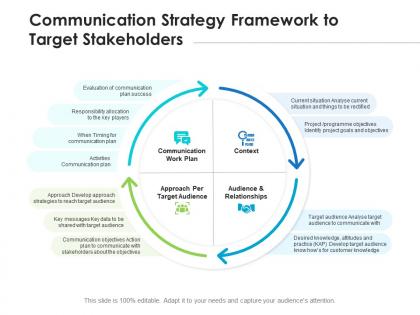
Communication strategy framework to target stakeholders




Try Before you Buy Download Free Sample Product
 Impress Your
 Audience
 100%
100% Editable
 Save Hours
 of Time


Our Communication Strategy Framework To Target Stakeholders are topically designed to provide an attractive backdrop to any subject. Use them to look like a presentation pro.
People who downloaded this PowerPoint presentation also viewed the following :
Communication strategy framework to target stakeholders with all 2 slides:
Use our Communication Strategy Framework To Target Stakeholders to effectively help you save your valuable time. They are readymade to fit into any presentation structure.
FAQs for Communication strategy framework
Start by figuring out who you're actually talking to - and I mean really figure it out, not just guess. What do you want them to do afterward? That's your north star. Find where they actually spend time online (hint: probably not LinkedIn if they're Gen Z). Your message should stay consistent but tweak it for each platform. Set up ways to track if it's working from day one. Oh, and build in feedback loops so you're not just shouting into the void. Success means different things - are you trying to inform people, change minds, or get them to act? Define that upfront or you'll be measuring random stuff later.
Honestly, don't try to track everything or you'll go crazy. Pick like 3-5 metrics that actually matter to your business goals - engagement rates, conversions, website traffic, that stuff. Numbers are great but they're not the whole story. You need the human side too - surveys, listening to what people say on social, actually talking to customers. That's where you find out if your message hits or misses. I'd say review monthly rather than obsessing daily. Oh, and decide your KPIs upfront so you're not just measuring random stuff later.
Honestly, you can't write anything decent without knowing who you're talking to first. Figure out their pain points and what makes them tick. A CEO needs a totally different approach than some junior dev, you know? I always create those audience persona things before I even think about messaging - sounds nerdy but it actually works. Different people prefer different communication styles too. Once you nail down those insights, everything else flows better. Your tone, which platforms to use, how to frame stuff so it actually hits. It's like... the whole foundation basically.
Honestly, visuals are a game changer for presentations. People retain like 65% of what they see but only 10% of what they hear - wild, right? Nobody wants to stare at boring text slides that go on forever. Charts and images keep people awake and actually paying attention. Plus they're super helpful when you're explaining complicated stuff that sounds like gibberish when you just talk through it. I mean, sometimes I zone out during presentations if there's nothing interesting to look at. Just don't go overboard with flashy graphics that'll distract from your main points. Keep it clean and relevant.
Honestly, the worst thing you can do is try to talk to everyone at once - pick ONE audience first. Also don't assume people think like you do (I mess this up constantly). Skip the research and you're basically shooting in the dark. Set up actual success metrics before you start, not after. Testing your messages is huge too - like, don't just wing it and hope for the best. Oh and make it a conversation, not a lecture. People can smell when you're just talking at them. Start small with one clear message and expand from there once you nail that.
Honestly, start with analytics tools to see what's actually working with your audience - that data is super helpful. Automation platforms are clutch for personalizing content without losing your mind doing it manually. Social listening tools give you crazy good insights too. Oh, and don't sleep on project management tools that make communication workflows transparent (video conferencing is obvious but those PM tools are underrated). Pick maybe 2-3 things that play nice together rather than going overboard. First figure out where you're struggling communication-wise, then grab tech that fixes those specific problems.
Honestly, company culture is like the invisible rulebook for how your messages actually get received. Some places are super open - you can say whatever and people will give you real feedback. Others? Total nightmare. Everyone's walking on eggshells and you'll never get a straight answer about anything. The same exact email that works perfectly at one job might completely backfire at another (learned this the hard way). People only speak up when they feel safe to do so. Before sending anything important, I always try to figure out what communication style actually flies there first.
Okay so here's what I've learned the hard way - don't save feedback for the very end. Ask your key people what's actually worked before during planning. Test concepts with focus groups first (trust me on this one). I always do a quick survey before finalizing anything because it saves so much pain later. After launch, check in regularly and keep measuring. Oh and make it ongoing! Like, actually use what people tell you to keep tweaking things. The whole point is making it cyclical instead of just checking a box once.
Okay so first thing - make a master doc with all your key messages that everyone can access. Then build out templates for different channels but tweak the tone for each one (email vs social obviously need different vibes). Those regular team meetings are honestly a lifesaver, trust me on this. A content calendar helps coordinate everything too. Oh and definitely have one person review stuff before it goes live - catches all those weird inconsistencies that slip through. It's way easier than fixing mixed messages after the fact.
Start with a story that grabs them - something they'll actually care about. Then thread that narrative through your whole presentation instead of just dumping facts on people. Think of it like a movie: set up the problem, build some tension around what's going wrong, then boom - your solution saves the day. Honestly, stories stick way better than those boring bullet point slides everyone zones out during. Use real characters and situations your audience knows. Paint the scene with details that make them feel something. Circle back to your opening story at the end, or leave them hanging with "so what's next?" That's what gets people moving.
Here's the thing - speed matters more than having perfect answers. Get your story out there fast before people start making stuff up to fill the silence. Tell them what you know AND what you're still figuring out. Give them dates for your next update too. Make sure your whole team's on the same page though - mixed messages will torpedo your credibility instantly. Don't just stick to corporate talking points either, actually address what people are worried about. Oh, and set up regular check-ins so they know when to expect news, even if it's just "still working on it."
You really can't just translate stuff and hope it works globally - learned that the hard way! Different cultures want totally different communication styles. Some love direct messages, others prefer being super formal. Even colors matter (red = lucky in China, danger here). Timing's huge too. Germans want all the details while Americans prefer quick hits. Don't even get me started on humor - it bombs spectacularly across borders. My advice? Research each market's communication style first, then find local partners who actually get the cultural stuff. They'll save you from looking like an idiot.
Honestly, you've gotta overcommunicate like crazy. Set up regular check-ins that aren't just work stuff - actually ask how people are doing, what's getting in their way. Celebrate the wins too. Video calls help way more than just audio since you can read faces, though we're all so burned out on cameras at this point. Make some casual Slack channels for random chat and working together async. Mix the formal meetings with relationship stuff that actually matters. Oh, and start each week asking what communication rhythm works for them right now - people's needs change constantly.
So here's the thing - good communication makes customers actually *want* to stick around. You're not just pushing content at them, you're having real conversations. Quick responses to their messages? Consistency across your socials? That stuff matters way more than people think. It's like... imagine if your favorite coffee shop remembered your order and actually cared when you had feedback. Same energy. Map out where your customers are in their journey and find those natural spots to connect. Oh, and ditch the corporate voice - nobody wants to chat with a robot.
Honestly, I'd go with Canva first - it's super intuitive and you can whip up something decent pretty fast. Google Slides is solid too if your team's already living in Google workspace. PowerPoint's obviously still around if you're more traditional. Figma's actually really cool because everyone can edit at the same time (no more emailing files back and forth, thank god). You can build proper design systems with it too. But maybe that's overkill depending on what you need? I'd just start with whatever tool your team knows best, then try Canva for one project to see if it's worth switching.
-
Visually stunning presentation, love the content.
-
Top Quality presentations that are easily editable.