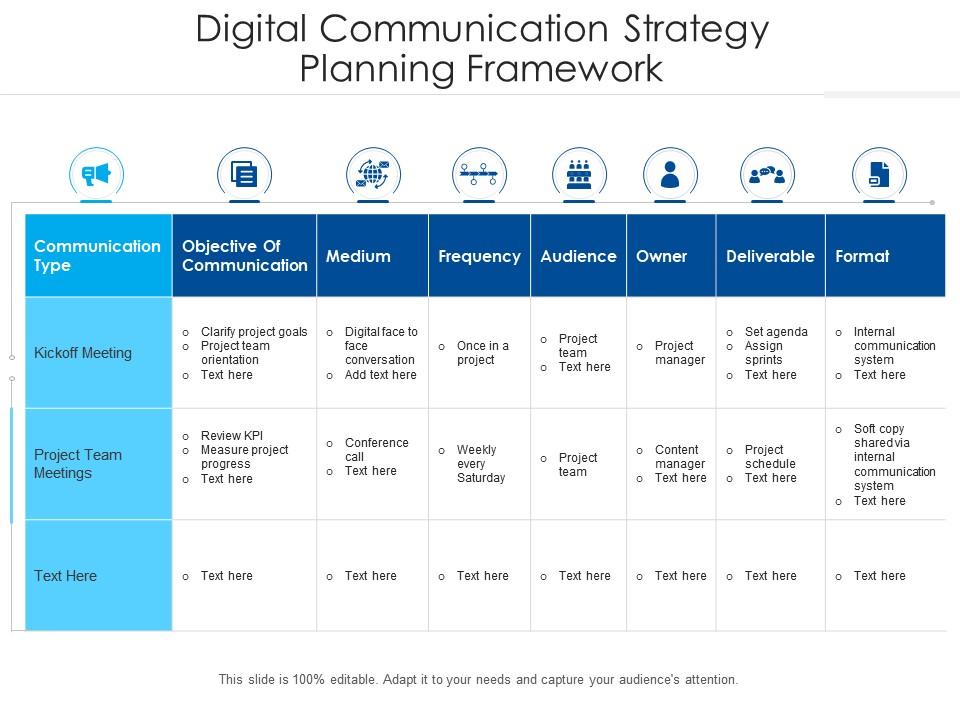
Digital communication strategy planning framework
Try Before you Buy Download Free Sample Product
Audience
Editable
of Time
Our Digital Communication Strategy Planning Framework are topically designed to provide an attractive backdrop to any subject. Use them to look like a presentation pro.
People who downloaded this PowerPoint presentation also viewed the following :
Digital communication strategy planning framework with all 2 slides:
Use our Digital Communication Strategy Planning Framework to effectively help you save your valuable time. They are readymade to fit into any presentation structure.
FAQs for Digital communication
Honestly, just nail down who you're targeting first - that's like half the battle right there. Instagram crowds are totally different from LinkedIn people, so don't waste time posting everywhere. Pick maybe 2-3 platforms max and actually get good at them. Your content needs to help people, not just sell stuff (nobody wants constant ads in their feed). Track your numbers so you know what's actually working. I swear, most people just throw content out there and hope for the best. Set clear goals from the start, keep your messaging consistent, then scale up whatever gets results. Way better than spreading yourself thin across every platform.
Track your open rates, clicks, and social shares first - that stuff shows if people actually care about your content. But don't get obsessed with vanity metrics, honestly they're pretty useless if they're not making you money. What really matters is leads, conversions, and how many customers stick around. Revenue attribution is the big one though. Set up UTM codes and dig into Google Analytics to see which channels actually bring in business. I learned this the hard way - had amazing engagement once but zero sales to show for it.
Look, audience segmentation is honestly the make-or-break thing for digital marketing. You can't just spray the same message everywhere and hope it sticks - that's why most campaigns flop. What works is figuring out 3-5 solid groups based on how people actually behave or what they need. Then you create different messages for each. Like, your Gen Z audience lives on TikTok while your B2B clients are scrolling LinkedIn during lunch breaks. Completely different vibes needed. Start by digging into whatever data you already have - you'll probably spot some obvious patterns pretty quickly. Trust me, it's worth the extra effort upfront.
Here's the thing - people's brains are literally wired for stories, not boring feature lists. You want engagement? Tell them about Sarah who used to work late every night until your software saved her 3 hours daily and she finally made it home for family dinners. That hits different than "40% efficiency boost," you know? Stories stick because we feel something. Always have since we were kids listening to bedtime stories. Try mixing in customer wins, behind-the-scenes stuff, maybe even how you screwed up and bounced back. Works way better than just rattling off benefits.
Honestly, it all comes down to where your people actually hang out. LinkedIn's killer for business stuff, Instagram and TikTok own the younger crowd. Facebook still works decent for 30+ folks, but man their organic reach has tanked hard lately. YouTube's perfect if you're doing longer videos or how-to content. But here's what I'd do - pick maybe 2 or 3 platforms max and actually get good at them. Spreading yourself everywhere just burns you out. Do some digging on where your audience spends time, then test what gets engagement. Way better than being mediocre on six different apps.
Honestly, tech moves so fast it's kinda insane - like TikTok basically destroyed everything we thought we knew about video marketing overnight. You can't just stick with what worked last year anymore. AI tools are changing the game too, and I'm still figuring out half of them tbh. People's attention jumps around constantly now, so you've got to be ready to pivot your messaging and try new channels. What I do is check my current platforms every few months and force myself to test something new each quarter. It's exhausting but necessary.
Ugh, the worst mistake is trying to be on every single platform at once. Your messaging turns into bland nonsense real quick. Been there! Also figure out where your people actually spend time online, not where you *think* they should be. Instagram vs LinkedIn makes a huge difference, you know? Oh and this is clutch - set up your success metrics BEFORE you launch anything. Don't be like me scrambling later trying to prove it worked. Honestly just pick 2-3 channels, get really good at those first, then expand.
Honestly, you just gotta document your brand voice first - like actually write down how you want to sound. Then make templates for each platform because yeah, LinkedIn's gonna be way different than TikTok. The biggest thing though? Get your teams talking to each other. Social media people and email folks work in totally separate bubbles half the time. I'd do like quarterly check-ins where you look at posts across everything and see what's off-brand. Sometimes you don't notice how scattered you sound until you see it all together. Oh, and make sure everyone can actually find those guidelines - don't just stick them in some random shared folder nobody checks.
Dude, visuals are everything. People process images like 60,000 times faster than text - our brains are just wired that way. I found this out when my super text-heavy posts totally bombed last year. Nobody wants to read paragraphs anymore, you know? They'll scroll right past but stop dead for a good image or video. Visuals can boost your engagement by like 650% too, which is insane. They make complex stuff way easier to understand and people actually remember them longer. My rule now? Every single post gets at least one visual element.
Think of feedback data as your reality check - it'll show you what's actually working versus what you think is working. Track your engagement rates, clicks, how people respond across different platforms. Comments can be harsh but honestly they're goldmines for real insights. I spend way too much time reading them but whatever. Look for patterns in your best-performing content and when your audience is most active. The key part though? Actually review this stuff monthly and tweak your messaging based on what you find. Most people just collect data and never look at it again.
Okay so there's basically three big things you gotta watch out for. First - just be upfront about who you are and what you're doing. None of that fake grassroots BS or pretending to be regular people when you're actually a company. Privacy stuff matters too - don't be creepy with people's data. And honestly? Just keep your messaging real. I know it's tempting to manipulate emotions for clicks, but that always backfires eventually. My advice would be to look at your current campaigns and ask yourself if you'd panic if everything went totally public tomorrow. If yes, probably need to rethink some things.
Think of crisis communication as your backup plan when everything hits the fan online. You'll want this sorted way before you need it - trust me, panicking while your mentions explode is not fun. Have templates ready, know who's gonna speak for your brand, and set up alerts so you catch problems early. Same channels you always use, just faster and way more honest than usual. The whole thing should feel like a natural extension of how you normally talk to people, except now you're putting out fires. Oh, and don't wait until something breaks to figure this out.
Dude, analytics are a game changer. I thought I knew what worked for our content, but the data completely proved me wrong - kind of embarrassing honestly! You'll see which posts actually get engagement vs the ones you thought were hits. Plus it shows when your audience is online and which platforms are worth your time. I check ours every Friday now with coffee (maybe overkill but whatever). The budget stuff is huge too - you can stop wasting money on channels that don't convert. Just start tracking your top 3 platforms and you'll be amazed at what you discover.
Honestly, start with a simple hashtag campaign on one platform this month and see what happens. Get your customers posting photos or reviews with your branded hashtag, then reshare the good stuff. UGC contests work really well too - though I always forget how much people actually love seeing themselves featured lol. Don't just randomly grab posts though, that feels weird. You'll want some kind of system for collecting and curating content regularly. Always credit the original creators obviously. The whole thing only works if it feels genuine, not forced. Pick your best user posts and make them part of your regular content mix.
Honestly, AI personalization is huge right now, plus everyone's obsessing over interactive stuff - polls, AR filters, all that. Audio content is blowing up too. Voice messages are everywhere (probably 'cause we're sick of typing lol). There's also this shift toward smaller, private communities instead of giant public feeds. People want real behind-the-scenes content now, not the super polished marketing stuff. I'd pick one interactive thing to try this quarter and see what happens. Your audience will basically tell you what's working - then you can double down on whatever sticks.
-
Designs have enough space to add content.
-
Best way of representation of the topic.
-
Appreciate the research and its presentable format.
-
Great experience, I would definitely use your services further.
-
Excellent work done on template design and graphics.