Developing Corporate Communication Corporate Communication Strategy Framework
Try Before you Buy Download Free Sample Product
Audience
Editable
of Time
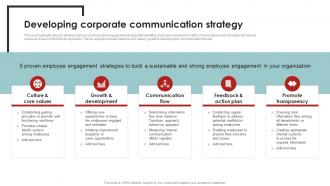
This slide highlights steps to develop internal communication engagement strategy that identifies corporate objectives for staff communications and schedules the actions necessary to accomplish those objectives. The key aspects include culture and core values, growth and development, communication flow etc
People who downloaded this PowerPoint presentation also viewed the following :
Developing Corporate Communication Corporate Communication Strategy Framework with all 9 slides:
Use our Developing Corporate Communication Corporate Communication Strategy Framework to effectively help you save your valuable time. They are readymade to fit into any presentation structure.
FAQs for Developing Corporate Communication Corporate
Effective corporate communication strategies include clear messaging frameworks, stakeholder mapping, multi-channel distribution plans, crisis communication protocols, and performance measurement systems. These elements work together by ensuring consistent brand voice, targeted audience engagement, and transparent information flow, with many organizations finding that strategic alignment across internal and external communications ultimately delivers enhanced reputation management and stronger stakeholder relationships.
Companies can assess their communication practices through employee surveys, communication audits, stakeholder feedback sessions, message consistency reviews, and channel effectiveness analysis. These evaluation methods enable organizations to identify gaps in information flow, measure engagement levels, and pinpoint bottlenecks, with many finding that systematic assessments reveal opportunities to streamline processes and enhance overall organizational transparency.
Stakeholder analysis identifies key audiences, assesses their interests, influence levels, and communication preferences, enabling organizations to prioritize messaging and select appropriate channels. This strategic mapping helps companies tailor content for investors, employees, customers, and regulators, ultimately delivering more targeted communications, stronger relationships, and enhanced organizational reputation across diverse stakeholder groups.
Internal communication enhances employee engagement and productivity by establishing clear channels for feedback, recognition, and strategic updates, creating transparency around company goals and individual contributions. Through regular town halls, digital collaboration platforms, and structured feedback loops, organizations streamline information flow, minimize confusion, and foster accountability, ultimately delivering higher retention rates and improved performance metrics.
Crisis communication best practices include establishing clear communication protocols, designating spokesperson roles, maintaining transparent messaging, monitoring media channels, and engaging stakeholders proactively. These strategies streamline response efforts by ensuring consistent information flow, minimizing misinformation spread, and preserving stakeholder trust, with many organizations finding that prepared crisis frameworks ultimately deliver faster resolution times and stronger reputation recovery.
Digital tools and social media integrate into corporate communication strategies through internal collaboration platforms, customer engagement channels, real-time feedback systems, and brand storytelling mediums. These technologies streamline communication by enabling instant messaging, automated responses, and targeted content distribution, with many organizations finding that strategic social media integration enhances transparency, accelerates decision-making, and ultimately delivers stronger stakeholder relationships and competitive market positioning.
Key metrics include employee engagement scores, message reach and frequency, stakeholder sentiment analysis, media coverage quality, internal survey feedback, and communication channel effectiveness. These measurements enable organizations to assess audience comprehension, brand perception shifts, and behavioral changes across departments, with many companies finding that combining quantitative data with qualitative insights delivers comprehensive visibility into communication impact and strategic alignment.
A compelling corporate brand story aligns organizational values with stakeholder aspirations, weaving authentic narratives that showcase mission, culture, and impact through consistent messaging across all touchpoints. By emphasizing shared purposes and tangible outcomes, companies create emotional connections that enhance employee engagement, customer loyalty, and market positioning, ultimately delivering stronger brand equity and competitive advantage.
Companies can ensure consistent corporate messaging through centralized brand guidelines, standardized templates, unified content calendars, cross-functional communication teams, and regular training programs. These strategies streamline messaging by establishing clear voice parameters, coordinating campaign timing, and empowering teams with consistent tools, with many organizations finding that integrated approaches ultimately deliver stronger brand recognition and enhanced customer trust across all touchpoints.
Corporate communication significantly shapes organizational culture by establishing shared values, expectations, and behavioral norms through consistent messaging, transparent leadership updates, and clear policy communication. Effective communication strategies enhance employee morale by fostering trust, reducing uncertainty, and creating alignment around company goals, with many organizations finding that open, regular communication channels ultimately deliver higher engagement, improved retention, and stronger workplace cohesion.
Feedback mechanisms can be incorporated through regular employee surveys, anonymous suggestion systems, focus groups, digital collaboration platforms, and structured review cycles with leadership teams. These approaches enable organizations to identify communication gaps, measure message effectiveness, and adapt strategies based on real-time insights, ultimately fostering a culture of continuous improvement and enhanced employee engagement across departments.
Implementing corporate communication strategy globally presents challenges including cultural differences, language barriers, time zone coordination, regulatory compliance variations, and maintaining consistent messaging across diverse markets. While these complexities require careful navigation, organizations increasingly find that strategic localization, technology-enabled coordination, and culturally-aware messaging frameworks ultimately deliver enhanced stakeholder engagement and competitive advantage in international markets.
Visual communication enhances corporate messaging by simplifying complex information, increasing retention rates, and creating emotional connections with audiences through infographics, presentations, and branded graphics. These visual elements streamline communication across diverse stakeholder groups, with many organizations finding that strategic visual integration delivers faster comprehension, stronger brand recognition, and ultimately more impactful business outcomes.
Leadership plays a pivotal role in corporate communication strategy by setting the vision, tone, and messaging priorities while ensuring alignment across all organizational levels. Through strategic direction, resource allocation, and personal modeling of communication standards, leaders enable consistent messaging, foster stakeholder trust, and drive employee engagement, ultimately delivering enhanced brand credibility and competitive advantage in today's complex business environment.
A corporate communication strategy aligns with business goals through consistent messaging that reflects company values, strategic objectives, and stakeholder expectations across all channels. This alignment enables organizations to streamline brand positioning, enhance employee engagement, and strengthen customer relationships, with many companies finding that integrated communication approaches ultimately deliver greater market credibility and competitive advantage.
-
If you are looking for satisfactory PowerPoint services, SlideTeam is your go-to place. I am fully contented with their research and development team.
-
Happy to found you SlideTeam. You guys are value for money. Amazing slides.