


Corporate Communication Strategy Powerpoint Presentation Slides Strategy CD





Try Before you Buy Download Free Sample Product
 Impress Your
 Audience
 100%
100% Editable
 Save Hours
 of Time


A Corporate Communication Strategy can help understand your company and enhance its reputation with people whose attitudes and actions influence your success the most. Grab our Communication Strategy template. It is a well-crafted deck for organizations to communicate effectively with their stakeholders. Our Stakeholder communication PPT covers techniques for public relations, stakeholder communication, internal communication, etc. It stresses public relations, which plays a crucial role in building and maintaining a positive image for the organization in the eyes of the public. Stakeholder communication ensures the organizations effective communication with its investors, customers, suppliers, and other stakeholders. Internal communication facilitates smooth organizational communication among employees, departments, and management. Crisis communication is vital to any corporate communication strategy to manage and mitigate any negative impact on the organization during a crisis. A well-designed social media communication framework can enhance the organizations reach and engagement with its target audience. Event communication can create awareness about the organizations products, services, and initiatives. Lastly, our event communication module exhibits essential elements to enhance the organizations reputation, build stakeholder trust, and drive business success. Get access right away.
People who downloaded this PowerPoint presentation also viewed the following :
Content of this Powerpoint Presentation
Slide 1: This slide introduces Corporate Communication Strategy. Commence by stating Your Company Name.
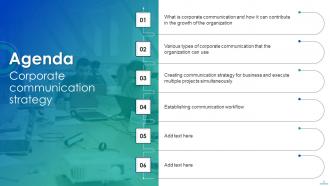
Slide 2: This slide depicts the Agenda of the presentation.
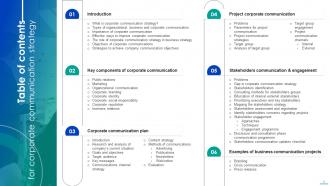
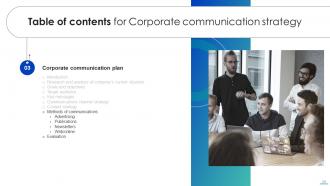
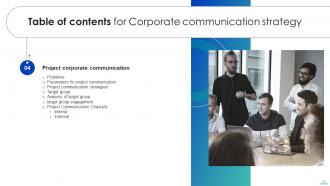
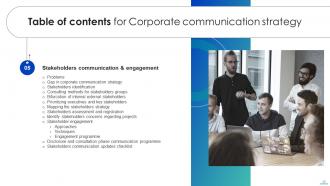
Slide 3: This slide incorporates the Table of contents.
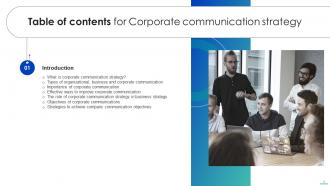
Slide 4: This slide highlights the Title for the Topics to be covered further.
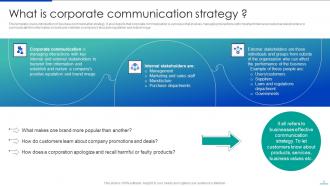
Slide 5: This template covers introduction of business communication strategy.
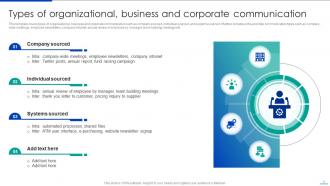
Slide 6: This slide states the types of organizational, business and corporate communication.
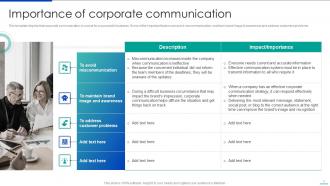
Slide 7: This slide depicts that corporate communication is crucial for a successful business.
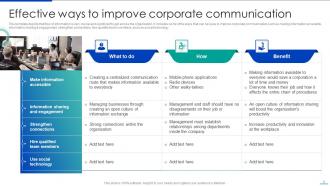
Slide 8: This template depicts the Effective ways to improve corporate communication.
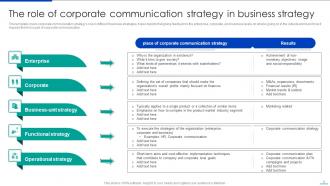
Slide 9: This slide exhibits the role of corporate communication strategy in business strategy.
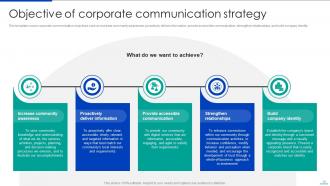
Slide 10: This slide displays the Objective of corporate communication strategy.
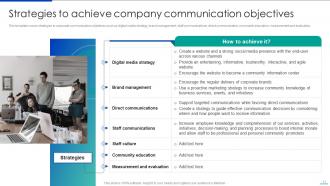
Slide 11: This slide showcases the Strategies to achieve company communication objectives.
Slide 12: This slide mentions the Heading for the Contents to be discussed next.
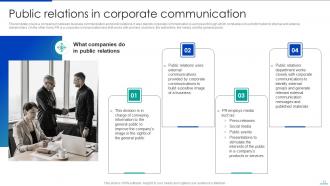
Slide 13: This template covers a comparison between business communication and public relations.
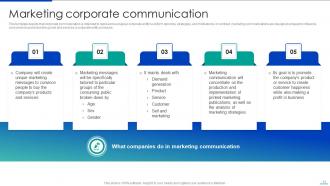
Slide 14: This slide illustrates the Marketing corporate communication.
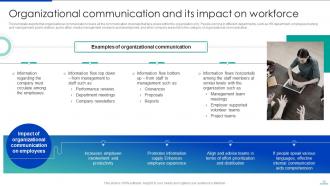
Slide 15: This slide portrays the Organizational communication and its impact on workforce.
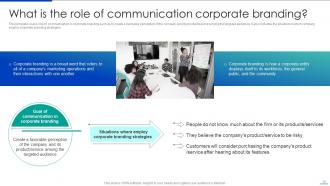
Slide 16: This template incorporates the role of communication in corporate branding.
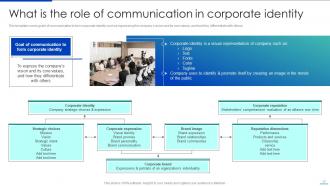
Slide 17: This slide states the goals of communication to form corporate identity.
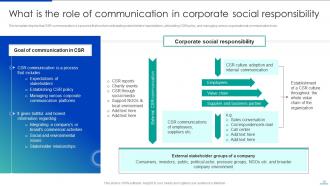
Slide 18: This slide depicts the role of communication in corporate social responsibility.
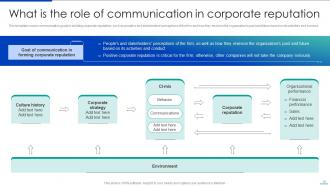
Slide 19: This template highlights the communication goals in building corporate reputation.
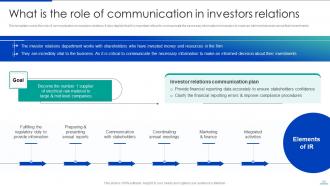
Slide 20: This template exhibits the role of communication in investors relations.
Slide 21: This slide showcases the Title for the Ideas to be discussed next.
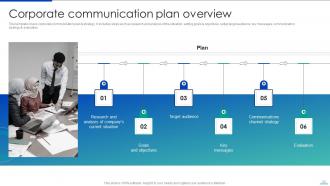
Slide 22: This slide presents the Corporate communication plan overview.
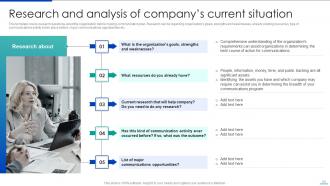
Slide 23: This slide shows the Research and analysis of company’s current situation.
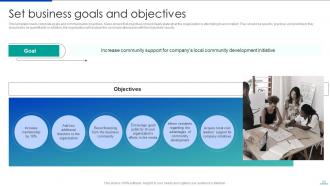
Slide 24: This template covers corporate goals and communication objectives.
Slide 25: This slide talks about Determining your target audiences.
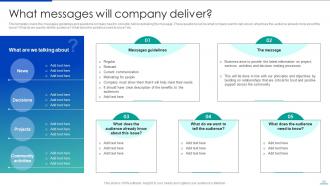
Slide 26: This template showcases the messages guidelines and questions company need to consider before delivering the message.
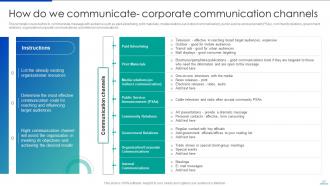
Slide 27: This template incorporates the tactics to communicate message with audience such as paid advertising, print materials, etc.
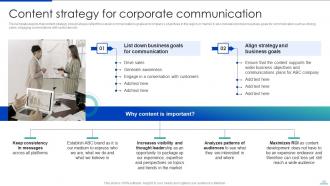
Slide 28: This slide displays the Content strategy for corporate communication.
Slide 29: This slide reveals the Heading for the Ideas to be covered next.
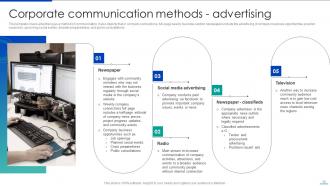
Slide 30: This template contains advertising as a method of communication.
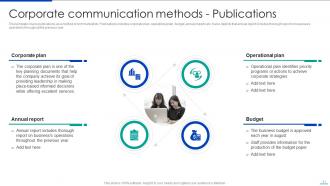
Slide 31: This slide elucidates publications as a method of communication.
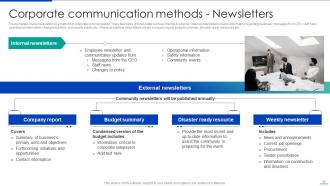
Slide 32: This template presents newsletter as a method of corporate communication.
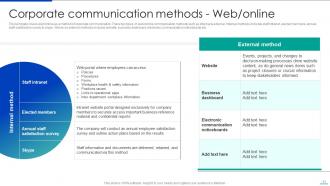
Slide 33: This template exhibits web/online as a method of corporate communication. T
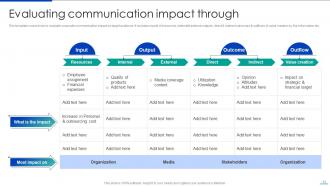
Slide 34: This slide deals with Evaluating communication impact.
Slide 35: This slide mentions the Title for the Components to be discussed next.
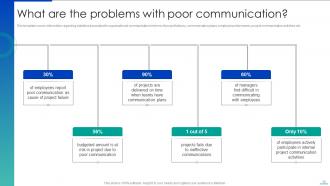
Slide 36: This template covers information regarding statistics associated to organizational communication in terms of project failures, communication plans, employee performance, etc.
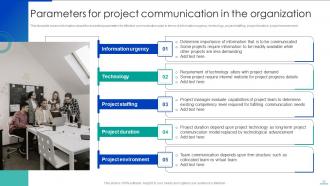
Slide 37: This slide lists the Parameters for project communication in the organization.
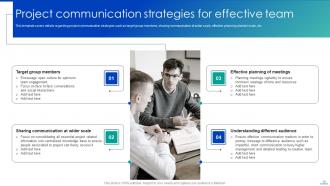
Slide 38: This slide focuses on Project communication strategies for effective team.
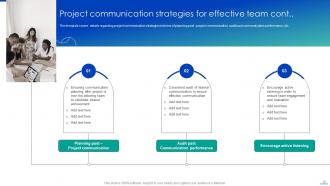
Slide 39: This slide continues the Project communication strategies for effective team.
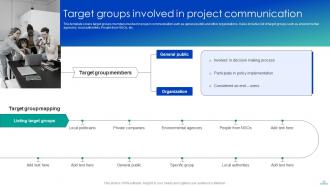
Slide 40: This template focuses on target groups members involved in project communication.
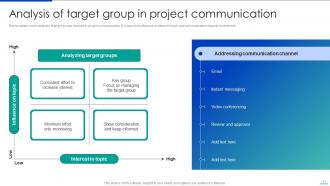
Slide 41: This slide exhibits the Analysis of target group in project communication.
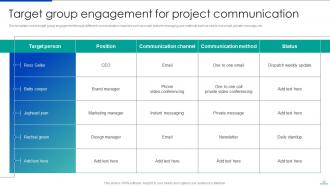
Slide 42: This slide incorporates the Target group engagement for project communication.
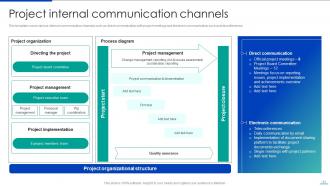
Slide 43: This slide deals with Project internal communication channels.
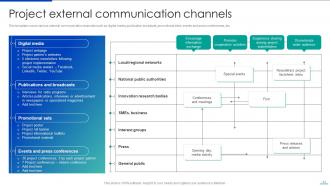
Slide 44: This slide talks about the Project external communication channels.
Slide 45: This slide presents the Heading for the Topics to be covered in the following template.
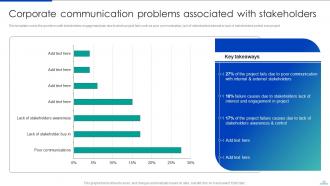
Slide 46: This template showcases the problems with stakeholders engagement plan due to which project fails.
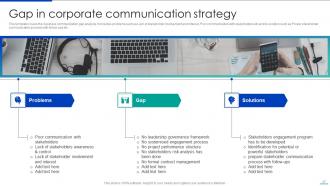
Slide 47: This slide template elucidates the Gap in corporate communication strategy.
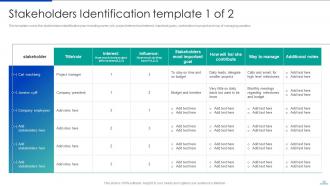
Slide 48: This template covers the stakeholders identification plan including name, role, project interest and interest, etc.
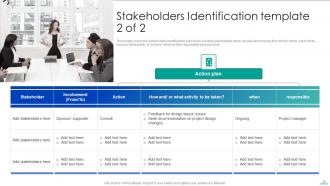
Slide 49: This temple covers the stakeholders identification action plan including stakeholders name, involvement covering from who to whom, action taken, etc.
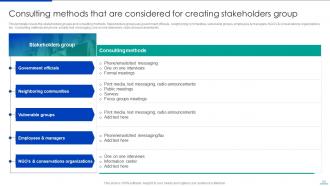
Slide 50: This slide focuses on the Consulting methods that are considered for creating stakeholders group.
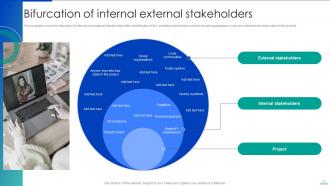
Slide 51: This slide reveals the Bifurcation of internal external stakeholders.
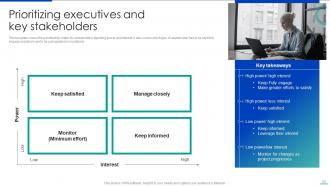
Slide 52: This template incorporates the prioritization matrix for stakeholders depicting power and interest.
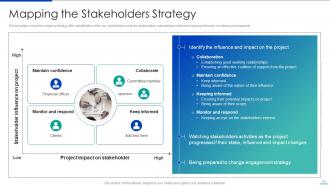
Slide 53: This slide talks about Mapping the Stakeholders Strategy.
Slide 54: This slide exhibits Stakeholders assessment and registration.
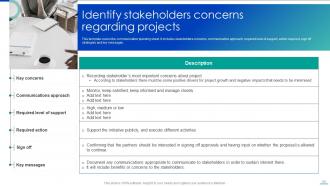
Slide 55: This template covers the communication planning sheet.
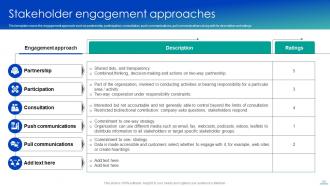
Slide 56: This template showcases the engagement approach such as partnership, participation, etc.
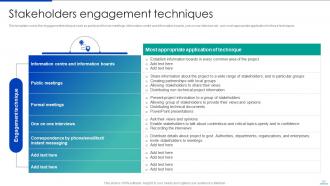
Slide 57: This slide deals with Stakeholders engagement techniques.
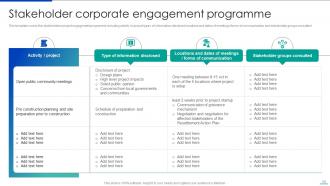
Slide 58: This slide represents the Stakeholder corporate engagement programme.
Slide 59: This slide provides information about the Disclosure and consultation phase communication programme.
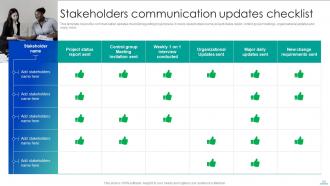
Slide 60: This slide elucidates the Stakeholders communication updates checklist.
Slide 61: This slide presents the Title for the Topics to be discussed further.
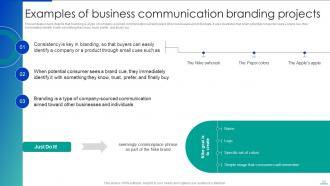
Slide 62: This slide portrays the Examples of business communication branding projects.
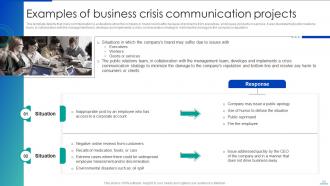
Slide 63: This slide depicts the Examples of business crisis communication projects.
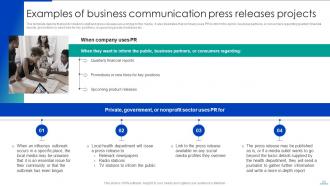
Slide 64: This slide reveals the Examples of business communication press releases projects.
Slide 65: This is the Icons slide containing all the Icons used in the plan.
Slide 66: This slide elucidates Additional information.
Slide 67: This slide is used for showcasing the organization's Vision & Mission.
Slide 68: This is the 30 60 90 Days Plan sldie for efficient planning.
Slide 69: This slide contains the Post it Notes for reminders and deadlines.
Slide 70: This is the Venn diagram slide.
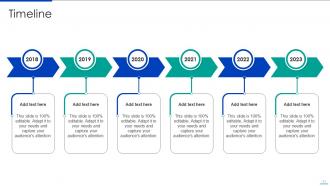
Slide 71: This slide reveals the Company Timeline.
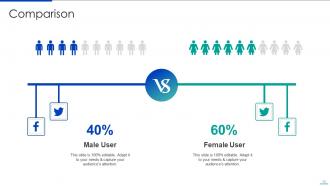
Slide 72: This slide is used for the purpose of Comparison.
Slide 73: This slide represents the Roadmap of the firm.
Slide 74: This is the Thank you slide for acknowledgement.
Corporate Communication Strategy Powerpoint Presentation Slides Strategy CD with all 79 slides:
Use our Corporate Communication Strategy Powerpoint Presentation Slides Strategy CD to effectively help you save your valuable time. They are readymade to fit into any presentation structure.













FAQs for Corporate Communication Strategy Powerpoint Presentation
You'll need five main things: messaging that actually matches what your company stands for, knowing exactly who you're talking to (inside and outside the company), picking the right channels to reach people, keeping your brand voice consistent everywhere, and - this is where most places screw up - setting goals you can actually measure. Oh, and don't forget crisis protocols because something will go wrong eventually. Regular feedback helps too. I'd start by looking at what you're doing now, then figure out the biggest gaps. Most companies get the messaging part right but completely ignore whether any of it's working.
Honestly, audience analysis is everything when it comes to communication strategy. It decides your messages, how you frame stuff, and what channels you pick. You can't just send the same boring corporate jargon to employees, customers, and investors - trust me, I've seen that backfire spectacularly. Once you get their pain points and what actually motivates them, your messages will hit different instead of landing in the trash. Oh, and map out your stakeholder groups first. Different people need different approaches, and it'll save you from those cringe moments when everyone's like "what were they thinking?"
Honestly, internal communication is what makes or breaks your company culture. It's how people actually connect with your values and feel part of something bigger. Be transparent about decisions, celebrate wins as a team, create real spaces for feedback - that's how you build the culture you want. I've watched companies totally flip their whole vibe just by talking to employees better. Makes people feel valued instead of like they're on the outside looking in. Oh, and definitely check what communication channels you're using now - are they actually bringing people together or just dumping information on them?
First, figure out where your people actually hang out online - no point posting to Instagram if everyone's on LinkedIn. Each platform has its own personality, so don't just copy-paste the same content everywhere. LinkedIn's great for thought leadership stuff, Twitter works for quick updates, Instagram's perfect for showing company culture. But here's the thing - actually respond when people comment or mention you. I see so many companies just shouting into the void. Think of it as having conversations, not giving speeches. Oh, and definitely make content calendars for each platform that tie back to your bigger communication strategy.
Track the obvious stuff first - website traffic, social engagement, media mentions, employee satisfaction scores. But honestly, the sentiment behind those numbers matters way more than most people realize. Are people actually talking positively about you? Did your key messages land or just create noise? Also check if communications are driving real behaviors - more sales leads, better retention rates, whatever your goal is. Oh and set up some kind of monthly check-in system. Doesn't have to be fancy, just something so you can course-correct when things aren't hitting right. The qualitative feedback often tells the real story.
Honestly, just be real with people from day one. Don't sugarcoat stuff or wait until someone corners you with tough questions. Bad news? Share it. Screwed something up? Own it fast. I swear, companies that try to spin everything just dig themselves deeper holes. Make it a regular thing too - like actual town halls where people can ask whatever. Skip the corporate BS language (nobody talks like that anyway). Follow through on what you say you'll do. It's wild how many leaders think transparency is only for crisis mode when really it should just be... normal?
Honestly, don't wait until shit hits the fan to think about crisis communication. Figure out what could go wrong in your industry first, then prep response templates for different scenarios. Train your spokespeople regularly - and I mean actually practice, not just send them a PDF. Set up clear decision-making chains so you're not playing telephone when everything's on fire. Most companies think "oh that'll never happen to us" until... it does. Get monitoring systems running to catch problems early. Speed matters huge here, so practice your whole response process every few months. That way when something actually happens, you'll react on autopilot instead of panicking.
First thing - make your brand values actually mean something. Like if you say "innovation," spell out what that looks like day-to-day. Then build your messaging around those specifics so your team has a real filter for decisions. Map your content calendar to those values and get everyone asking "does this sound like us?" before posting anything. Honestly, this part takes some getting used to but saves tons of headaches later. Oh, and do quarterly check-ins on your recent stuff to catch when you're going off-brand. The whole point is making it feel natural, not like you're following some rigid script.
Honestly, stories are where it's at for corporate messaging. Facts and bullet points? Nobody remembers that stuff. But tell them about how Sarah's team crushed their project using the new process, or share what happened when your company values were actually tested during that crazy deadline last month - now you've got their attention. Stories stick in people's heads way better, plus employees will actually retell them naturally. I'd pick 2-3 solid company stories that showcase your main points. Then just work them into your communications regularly. It's way more engaging than another boring policy memo.
Honestly, visuals are everything for corporate stuff. People absorb images 60,000x faster than text - wild, right? Your colors and graphics literally create first impressions before anyone even starts reading. I've watched companies flip their whole engagement game just by keeping their visual brand consistent. Complex info becomes so much easier to digest when your visuals actually match what you're saying. Oh, and definitely audit what you have now - are your images supporting your message or just taking up space? Most companies don't realize how much their random stock photos are hurting them.
Dude, translation is just the start - you've gotta adapt your whole vibe to each region. Tokyo audiences might hate what crushes it in Silicon Valley, seriously. Some cultures want you to be super direct, others prefer the relationship-building route first. Even your colors and meeting styles matter! Oh and don't mess up the platforms - WeChat for China, WhatsApp for Latin America. Time zones are obvious but people forget anyway. I'd honestly just pick 2-3 markets max and really figure out how they actually communicate before you try expanding everywhere. Research their style first or you'll waste a ton of effort.
Honestly, it depends on your team size but Slack is a game-changer for daily chat. We use Teams at my job and it works just as well. You'll need something like SharePoint for company-wide announcements too. Zoom's obvious for meetings, though Teams does that if you're already paying for it. Project management stuff like Asana keeps everyone on track - trust me, you need this or things get messy fast. Oh and Mailchimp's solid for emailing external people. My advice? Pick one tool per thing first, then add more later. Too many platforms just confuse everyone.
Honestly, feedback loops are like a sanity check for your communication. Set up surveys or focus groups to see if people actually get what you're saying. We've all sat through meetings where the boss thinks they're being super clear but everyone's totally lost, right? Try quarterly surveys, maybe some open office hours, or those anonymous suggestion boxes. Short pulse checks work too. This stuff helps you fix your messaging before things get messy. Oh, and don't go overboard initially - pick one simple feedback method first, then add more later. You'll catch problems way earlier this way.
Honestly, the biggest pain points are gonna be budget limits and getting everyone on board - especially if leadership isn't backing you 100%. Keeping your messaging consistent across teams is a nightmare too. Market changes will force you to pivot while somehow staying on brand, which... good luck with that. Oh, and people absolutely hate changing how they've always done communication. Internal pushback is real. Start with small pilot programs though. Get some quick wins to show it actually works, then use those results to build momentum. Track everything from the start so you can prove ROI when people start questioning the investment.
Honestly, start with a decent style guide and figure out your approval process first. Templates are a lifesaver - your team won't have to reinvent the wheel constantly. Get someone to own each channel who actually communicates with the others (wild idea, right?). I'd map out where your messaging is inconsistent right now. You'll probably find way more gaps than you think. Content audits help too, but don't make them a huge ordeal. The trick is having one core message that you tweak for each platform - same substance, different vibe. Works way better than starting fresh everywhere.
-
Innovative and attractive designs.
-
Unique design & color.