

Project Communication Strategy Overview Determine Stakeholder Communication Plan




Try Before you Buy Download Free Sample Product
 Impress Your
 Audience
 100%
100% Editable
 Save Hours
 of Time


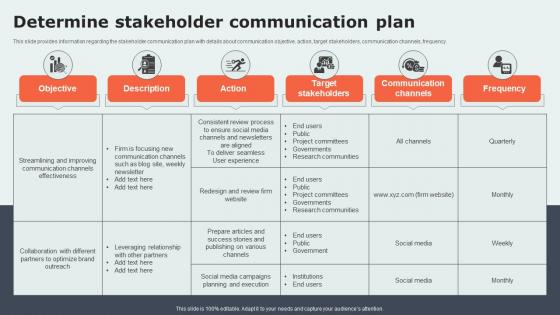
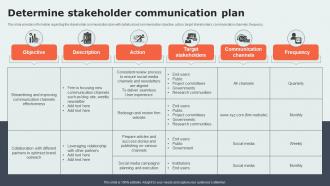
This slide provides information regarding the stakeholder communication plan with details about communication objective, action, target stakeholders, communication channels, frequency.
People who downloaded this PowerPoint presentation also viewed the following :
Project Communication Strategy Overview Determine Stakeholder Communication Plan with all 6 slides:
Use our Project Communication Strategy Overview Determine Stakeholder Communication Plan to effectively help you save your valuable time. They are readymade to fit into any presentation structure.





FAQs for Project Communication Strategy Overview Determine
Key components of an effective project communication strategy include stakeholder identification, communication channels, frequency protocols, message formats, and feedback mechanisms. These elements work together by ensuring relevant information reaches appropriate audiences through optimal channels, establishing clear reporting structures, and creating transparent feedback loops, ultimately delivering improved project coordination and stakeholder alignment across all organizational levels.
Project communication strategies can be tailored by identifying each stakeholder's information requirements, preferred communication channels, decision-making authority, and project involvement level. Organizations achieve this through stakeholder mapping, customized reporting formats, and varied communication frequencies, with executives receiving high-level dashboards while technical teams get detailed progress reports, ultimately ensuring relevant information reaches the right audiences efficiently.
Communication tools include project management platforms like Asana and Trello, video conferencing software, instant messaging apps, collaborative document systems, and real-time dashboard technologies. These solutions streamline coordination by centralizing information, enabling instant feedback, and providing transparent progress tracking, with many organizations finding that integrated communication ecosystems significantly reduce project delays while enhancing team productivity.
Success measurement includes tracking stakeholder engagement rates, message comprehension levels, feedback response times, meeting attendance, and communication channel effectiveness through surveys and analytics. These metrics enable project managers to identify communication gaps, optimize information flow, and enhance team collaboration, with many organizations finding that regular assessment leads to improved project outcomes, reduced misunderstandings, and ultimately stronger stakeholder alignment throughout the project lifecycle.
Feedback serves as a critical mechanism for identifying communication gaps, measuring message effectiveness, and adapting delivery methods to stakeholder preferences and project evolution. Through regular feedback loops, project managers can streamline information flow, enhance stakeholder engagement, and optimize resource allocation, with many organizations finding that responsive communication strategies ultimately deliver improved project outcomes and stronger stakeholder relationships.
Cultural differences significantly impact project communication through varying communication styles, decision-making processes, hierarchy expectations, time perceptions, and conflict resolution approaches. These variations can create misunderstandings in multinational teams, with organizations increasingly finding that culturally-aware communication strategies, standardized protocols, and cross-cultural training ultimately enhance collaboration and deliver more successful project outcomes.
Common challenges include stakeholder resistance to new communication protocols, information overload from multiple channels, inconsistent messaging across teams, time zone coordination difficulties, and technology adoption barriers. These obstacles can significantly impact project timelines and team alignment, with many organizations finding that proactive training, streamlined communication tools, and clear escalation processes help minimize disruptions while enhancing overall project transparency and stakeholder engagement.
Visual aids improve project communication by transforming complex data into digestible formats, enhancing audience engagement, and reducing misinterpretation of critical information. Through infographics, charts, and interactive dashboards, project managers streamline stakeholder understanding, accelerate decision-making processes, and ensure alignment across diverse teams, ultimately delivering clearer project outcomes and stronger stakeholder buy-in.
During project crisis communication, strategies include establishing emergency communication protocols, creating dedicated crisis response teams, implementing real-time status dashboards, conducting frequent stakeholder briefings, and maintaining transparent escalation channels. These approaches enable organizations to coordinate responses effectively while ensuring all team members and stakeholders receive timely, accurate updates, ultimately minimizing confusion and accelerating crisis resolution across departments.
Project update frequency depends on project complexity, stakeholder preferences, and milestone criticality, typically ranging from weekly status reports for active phases to bi-weekly or monthly updates for stable periods. Many organizations find that regular, predictable communication schedules enhance transparency and stakeholder engagement, while milestone-based updates ensure critical decisions receive timely attention, ultimately delivering better project outcomes.
Methods to ensure transparency in project communications include regular status reports, open stakeholder dashboards, structured meeting protocols, clear documentation standards, and accessible feedback channels. These approaches streamline information flow by establishing consistent updates, centralizing project visibility, and enabling real-time progress tracking, with many organizations finding that transparent communication ultimately delivers improved stakeholder trust and faster project resolution.
Effective project change communication requires structured protocols including immediate stakeholder notifications, detailed impact assessments, revised timeline distributions, and clear approval processes. Through centralized communication platforms and regular update meetings, project managers ensure transparency across teams, departments, and executive leadership, while maintaining stakeholder buy-in and minimizing disruption to ongoing deliverables.
A communication plan in the initial project phase establishes clear channels, defines stakeholder roles, sets expectations for information flow, and creates structured feedback mechanisms. This strategic foundation streamlines decision-making, minimizes misunderstandings, and accelerates project momentum, with many organizations finding that early communication planning reduces delays by up to 30% and enhances overall project success rates.
Project managers ensure communication strategy evolution by conducting regular stakeholder assessments, adjusting communication frequency and channels based on project phases, and incorporating feedback from team members and stakeholders. Through continuous monitoring and flexible adaptation, organizations streamline information flow, enhance team collaboration, and maintain stakeholder engagement, with many finding that iterative strategy refinement ultimately delivers improved project outcomes and stronger stakeholder relationships.
**INPUT**: What are the best practices for remote project communication in distributed teams? **OUTPUT**: Best practices for remote project communication include establishing clear communication protocols, utilizing collaborative platforms like Slack or Microsoft Teams, scheduling regular video check-ins, and maintaining shared documentation repositories. These approaches streamline coordination by ensuring transparency, minimizing information silos, and enabling real-time collaboration across time zones, with many distributed organizations finding that structured communication frameworks ultimately deliver improved project visibility and faster decision-making processes. **Word Count**: 60 words
-
Excellent work done on template design and graphics.
-
Wonderful ideas and visuals. I'm really pleased with the templates, which are unique and up to date.