


Communication plan strategic timeline powerpoint slide ideas





Try Before you Buy Download Free Sample Product
 Impress Your
 Audience
 100%
100% Editable
 Save Hours
 of Time


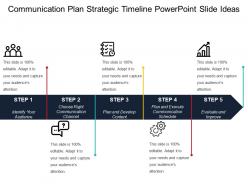
Download our communication plan strategic timeline PowerPoint slide ideas. This presentation graphic assists you to effectively communicate your strategic plan to your employees. The objective of a strategic communication plan is to incorporate all the businesses programs, public education and advocacy efforts. This PPT template can be used to communicate marketing strategy adopted by a business or marketer to reach the target prospect through several types of communication. Besides this, you can also use this presentation layout to make your teammates understand the concept of building a corporate communication strategy step by step. Today corporate communication is a big part of work culture as you are required to share information about the business with your internal clients which are your employees as well as with your external clients who are investing in your business. This five step PowerPoint visual gives you an opportunity to come up with effective strategic planning communication and then communicate it effectively. You can use the design to build a better understanding of your business and enhance your reputation with people. Find the best cues in our Communication Plan Strategic Timeline Powerpoint Slide Ideas. Give yourself the exact hint you desire.
People who downloaded this PowerPoint presentation also viewed the following :
Communication plan strategic timeline powerpoint slide ideas with all 5 slides:
Finish faster than ever expected with our Communication Plan Strategic Timeline Powerpoint Slide Ideas. You will beat all the deadlines.


FAQs for Communication plan strategic timeline
So first thing - grab a whiteboard or something and map out your key milestones visually. Way easier than jumping straight into a spreadsheet. Figure out who you're talking to at each phase, what messages you're sending, and through which channels. Deadlines are obviously crucial, but honestly? The "who does what" part is where most teams crash and burn. Build in some feedback checkpoints so you can pivot if needed. Oh, and think about dependencies - like if message A has to go out before message B makes any sense. Always pad your timeline with buffer days for revisions because something always takes longer than expected.
Honestly, it's just about avoiding those "oh crap, who was supposed to tell them?" disasters. Think of it like a schedule for when you need to loop people in - when updates go out, when your boss expects reports, all that stuff. Really saves your butt when things get hectic. You can catch communication problems early instead of scrambling later. What I'd do is figure out your must-communicate moments first, then pad some extra time around the big ones because something always goes sideways. It's basically your cheat sheet for keeping everyone informed without losing your mind.
Depends on your budget really. Asana and Monday.com are pretty solid for visual timelines - they've got good collaboration stuff built in. Microsoft Project is overkill unless you're dealing with crazy complex dependencies. Honestly though? Sometimes a good Google Sheets setup works just as well for simpler stuff. There's also GanttPRO and TeamGantt if you want something made specifically for timelines. My advice would be to stick with whatever your team's already using for projects. Best tool is the one people will actually keep updated, you know?
Honestly? Check it monthly at minimum, but it really depends on your project's pace. Weekly reviews work better for fast-moving stuff. I've watched teams cling to timelines that made zero sense anymore - like, the whole project shifted but they're still following the original schedule lol. Build in regular check-ins from the start rather than just hoping it'll stay relevant. When you miss deadlines or get pushback from stakeholders, that's your cue to update things. Set a recurring reminder to ask yourself: does this timeline still make sense? Then tweak it. Don't be precious about changing it.
So there's basically four phases you want to hit. Planning comes first - figure out your key messages and who you're talking to. Launch phase is next (honestly this part always feels like controlled chaos). Then implementation where you're actually sending stuff out and watching how people react. Oh, and don't forget evaluation at the end to see what bombed and what worked. I'd definitely pad each phase with extra time because nothing ever goes as fast as you think it will. Map everything to your project milestones first though - makes the whole thing way easier.
Don't just dump a timeline on people - get them involved in building it from the start. I made that mistake once and wow, the pushback was brutal! Have them weigh in on milestones and deadlines upfront. Walk through why certain tasks need to happen in order so they get the dependencies. Build in buffer time and be honest about what could go sideways. Show how everything ties back to what they actually care about achieving. Oh, and definitely nail down who's doing what before everyone leaves the room - otherwise you'll be chasing people down later asking "wait, didn't you say you'd handle this?"
Ugh, the timing thing will get you every single time - I swear everything takes way longer than expected. Don't dump all your comms into those final weeks either, it's pure chaos. Stakeholders will definitely want "one more tiny edit" so pad time for approvals. Oh, and holidays! I always forget about blackout periods or when the CEO decides to announce layoffs the same week (fun times). Honestly? Take whatever timeline seems reasonable, then tack on 25% extra to each part. Sounds excessive but you'll be so grateful when stuff inevitably gets pushed.
Honestly, visual timelines are game-changers. Your brain just gets it instantly when you can actually see how everything connects – overlapping tasks, who's waiting on what, all those deadlines. Way better than scrolling through endless text docs trying to figure out what's happening when. I swear stakeholders suddenly become so much more helpful when they can see exactly where their part fits in. And when stuff changes (which it always does), you're not rewriting a whole document – just drag things around. Even something basic like a Gantt chart works, or hell, just use sticky notes on the wall if that's your vibe.
Look, feedback is basically your canary in the coal mine for timeline problems. When stakeholders start saying they're confused or need more time to digest stuff, that's your cue something's off. I always set up checkpoints at major milestones - kinda like having pit stops where you can actually catch issues before they blow up your whole schedule. If the messaging isn't clicking or people want more context, you'll need extra time for revisions. Honestly, I learned this the hard way on a project last year. Always pad your timeline with 15-20% buffer just for feedback adjustments.
Oh man, this is so true from experience. Different cultures approach timelines completely differently - some places want tons of relationship-building first, others dive straight into business. I learned this the hard way in Japan once. Meeting styles vary wildly too, plus you've got different holidays and decision-making processes to think about. What New Yorkers see as urgent can feel super pushy elsewhere. Religious stuff matters, local customs, whether people communicate directly or not. Honestly? Build in extra buffer time and definitely get local team members to sanity-check your timeline before you commit.
Look, timing your comms with company goals is honestly huge. Map out what you're saying against quarterly priorities - the gaps become super obvious right away. Your messages actually land when they matter most. Like announcing that product launch exactly when sales needs the boost, you know? Culture changes hit different when leadership's already pushing similar stuff. I mean, nobody wants that weird "uh why are we discussing this now" moment in meetings. People buy in way more because it feels intentional instead of just random corporate noise. Total game-changer for getting everyone moving together.
Build your metrics right into the timeline from day one. Pick specific checkpoints - email open rates after week 1, engagement at halfway, stakeholder surveys at the end. Honestly I mess this up all the time and forget until it's way too late. Your metrics need to match what you're actually trying to do - awareness, understanding, behavior change, whatever. Grab baseline data before launching so you can prove real impact later. Oh, and schedule those metric reviews directly in your timeline. Don't just assume you'll remember to check them because you won't.
Figure out who absolutely has to hear from you first - like your boss or key project people. Those deadlines aren't moving. Then map out what needs to happen in order, since some conversations have to come before others. I make this super basic grid thing (nothing fancy) where I rank stuff by how urgent it is vs. how much impact it'll have. Always pad your timeline though - trust me, something will definitely blow up. Honestly, don't try to keep everyone in the loop about everything or you'll go crazy. Work backwards from your big milestone dates and focus on communications that actually move your project forward.
Okay so first - don't freak out or act like nothing happened. That never works. Take a step back and figure out what's actually screwed vs what just feels screwed (usually it's not as bad as your brain thinks). Look at your big deadlines and see which ones you can push without creating a domino effect. Then just be straight with everyone about what changed and when things will actually happen now. Honestly, people get way more pissed about being blindsided than they do about delays. The main thing is moving fast on this - the longer you wait to deal with it, the more trust you'll lose.
Dude, flexibility is everything because stuff WILL go sideways - trust me on this. Stakeholders always need more time than they say. Decision-makers disappear into other projects. External drama changes your whole message overnight. I've watched so many rigid plans completely implode when real life happens. Build in buffer time from day one - like 20% extra on everything, honestly. Map out what's actually critical vs what would just be nice. Oh and have backup plans ready! That way when things shift (not if, when), you can roll with it instead of panicking and losing all your momentum.
-
Use of icon with content is very relateable, informative and appealing.
-
Best Representation of topics, really appreciable.