


Block Diagram Depicting Integration Of Python In Cloud Test Automation Framework




Try Before you Buy Download Free Sample Product
 Impress Your
 Audience
 100%
100% Editable
 Save Hours
 of Time


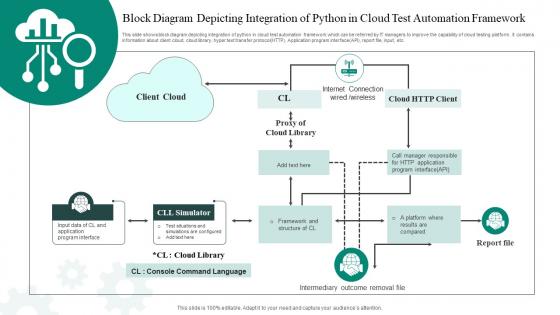
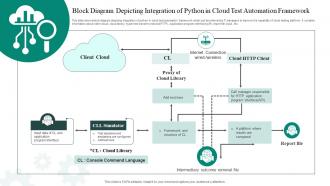
This slide shows block diagram depicting integration of python in cloud test automation framework which can be referred by IT managers to improve the capability of cloud testing platform. It contains information about client cloud, cloud library, hyper text transfer protocol HTTP. Application program interface API, report file, input, etc.
People who downloaded this PowerPoint presentation also viewed the following :
Block Diagram Depicting Integration Of Python In Cloud Test Automation Framework with all 6 slides:
Use our Block Diagram Depicting Integration Of Python In Cloud Test Automation Framework to effectively help you save your valuable time. They are readymade to fit into any presentation structure.





FAQs for Block Diagram Depicting Integration Of Python In Cloud
Python offers significant benefits for cloud test automation through its extensive library ecosystem, cross-platform compatibility, simple syntax, and robust frameworks like Selenium and Pytest. These capabilities streamline test development by reducing coding complexity, enabling faster deployment cycles, and seamlessly integrating with cloud platforms like AWS and Azure, ultimately delivering enhanced scalability and cost-effective testing solutions.
Python's extensive libraries enhance cloud test automation through Selenium for web testing, Requests for API validation, Pytest for framework management, and Boto3 for AWS integration. These libraries streamline test development by enabling cross-platform compatibility, automated deployment pipelines, and seamless cloud resource management, with many organizations finding that Python's ecosystem accelerates testing cycles while reducing infrastructure costs.
Popular Python frameworks for cloud test automation include Selenium, Pytest, Robot Framework, Behave, and TestProject, each offering distinct advantages for web application testing. These frameworks streamline cloud testing by enabling cross-browser compatibility, parallel execution, and seamless CI/CD integration, with many organizations finding that strategic framework selection significantly reduces testing cycles while enhancing application reliability and deployment confidence.
Python cloud test automation integrates with CI/CD pipelines through automated triggers, containerized test environments, parallel execution across multiple cloud instances, and real-time reporting dashboards. These integrations streamline deployment workflows by enabling continuous testing at scale, reducing feedback cycles from hours to minutes, and automatically blocking faulty code from production, with many development teams finding that cloud-based parallel testing delivers faster releases and higher software quality.
Best practices for maintainable Python cloud test scripts include implementing modular test design, using environment-specific configuration management, incorporating robust error handling, leveraging cloud-native testing frameworks, and establishing comprehensive logging mechanisms. These approaches streamline test maintenance by enabling seamless environment transitions, reducing debugging time, and facilitating scalable test execution, with many organizations finding that strategic automation delivers faster deployment cycles and enhanced reliability.
Managing dependencies in Python cloud test automation involves using virtual environments, requirements.txt files, dependency pinning, automated dependency scanning, and containerization through Docker. These approaches streamline deployment consistency, minimize version conflicts, and enhance security across distributed cloud environments, with many organizations finding that combining pip-tools with CI/CD pipelines ultimately delivers faster testing cycles and more reliable automation infrastructure.
Cloud service providers enable Python test automation by offering scalable infrastructure, managed testing environments, and integrated CI/CD pipelines that eliminate hardware constraints. Through platforms like AWS, Azure, and Google Cloud, organizations streamline test execution across multiple configurations, reduce operational costs, and accelerate deployment cycles, with many finding that cloud-based automation delivers enhanced reliability and faster feedback loops.
Python enables cloud-based load testing through frameworks like Locust, pytest-benchmark, and Apache JMeter integration, combined with cloud platforms such as AWS, Google Cloud, and Azure. These tools streamline scalable testing by distributing virtual users across multiple cloud instances, automating performance monitoring, and generating detailed analytics, ultimately delivering faster deployment cycles and enhanced application reliability under peak traffic conditions.
**INPUT**: What strategies can be employed to ensure data privacy and security during automated testing in the cloud? **OUTPUT**: Data privacy and security strategies include encryption of test data, access controls with role-based permissions, secure test environments, anonymized datasets, and compliance monitoring tools. These approaches streamline security by isolating sensitive information, automating vulnerability scanning, and maintaining audit trails, with many organizations finding that strategic data masking and encrypted connections ultimately deliver robust protection while enabling scalable testing operations. **Word count: 60 words**
Python's RESTful API integration enables cloud test automation through seamless service communication, automated endpoint validation, dynamic test data management, and comprehensive response verification. Through libraries like requests and pytest, organizations can efficiently test microservices architectures, validate cloud-based applications, and automate complex workflows, while significantly reducing manual testing overhead and accelerating deployment cycles.
Tools to enhance Python cloud testing workflows include Selenium for web automation, pytest for test framework management, Docker for containerized environments, Jenkins for CI/CD integration, and Terraform for infrastructure provisioning. These technologies streamline testing by enabling scalable test execution, automated deployment pipelines, and consistent environment management, with many organizations finding that this strategic combination significantly reduces testing cycles while delivering faster, more reliable cloud applications and enhanced operational efficiency.
**INPUT**: How do you approach test case design specifically for cloud-based applications using Python? **OUTPUT**: Test case design for cloud applications using Python involves creating scalable test suites that address network latency, data consistency, security protocols, and multi-region deployment scenarios. Through frameworks like pytest and cloud-specific libraries, organizations streamline validation of auto-scaling behaviors, API reliability, and cross-platform compatibility, ultimately delivering robust applications while minimizing deployment risks.
Teams implementing Python for cloud test automation often face challenges including environment configuration complexities, dependency management across different cloud platforms, scaling test infrastructure efficiently, and managing authentication across multiple services. While these obstacles initially slow deployment, many organizations find that Python's extensive libraries, strong community support, and cloud-native integrations ultimately streamline automation processes, reduce long-term maintenance costs, and deliver faster testing cycles.
Python's readability enhances collaborative test automation by enabling clear code documentation, simplified knowledge transfer, and faster onboarding of new team members. This accessibility streamlines cross-functional collaboration between developers, QA engineers, and DevOps teams in cloud environments, ultimately reducing maintenance overhead, accelerating delivery cycles, and ensuring consistent testing standards across distributed development teams.
Python testers should monitor serverless computing, containerization with Kubernetes, AI-driven testing tools, edge computing, and multi-cloud strategies. These technologies revolutionize test automation by enabling faster deployment cycles, enhanced scalability, and intelligent test case generation, with many organizations finding that early adoption of cloud-native testing frameworks delivers significant competitive advantages and operational efficiency.
-
Excellent design and quick turnaround.
-
“I always have a wonderful experience with SlideTeam. It's my ""go to"" when I need a template.”