

Blockchain Use Cases In IoT Ecosystem IoT Security And Privacy Safeguarding IoT SS




Try Before you Buy Download Free Sample Product
 Impress Your
 Audience
 100%
100% Editable
 Save Hours
 of Time


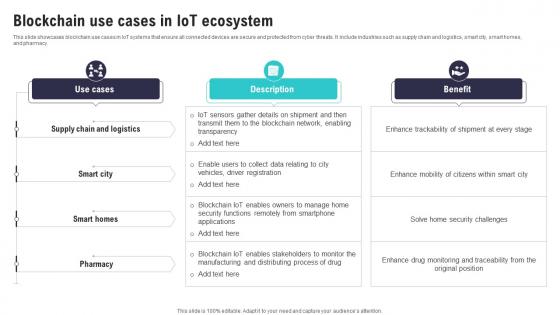
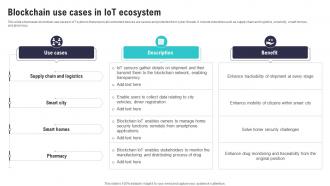
This slide showcases blockchain use cases in IoT systems that ensure all connected devices are secure and protected from cyber threats. It include industries such as supply chain and logistics, smart city, smart homes, and pharmacy.
People who downloaded this PowerPoint presentation also viewed the following :
Blockchain Use Cases In IoT Ecosystem IoT Security And Privacy Safeguarding IoT SS with all 9 slides:
Use our Blockchain Use Cases In IoT Ecosystem IoT Security And Privacy Safeguarding IoT SS to effectively help you save your valuable time. They are readymade to fit into any presentation structure.








FAQs for Blockchain Use Cases In IoT Ecosystem IoT Security And Privacy
Traditional IoT systems face vulnerabilities including centralized points of failure, weak device authentication, inadequate data encryption, lack of secure firmware updates, and insufficient access controls. Blockchain addresses these by creating decentralized security frameworks, enabling cryptographic device identities, and providing immutable audit trails, with manufacturing and healthcare sectors finding that distributed ledger approaches significantly enhance network resilience and data integrity.
Blockchain enhances IoT data integrity through immutable ledger technology, cryptographic hashing, distributed validation, and decentralized consensus mechanisms that prevent tampering or unauthorized modifications. These security protocols enable manufacturing plants, smart cities, and healthcare networks to verify authentic sensor data, eliminate single points of failure, and maintain transparent audit trails, ultimately delivering trusted IoT ecosystems with enhanced operational reliability.
Smart contracts facilitate automated IoT security by executing predefined security protocols, automatically updating device permissions, validating data integrity, and triggering immediate responses to threats without human intervention. Through blockchain integration, manufacturing plants and smart cities can streamline access control, enhance real-time monitoring, and minimize security vulnerabilities, ultimately delivering consistent protection and operational efficiency across interconnected device networks.
Scalability challenges include limited transaction throughput, high energy consumption, storage constraints, network latency issues, and consensus mechanism bottlenecks in large IoT ecosystems. While these present implementation hurdles, many organizations are finding that hybrid blockchain approaches, edge computing integration, and lightweight consensus protocols enable strategic scaling, ultimately delivering enhanced security across manufacturing plants, smart cities, and supply chain networks.
Blockchain-based identity management enhances IoT device authentication by creating immutable digital identities, enabling decentralized verification, eliminating single points of failure, and providing cryptographic proof of device legitimacy. Through distributed ledger technology, organizations streamline authentication processes, reduce security vulnerabilities, and enable trusted device-to-device communication, with manufacturing and smart city implementations finding significantly improved network integrity and operational security.
Decentralized consensus eliminates single points of failure by requiring multiple network nodes to validate IoT device transactions, data exchanges, and system updates through cryptographic verification. This distributed validation approach significantly reduces risks from cyberattacks, unauthorized access, and data manipulation, with smart manufacturing and connected healthcare systems finding enhanced operational security and improved trust across device networks.
Different blockchain architectures impact IoT security through varying levels of access control, scalability, and trust models, with public blockchains offering transparency, private blockchains enabling organizational control, and consortium blockchains balancing collaboration with security. Financial institutions and healthcare organizations increasingly favor private architectures for device authentication, while supply chain networks leverage consortium models to streamline cross-partner verification, ultimately delivering enhanced data integrity and operational efficiency.
Blockchain in IoT presents both enhanced security through decentralized authentication, immutable transaction records, and distributed consensus mechanisms, while potentially introducing latency issues, increased computational overhead, and higher energy consumption. Many organizations find that strategic implementation using lightweight consensus protocols and edge computing integration minimizes performance impacts, ultimately delivering stronger device security and data integrity with acceptable operational efficiency.
Blockchain supports secure IoT firmware updates by creating tamper-proof audit trails, enabling cryptographic verification of update authenticity, and establishing decentralized consensus mechanisms that prevent malicious modifications. Through distributed ledgers, manufacturers can ensure only authorized updates reach devices while maintaining transparent version histories, with many automotive and industrial IoT deployments finding significantly reduced security vulnerabilities and streamlined update management processes.
Using blockchain for IoT data interoperability creates standardized, tamper-proof communication protocols across diverse platforms, enabling seamless data exchange while maintaining security integrity and audit trails. This approach allows healthcare systems, smart cities, and manufacturing networks to share critical information transparently, ultimately reducing integration costs and accelerating cross-platform innovation in increasingly connected environments.
Blockchain ensures accountable IoT data usage through immutable audit trails, cryptographic access controls, automated consent management, and transparent data lineage tracking that creates verifiable compliance records. Financial services and healthcare organizations leverage these capabilities to demonstrate regulatory adherence, enable granular user permissions, and provide real-time visibility into data processing activities, ultimately delivering enhanced privacy protection and streamlined compliance reporting.
Successful blockchain-IoT security integration requires partnerships between IoT device manufacturers, blockchain platform providers, cybersecurity firms, telecommunications companies, and cloud service providers. These strategic collaborations enable standardized security protocols, seamless device authentication, and scalable infrastructure deployment, with many organizations finding that cross-industry partnerships accelerate implementation while reducing costs and complexity.
Real-world blockchain IoT security implementations include Walmart's food traceability systems, BMW's supply chain verification, Bosch's IoT device authentication networks, and smart city infrastructure in Dubai and Singapore. These deployments demonstrate how blockchain enhances IoT security by preventing data tampering, automating device authentication, and creating immutable audit trails, with organizations finding significantly reduced cyber vulnerabilities and enhanced operational transparency.
The convergence enhances IoT security by enabling real-time threat detection, distributed consensus validation, and reduced attack surfaces through localized processing. Edge-blockchain integration streamlines authentication, minimizes latency vulnerabilities, and strengthens data integrity across manufacturing plants, smart cities, and healthcare networks, ultimately delivering faster incident response and more resilient infrastructure protection.
Future blockchain-IoT security trends include quantum-resistant encryption, edge computing integration, interoperability protocols, automated smart contracts, and decentralized identity management systems. These advancements streamline device authentication, enhance data integrity, and minimize cyber vulnerabilities, with manufacturing, healthcare, and smart city initiatives finding that strategic blockchain implementation ultimately delivers scalable security frameworks and competitive operational advantages.
-
Design layout is very impressive.
-
Well-designed and informative templates. Absolutely brilliant!