






 0 Comment
 Customer Reviews

In 2014, Microsoft acquired Nokia’s mobile phone division in a high-profile $7.2 billion deal. What seemed like a strategic move to dominate the smartphone market quickly turned into a cautionary tale, as the acquisition failed to deliver the expected results. Industry experts later pointed to insufficient due diligence in assessing market trends, Nokia’s declining brand value, and potential integration challenges as key reasons for the deal’s downfall.
Acquisition due diligence is the backbone of any successful merger or acquisition. It’s the process that ensures you’re not just buying an asset but also understanding its potential risks, synergies, and future value. This involves critical steps such as financial assessment, ensuring legal compliance, managing potential risks through robust risk management strategies, and conducting thorough asset evaluation and contract review to leave no stone unturned.
Are you preparing for an acquisition and need to streamline the due diligence process? SlideTeam’s Acquisition Due Diligence Templates are here to help. These templates provide comprehensive frameworks to evaluate every aspect of a potential deal, helping you make informed decisions and avoid costly mistakes.
Let’s explore these templates and see how they can simplify the acquisition process and set you up for success.
BONUS: All templates are 100% customizable, so you can tailor them to suit the unique requirements of your transaction.
Template 1: Due Diligence for Mergers and Acquisition
This Due Diligence Outline PPT offers a comprehensive roadmap for evaluating business transactions, mergers, or acquisitions. Beginning with Financial Due Diligence, it delves into critical aspects such as Technology/Intellectual Property and Customer/Sales analysis to ensure robust evaluations. The deck further explores Strategic Fit with Buyer, identifying alignment opportunities, and assesses Material Contracts and Employee Management Issues, addressing key operational considerations. Legal risks are examined through Litigation and Taxation reviews, while Insurance, Antitrust & Regulatory Issues safeguard compliance. Environmental concerns and general business matters are tackled in the Environmental Issues & General Business Affairs section. The presentation also encompasses Marketing & Business Development and Competitive Analysis, ensuring market readiness. Concluding with a Due Diligence Summary, this slide deck provides a holistic and detailed framework, essential for decision-makers aiming for informed and strategic conclusions in complex transactions.
[product_image id=256531]
Template 2: Due Diligence in Merger and Acquisition
This PPT deck serves as a definitive guide to the intricate process of due diligence in mergers and acquisitions (M&A), essential for successful business integrations. Starting with a Performance Glimpse of the Firm, it covers critical financial and operational highlights that establish the foundation for evaluating potential targets. The presentation delves into M&A Lifecycle Overview, Types of M&A, and Setting M&A Criteria, providing a strategic roadmap for identifying and assessing opportunities.
The deck further emphasizes Due Diligence Objective Activities, spotlighting Financial, Legal, HR, and Environmental Health & Safety due diligence components, along with robust checklists to ensure thorough assessments. It also outlines Target Company Due Diligence Analysis and Screening of Potential Targets to streamline decision-making.
Key sections include Determining the Purchase Price and Goodwill, Service Delivery Operating Models, and a Post-Merger Integration Plan, concluding with
insights into common Challenges During M&A and practical solutions. This comprehensive resource ensures informed and strategic M&A outcomes.
[product_image id=551549]
Template 3: Due Diligence Process in Mergers and Acquisition
This slide outlines a clear and systematic Due Diligence Process in Mergers & Acquisitions (M&A), detailing the critical steps for comprehensive evaluation and decision-making. The process begins with Identifying the Project Purpose, focusing on defining objectives and resources. It progresses to Business Case Financial Pre-Analysis, where financial records such as balance sheets and income statements are audited to assess performance.
Next, the Review Documents phase ensures a deep examination of gathered information, providing a holistic understanding of the target firm. The Plan Evaluation step assesses the compatibility of both firms' strategic plans and models, ensuring alignment for a seamless merger.
Risk mitigation is emphasized in the Risk Analysis phase, which involves identifying and forecasting associated risks. Finally, the process concludes with the Final Offer, where valuation techniques are applied, and negotiations finalize the deal. This structure ensures a thorough and strategic approach to successful M&A endeavors.

Template 4: Six Months IT Department Cultural Due Diligence Roadmap for Merger and Acquisition
The Six-Month IT Department Cultural Due Diligence Roadmap for Merger & Acquisition offers a structured timeline to ensure seamless integration of IT systems and cultural alignment during M&A activities. Starting with Month 1, the focus is on Information Gathering, encompassing HR, finance, legal, and IT due diligence to evaluate existing frameworks.
In Month 2, attention shifts to Planning and Design, with kickoffs for marketing, engineering, and cultural integration, fostering alignment between teams. Month 3 introduces Pre-Close Integration, highlighting shared service preparation, action plan confirmation, and deal closure celebrations, ensuring readiness for the merger.
The roadmap proceeds to Months 4 and 5, concentrating on Post-Close Integration through the implementation of cultural action plans, training on new systems, and team-building exercises with the acquired company. Concluding in Month 6, the roadmap focuses on consolidating efforts for smooth operational synergy, paving the way for a successful merger outcome.

Template 5: Due Diligence Process Timeline for Merger and Acquisition
The Due Diligence Process Timeline for Merger and Acquisition visually outlines the critical phases for executing a successful M&A process. Starting with Phase 1: M&A Strategy, the focus is on developing a strategic plan and establishing an executive team to guide the process. Phase 2: Target Screening involves arranging teams and analyzing potential targets to identify viable M&A opportunities.
Phase 3: Due Diligence is central to evaluating findings and organizing comprehensive analyses to inform decision-making. In Phase 4: Transaction Execution, key steps include estimating business value and formulating the deal structure to finalize terms. The timeline concludes with Phase 5: Integration, where the emphasis shifts to effectively communicating the M&A plan and aligning operations, products, and systems for seamless unification.
Designed across quarters, this timeline enables structured execution, ensuring that every stage—strategy, evaluation, execution, and integration—is systematically addressed to achieve merger success.

Template 6: Due Diligence for Mergers and Acquisitions One-Pager
This One-Pager on Due Diligence for Mergers and Acquisitions is an all-inclusive snapshot for evaluating the readiness and viability of a merger or acquisition target. Its purpose is to confirm vendor details, audit key information, and identify potential threats to mitigate risks associated with the investment process.
Key sections include:
- Objective: Ensuring accuracy of shared information and preempting potential issues to avoid poor investment decisions.
- Target Company Overview: Details reasons for selling and outlines long-term strategic goals like market expansion and diversification.
- Financial Analysis: Highlights the income statement from 2015–2022, offering a comprehensive view of revenue, gross profit, and net earnings.
- Patents, Strategy, and Legal Issues: Covers key assets, growth strategies, and potential legal concerns, such as intellectual property risks.
- Cost Breakdown: Provides an estimate of costs involved in due diligence across stakeholders like attorneys and investment bankers.
- Challenges and Management: Identifies hurdles like data breaches and disruptive technology while introducing the leadership team.
This document is a strategic guide for decision-makers navigating the M&A process.

Template 7: M&A Lifecycle Overview
The M&A Lifecycle Overview slide outlines the essential phases of a merger and acquisition journey, systematically categorized into three critical stages: Pre-Deal, Pre-Announcement, and Post-Announcement. This comprehensive framework ensures a seamless approach to navigating the complexities of mergers and acquisitions.
- Pre-Deal Phase: Focuses on crafting an effective M&A strategy and conducting meticulous target screening. This includes identifying strategies for both organic and inorganic growth and defining acquisition criteria for potential targets.
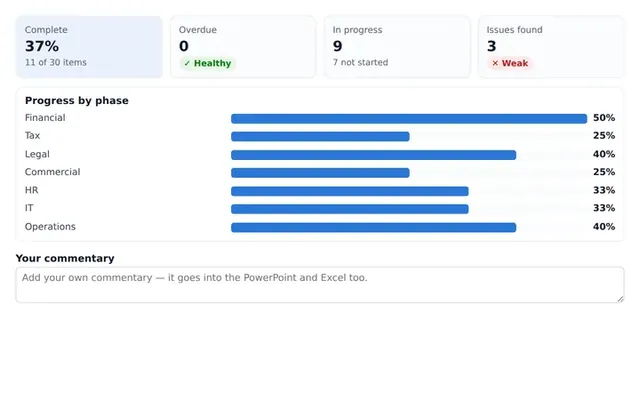
- Pre-Announcement Phase: Highlights due diligence and evaluation processes, covering financial, tax, legal, IT, HR, and commercial dimensions. This phase ensures that decision-makers are equipped with the insights needed for informed action.
- Post-Announcement Phase: Encompasses integration planning and execution, including the development of operational models and managing integration plans effectively to realize strategic goals.
This structured approach empowers businesses to align objectives, evaluate opportunities, and execute integration plans effectively, mitigating risks and maximizing the success potential of M&A initiatives.

Template 8: Setting M&A Criteria
The Setting M&A Criteria slide offers a structured approach to defining essential parameters for mergers and acquisitions. This comprehensive framework ensures businesses can strategically evaluate potential deals based on multiple dimensions:
- Strategic Combination: Determines the nature of the relationship, such as acquisition, joint ventures, or alliances, tailored to strategic goals.
- Value Chain: Focuses on how the partnership aligns within the operational and production chain for mutual benefit.
- Target Ownership: Specifies the type of ownership—public companies, privately held firms, or state-owned entities—critical for understanding governance and operational structures.
- Approach to Target: Defines the tone of engagement, ranging from hostile takeovers to friendly partnerships.
- Revenue Generation: Evaluates the financial scale of potential targets, categorizing them by revenue thresholds (<$5MM, $5-$20MM, >$20MM).
- Economic Area: Highlights geographic and operational focus, whether domestic or cross-border opportunities.
This slide emphasizes key takeaways that guide companies in screening and selecting potential customers or partners based on these tailored criteria, ensuring alignment with strategic objectives.

Template 9: Screening of Potential Targets
The Screening of Potential Targets slide provides a structured framework for evaluating prospective companies for mergers, acquisitions, or partnerships. The table outlines key metrics used to assess target companies:
- Revenue Generation: Highlights the financial performance of each company, providing insight into their market position and growth potential.
- Country: Identifies the geographical location of the companies, emphasizing the regional and global opportunities available through these targets.
- Industry Catered: Focuses on the sectors the companies operate within, helping align them with strategic business objectives and synergies.
- Ownership Structure: Clarifies the governance type—joint-stock companies, partnerships, or single ownership—offering insights into operational and decision-making frameworks.
This slide is instrumental for decision-makers, enabling them to compare key attributes and make informed choices regarding which companies align best with strategic
goals. It serves as a preliminary filter in the due diligence process to prioritize high-potential targets.

Template 10: Functional Responsibility of the Teams
The Functional Responsibility of the Teams slide provides a detailed breakdown of roles and responsibilities assigned to different teams across the phases of due diligence in mergers and acquisitions. This slide categorizes responsibilities into three primary areas:
- Preliminary Due Diligence: Activities include developing business cases, conducting site visits, reviewing initial contractual obligations, and setting integration goals. This phase focuses on laying the groundwork for a thorough evaluation.
- Detailed Due Diligence: Responsibilities shift towards creating detailed financial models, defining capital requirements, refining pricing strategies, and finalizing operational and integration plans.
- Deal Closing: Teams work on closing capital adjustments, identifying skill incorporation opportunities, finalizing customer communication plans, and ensuring smooth integration.
The slide highlights how each team—Business Development, Operations/Technology, Commercial, and Integration—contributes to specific functional areas. This
structured approach ensures clarity in task allocation and collaboration, enabling an efficient and effective due diligence process.

Template 11: Due Diligence Objective Activities and Outputs
The Due Diligence Objective Activities and Outputs slide provides a comprehensive overview of the three critical stages of the due diligence process in mergers and acquisitions: Preliminary Due Diligence, Detailed Due Diligence, and Final Due Diligence. Each stage is systematically outlined under three key headings:
- Objectives: The preliminary phase focuses on identifying business risks, progressing to detailed evaluation of negotiations, contract structures, and valuation, and concluding with integration planning and execution.
- General Activities: These include activities such as collecting and analyzing data in the initial stages, forming due diligence teams during the detailed phase, and executing closing agreements during the final phase.
- Outputs: Outputs range from preliminary valuation in the first stage to detailed reports and integration plans in later stages.
This slide acts as a roadmap for organizations to ensure all aspects of due diligence are covered methodically, promoting informed decision-making and seamless integration in M&A processes.

Template 12: Finance Due Diligence Checklist
The Finance Due Diligence Checklist slide outlines the critical financial evaluation criteria used during mergers and acquisitions. It includes key areas such as Profit & Loss Account, Balance Sheet, and Cash Flow Statements, confirming whether these components meet the required accuracy and reliability. Additionally, it highlights financial ratio reviews to ensure they exceed ideal thresholds. The slide allows space for additional due diligence areas and findings, providing flexibility for organization-specific needs. This checklist is an essential tool for assessing the financial health of a target company, ensuring informed decision-making in the M&A process.

Final Word
An acquisition isn’t just a purchase—it’s a high-stakes commitment to the future. Microsoft’s experience with Nokia highlights a critical truth: without thorough due diligence, even the most promising deals can unravel. Successful acquisitions are built on a foundation of careful evaluation, clear insights, and informed decision-making to uncover potential risks and maximize opportunities.
SlideTeam’s Acquisition Due Diligence Templates provide the structure and precision needed to navigate this complex process. From financial assessments to legal compliance and risk evaluation, these templates offer a step-by-step guide to ensure no detail is overlooked. They empower you to make confident, well-informed decisions that safeguard your investment and pave the way for long-term success.
In the high-stakes world of acquisitions, thorough due diligence isn’t optional—it’s essential. Use these templates to streamline your process, mitigate risks, and approach every deal with clarity and confidence. Because when it comes to acquisitions, the difference between a cautionary tale and a success story lies in the details you uncover before you sign.