



 0 Comment
 Customer Reviews

Have you wondered...
How does your smartphone get charged?
How does a blood glucose monitor work using a biosensor?
How do mechanics start a car using a battery?
These everyday conveniences use the power of electrochemistry. As an expert branch of science, electrochemistry bridges the gap between chemical reactions and electricity. Basically, electrochemistry is the study of electrons that move between substances during oxidation-reduction (redox) reactions, which is the primary resource for generating electricity or driving chemical reactions.
Explaining this complex chemical procedure to your audience might seem daunting. Well, we are here to let you in on a secret. Captivating your audience does not simply mean explaining a science concept; it also means how you present it! This blog presents top-notch presentation decks and electrifying templates that are neither dull nor text-heavy. Our Top Ten Electrochemistry PPT Templates will spark curiosity and ignite understanding among your listeners.
All templates are predesigned and explore topics on the way electricity interacts with chemical changes. They also clarify complex theories, such as Faraday principles and Gouy Chapman's theory, in a simplified and practical manner. The templates present effective solutions through electrochemistry, such as renewable systems such as solar panels and fuel cells, biosensors in healthcare, and nanomaterial synthesis in material science.
Innovative educators, top-performing students, high-profile scientists, and research students looking to explain advanced topics in easy-to-understand PPT templates would find these ready-made decks perfect for inspiring, informing, and innovating!
Let us explore these top 10 Electrochemistry PPT Templates.
Template 1 Electrochemistry Skipping Voltammetry PowerPoint Template
Electrochemistry Stripping Voltammetry is an electroanalytical technique to understand and detect amounts of substances in a solution. The stripping is used to denote a current generated, which is then measured and used to determine the amount of substance. This 30-slide presentation deck offers your audience an insight into the Electrochemistry Stripping Voltammetry. The predesigned templates present accurate content on the importance, overview, fundamental concepts, techniques, and types in stripping voltammetry. Researchers, scientists, educators, and academicians looking for a comprehensive and effective method to present Electrochemistry Stripping Voltammetry would find this presentation deck ideal for professional presentations.
[product_image id=1269976]
Template 2 Exploring the Gouy Chapman Theory in Electrochemistry PowerPoint
The Gouy Chapman Theory, introduced by Louis Georges Gouy and David Leonard Chapman, explains that the capacitance at the interface between a metal and electrolyte solution is not fixed, but depends on the applied voltage and concentration of ions in the solution. It helps understand how electric charges behave near surfaces in liquids, which is essential in biology, chemistry, and energy technologies. This presentation deck features 29 pre-designed slides ideal for presenting the Gouy Chapman theory in a clear and detailed manner. This ready-to-use presentation deck offers clarity on the historical context of the theory, its developments, the history, the actual concept of the double layer, the mathematical frameworks, the electrostatic potential in electrochemistry, etc. Download to present the complex idea of the Gouy Chapman theory practically to strategic decision makers, research students, and industry experts.
[product_image id=1313873]
Template 3 Understanding The Butler Volmer Equation In Electrochemistry
The Butler-Volmer equation is regarded as a key concept in electrochemistry. It helps understand the speed at which the reactions occur at an electrode’s surface. The reactions, which are the electron movement between electrodes and substances in a solution, are known as electrode kinetics. The Butler-Volmer equation highlights the amount to which the reaction depends on the voltage applied and the nature of the materials involved. This presentation deck consists of 33 slides offering insight into the introduction of the Butler-Volmer equation, the historical context of the equation, the fundamental concepts of electrochemistry, its importance, etc. Download and present complex theories in electrochemistry using clear explanations, visual representations, and practical examples to students, researchers, and science professionals!
[product_image id=1315798]
Template 4 Understanding Polarography: Techniques, Applications and Benefits
Polarography is an electroanalytical method for measuring how substances respond to electrode potential changes. It generates a current-voltage curve by using varying voltage to an electrode and relies on the standard electrode potential values to compare and identify substances. This comprehensive presentation deck offers an overview of polarography. The predesigned templates highlight the historical development of polarography, the principles of polarographic techniques, types of polarography, and electrolyte solutions in polarographic analysis. Download and present a professional and knowledgeable presentation to stakeholders in the fields of education, research, and science.
[product_image id=1236175]
Template 5 Fundamentals of Electrochemistry PPT Template
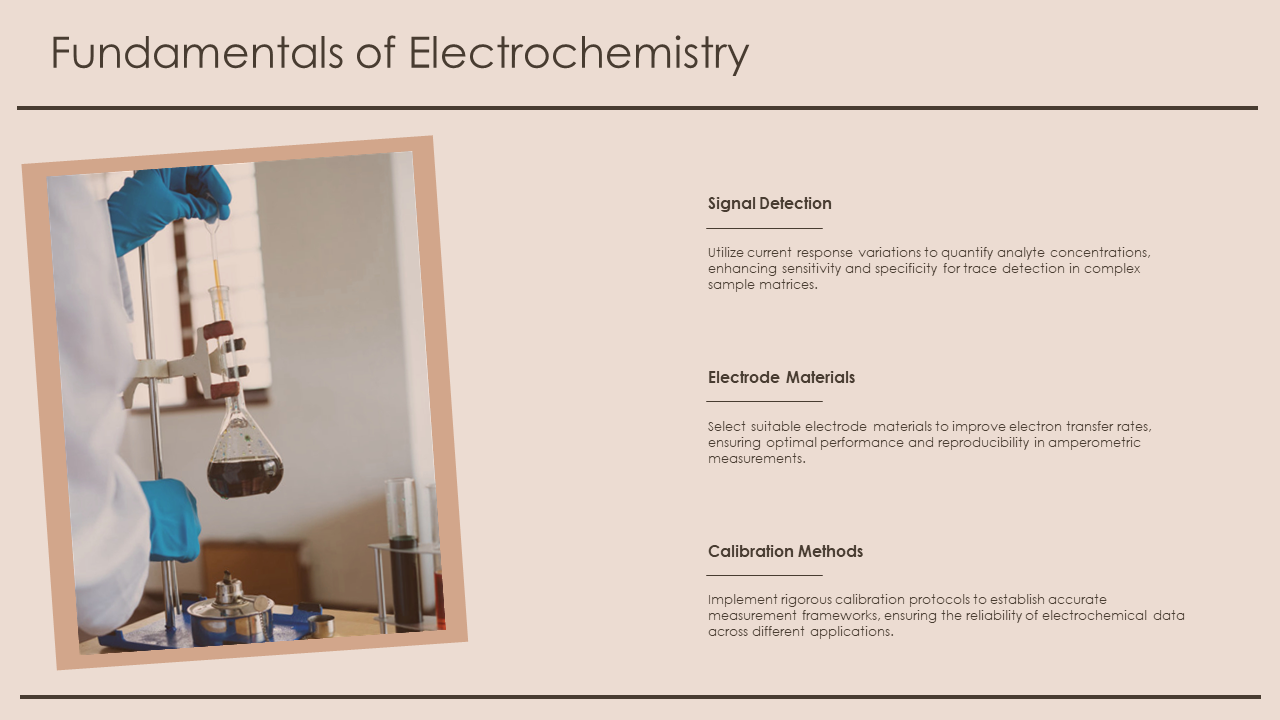
Electrochemistry is a unique branch of science that emphasizes electricity and chemical reactions. Electrochemical sensors are a primary application that detects substances in solution, so they are used in lab tests, monitoring environments, and industrial processes. Electroplating is another critical process in electrochemistry, which deposits a thin layer of metal onto a surface using an electric current. This slide focuses on electrochemistry fundamentals. It presents signal detection, electrode materials, and calibration methods. Each concept is critical to understanding electrochemical processes that improve appearance, prevent rust, and enhance durability. Download and present the essential fundamentals of electrochemistry, such as corrosion prevention critical to control chemical reactions such as rust or metal degradation.
Template 6 Potassium Ferricyanide in Electrochemistry PowerPoint Template
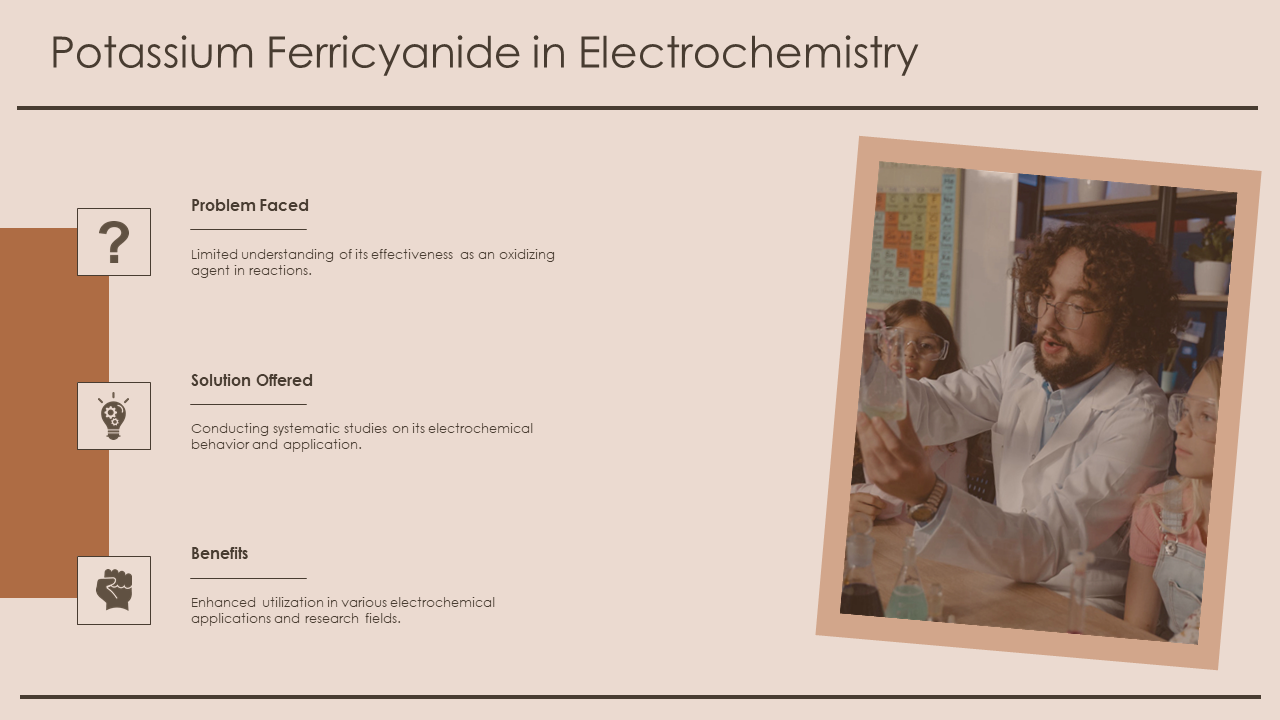
Potassium Ferricyanide is a coordination compound. It combines potassium, iron, and cyanide, and it is used as a standard redox agent because it easily gains and loses electrons. The concept is used in battery chemistry to understand the flow of charge moving into energy storage systems. It is used in the lab to make the pigment Prussian blue, which is used in blueprinting, drawing, electroplating, and dyeing wool. This slide presents the limitations in understanding oxidizing agents in reaction. It offers solutions using systematic studies through Potassium Ferricyanide and gives the benefits of this application. Download this slide to present the uses of Potassium Ferricyanide in Electrochemistry.
Template 7 Regulatory Considerations in Electrochemistry PPT Template
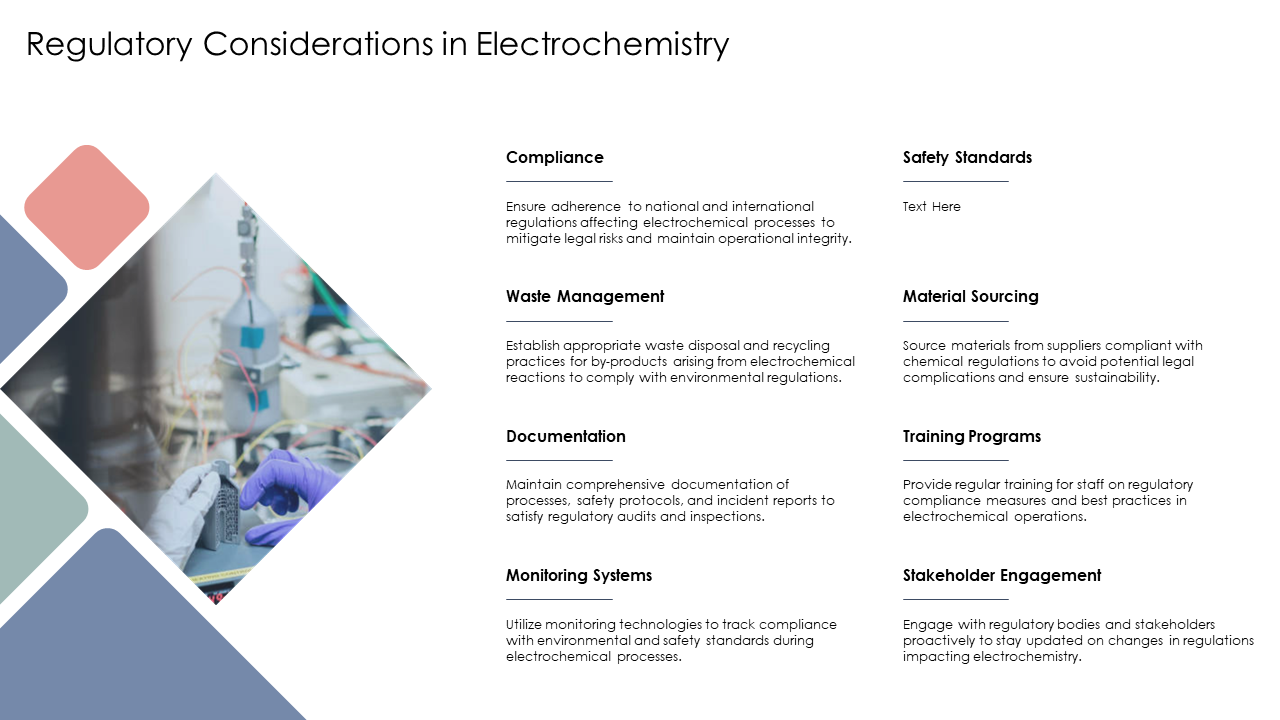
Electrochemical experiments are critical to energy storage, electroplating, and electrochemical sensor development. Since they involve hazardous chemicals, electrical equipment, and risky reactions, they must be handled carefully. Therefore, safety guidelines and regulations are the best resources for handling materials safely. This slide emphasizes regulatory considerations in electrochemistry. It highlights essential procedures in compliance, waste management, documentation, monitoring systems, safety standards, material sourcing, etc. Download to present a comprehensive process on following a well-defined regulatory process in the electrochemical process and highlight the best practices in the industry.
Template 8 Core Concepts of Electrochemistry PPT Template
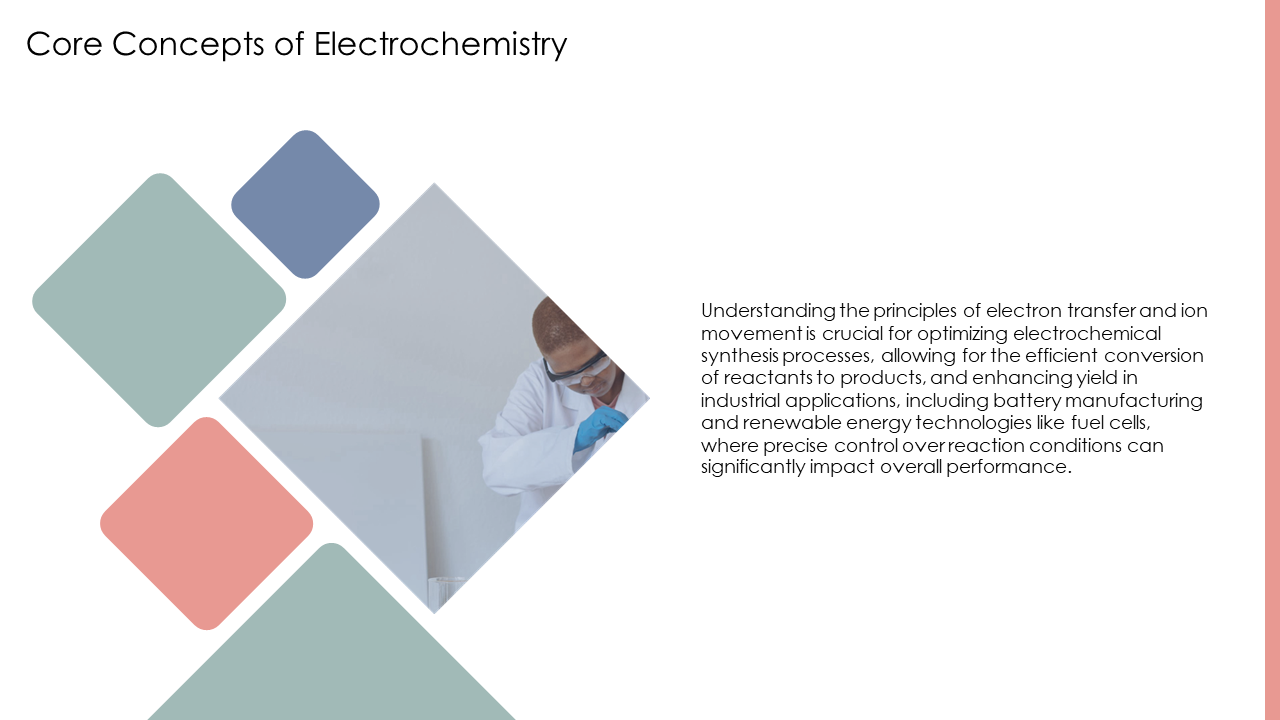
Electrochemistry is the study of chemical reactions involving the movement of electrons, also known as electricity! The reactions are called oxidation-reduction reactions or redox reactions, wherein when one substance loses electrons, another gains them. This slide explains the core concepts of electrochemistry. It highlights the need for this process with an example of fuel cells. Redox reactions are used by fuel cells to generate clean energy through the process of converting hydrogen and oxygen into electricity and water. Download and present a clear understanding of how electrons move during these reactions and how electrochemistry helps develop better batteries, sensors, and energy systems.
Template 9 Educational Resources for Electrochemistry PPT Template
Electrochemistry is essential as it helps understand how chemical reactions produce electricity. It is instrumental in understanding fuel cells, wastewater treatment, pollution monitoring, and corrosion prevention. This slide highlights educational resources that are excellent for learning and exploring opportunities in electrochemistry. It provides ideal educational resources for students, researchers, and professionals. Students can understand the basics of lab techniques through online courses such as Coursera and edX. YouTube offers various resource videos to understand experiments and solve common issues visually. Download and present the need for constant updates and hands-on learning to practice electrochemical reactions in a structured manner.

Template 10 - Regulatory Standards for Electrochemical Measurements PPT
The regulatory standards for electrochemical measurements ensure the collected data is consistent, reliable, and accurate. The slide overviews regulatory standards critical to maintaining high-quality electrochemical results. The three key aspects are quality control, compliance standards, and data management. Through regular calibration and quality checks, electrochemical experiments offer accurate results. International guidelines such as ISO, IEC, or ASTM provide adequate rules specific to electrochemical measurement and ensure they meet global expectations. Download and present a foolproof method to securely report results with data integrity.

LEARN TO LOVE ELECTROCHEMISTRY!
Electrochemistry is a complex topic, but using the PPT Templates make it simple to understand. It is a tool for educators, research scientists, and students. The rich designs, engaging content, and customizable slides are ideal for delivering electrochemical processes clearly. Researchers looking to present advantageous reasons to use specific electrochemical theories would find these slides perfect for academic projects and seminars. Download our visually appealing and professional slides to deliver fantastic lectures, scientific theories, and lab processes on electrochemistry.
PS Here is a link to our blog on electrochemical sensors. These templates are ideal for presenting complex electrochemical sensor topics in simple and easy to understand format!
FAQs on Electrochemistry PPT Templates
1. How do electrochemical cells generate electricity?
Electrochemical cells generate electricity using a chemical reaction that allows electrons to move from one material to another. The reactions occur in a galvanic cell wherein the electrons flow through a wire from one electrode to another, generating electric current.
2. What is the difference between galvanic and electrolytic cells?
Galvanic cells produce electricity using spontaneous redox reactions, which means they create chemical reactions on their own and generate electric currents similar to those of batteries. The electrolytic cell uses electricity through an external resource, a nonspontaneous chemical reaction.
3. How is electrochemistry applied in modern battery technology?
Batteries use chemical reactions to store energy and release it as and when needed. Electrochemical reactions move electrons from one material to another, helping to create electric current, which powers devices. Thus, electrochemistry is applied to modern battery technology and functions for modern applications, where the chemical composition needs to be converted into something we can use for practical purposes, such as blood sugar levels.