

 0 Comment
 Customer Reviews

A training plan is just as important to running a business as "Mitochondria is the powerhouse of the cell" is to biology texts. For decades, companies have used
organized learning tactics to make sure their employees stay proficient, flexible, and in line with the company's aims. With technology changing quickly and market needs changing, a good organizational training plan will be more important than ever in 2025.
Access our “Top 7 Employee Training Plan Templates With Examples And Samples” by clicking on the link provided.
A well-thought-out training strategy does more than just teach employees new skills. It also makes the business run more smoothly, keeps employees interested, and helps the business develop over time. Like a chemical reaction needs the correct catalysts, a business needs a clear way to plan and carry out training programs in order to be successful.
Training plans can be used in every department or business, from getting new employees up to speed to giving current ones new skills.
We've put together 10 great Organizational Training Plan Templates to help you create effective training programs without having to start from scratch. These professionally made PowerPoint decks come with proven frameworks, timeframes, skill matrices, and evaluation charts, so they are both complete and easy to change.
This article will show you how each template can help you save time, make sure training is effective, and help your firm reach its growth goals.
Get your hands on our “Top 10 Corporate Training Plan Templates with Examples and Samples” by clicking on the link provided.
Template 1: Organizational Training Initiative Plan with Estimate Budget
In the workplace, this slide would serve as a well-organized way of structuring and conducting training programs to the firm. It assists in ensuring training categories align with the strategic objectives, determine the most effective learning formats to be adopted to build up some skills and assign tasks to specific key stakeholders. It also facilitates working with training partners either inside teams or the outside providers to ensure that information is communicated. The budget estimation section assists in providing relevant funds planning and budgetary decisions. Such a prototype can assist professionals to simplify training design, keep people accountable, structure the involvement of vendors and control costs during the life cycle of the program.

Template 2: Organizational Change Management Training Plan for New Sales Employees
In this presentation, there is the inclusion of a training program that introduces new sales people into the roles to manage the concept of change in an organization. It is professionalized in terms of onboarding. It discusses the subject of training such as Dynamics 365, SAP, sales leads and opportunities as well as how to make people listen and take part. It contains the training tasks and the complete descriptions of the activities on each of the topics. This form may be used by HR managers and sales leaders in the real world to organize the sessions, clarify who will pass the information, and outline the objectives of the onboarding that aim to orient the systems and the sales process.

Template 3: Leadership Improvement Training Plan For Organizational Growth Improvement Plan
Members of the senior leadership team will have the chance to acquire certain skills through a leadership improvement training program that is the focus of this slide and that should aid the organization in its growth. It records the title, managerial area to be improved, training plan, mode of delivery and training duration and progress of each leader. This template enables the HR department and leadership teams to ensure that training activities fit strategic aspirations, monitor the progress, utilize resources effectively and ensure that leadership development becomes organized and quantifiable.

Template 4: Setting Organizational Training and Development Plan Personal Journey Organization
This slide is in the logical form of planning and conducting training and development processes in the organization. It displays the priority of the program, the target group, the starting dates, and benefits that can be obtained both by the organization and individuals who participate. It provides cost estimates and the source of the money, the name of the individual who will be expected to organize the training, and the date when the reviews and the actions that are required to be completed after the reviews. With such a format, managers and HR departments can ensure that training aligns with the long-term objectives, monitor expenditure, review progress and record clear accountability.

Template 5: Engaging Training Plan PPT Template
This template enables professionals to design training programs in an organized manner that can make an organization better in a coherent manner. It has places to plan training objectives consistent with strategic objectives, determine target populations, propose delivery mechanisms (like such workshops, e-learning, or a combination of both), match learning modules to target competencies, plan training timetables, resource allocation, and spell out evaluation measures. This ensures training programs enable business to flourish and attain its objectives of excellence.
[product_image id=1464432]
Template 6: Understanding Organizational Excellence
It can be adopted in this slide as a guideline in either developing or evaluating training plans which will lead to achieving the organizational excellence goals. It addresses four primary dimensions: stipulation of clear expectations in terms of setting defined performance objectives that can be measured, periodic performance appraisals which offer periodic feedback, specialized coaching to seal skill gaps and inculcating group problem solving and decision making at all hierarchies to generate empowered groups. Based on it, managers, HR departments, and training organizers could ensure that their learning programs are well-aligned with their strategic objectives, meaningfully track the progress, and develop the environment that fosters constant evolution and the long-term performance improvement process.

Template 7: Defining Training Objectives and Goals
One would use this slide to help in organizing training goals and objectives of professionals in a manner that would be of benefit. It incorporates the determination of requirements of the people through checking the skills gaps, the formulation of KPIs to track the performance, the identification of target audience to whom tailored programs can be directed, the design of resources to be used in the delivery, and the contents are ensured always that feedbacks are given to ensure any enhancement is carried out. The application of this framework can assist the training managers to ensure that the programs are in tandem with the objectives of the organization and that the progress would be measured in a standard manner to achieve improved results.

Template 8: Identifying Skill Gaps and Needs
This presentation can be used by professionals to identify and correct workforce shortages of skills. It tries to examine the current state, with employees lacking in the technical skills that they require, and their training programs not satisfying their requirements, and contrasts the current state with the wanted state, where personnel who possess desired skills are able to achieve the objectives of the organization. The results of the gap analysis would be an action plan that would entail assessments of talent across departments and prompt development of training based on the needs of the individuals. Such an approach ensures the concentration of capability creation on achieving strategic goals.

Template 9: Exploring Training Methods and Approaches
This slide would enable the professionals to select the most suitable training methods which they can apply to build their team. It discusses four learning styles, which are; hands-on training where one gets practical exercises so that one can recall what he/she has learned, e-learning where individuals are allowed to learn in their own pace and accordingly the work is not time-consuming, a mentor where the employees are given a one-on-one interaction under guidance and experience and lastly workshops where the individual is allowed to do work and share ideas through interactive methods. Applying these strategies in a strategic manner can enable the workers to become more competent, create a simpler experience in terms of disseminating what they learn, and ensure that learning activities are consistent with the objectives of the company.

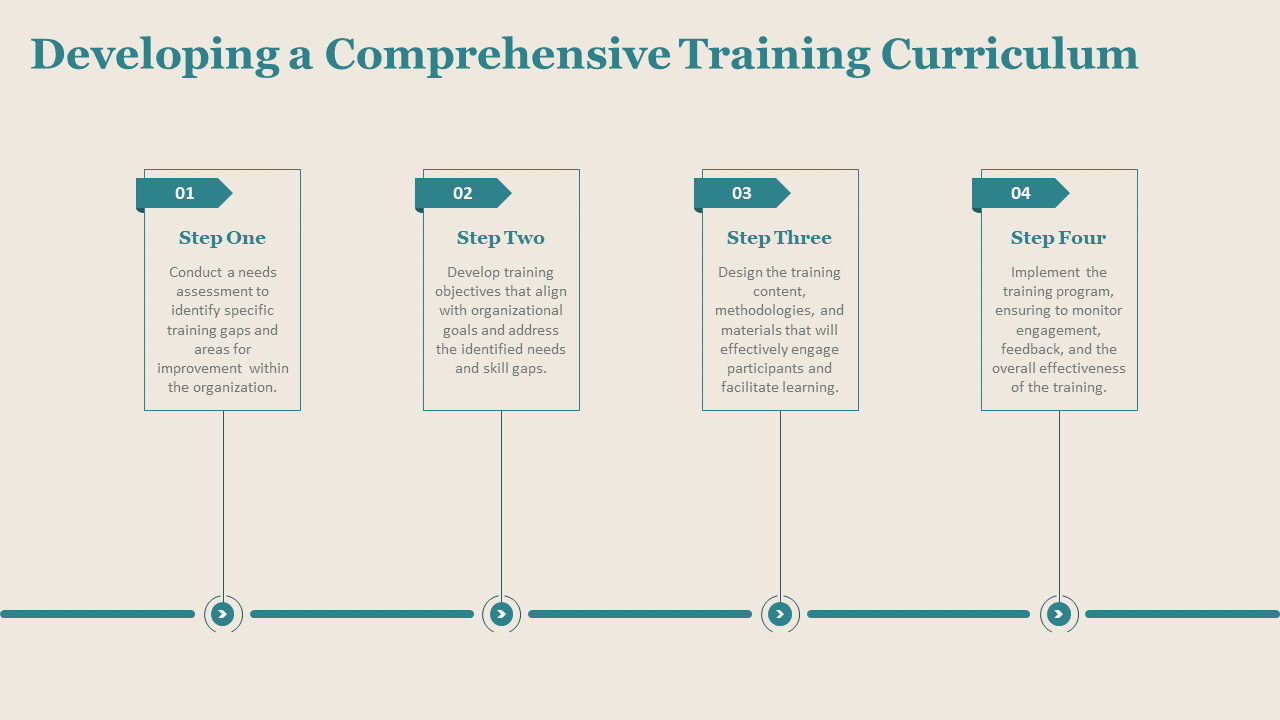
Template 10: Developing a Comprehensive Training Curriculum
By using this slide, professionals will be able to develop a logical training program, which complies with the organization requirements. The initial step is to conduct a needs assessment to know where training is wanted and where training is needed. It then proceeds in coming up with objectives that will close these gaps and make the organization achieve its objectives. The third step is to deliver engaging contents, techniques, and materials which will assist individuals in learning. Lastly, the program is implemented, and the involvement, the response, and the effectiveness are all monitored. This strategy will aid in making sure that the training programs would be targeted, measurable, and directly contribute to the workers in enhancing their abilities.
Conclusion
An effective organization training plan is not just a means to make people grow but it is also a strategic requirement. The templates presented here would provide you with plug and play frameworks that will consume less time, enable you to keep on the pace of your business and ensure that you achieve quantifiable results. Organizations can develop a competent, agile, and interested workforce through the occupations of skills shortage through filling the white spaces, establishing goals and through focused learning projects. Such resources simplify the process of program development, optimally utilize resources, and facilitate long-term development. This is highly helpful to HR leaders, managers and L&D teams who wish to design training that effectively contributes to organizational excellence and long term competitive advantage.
Get your hands on our “Top 10 Training Implementation Plan with Samples and Examples” by clicking on the link provided.
FAQs on Organizational Training Plan
1. What is an organizational training plan and why is it important?
A systematic organizational training plan entails learning objectives, approach, timeframes, and materials to ensure that employees develop their skills in accordance with the objectives of the company. This plays a vital role because it enhances the competencies of its staff members, secures more involvement and assists the organization to work effectively.
2. How do you develop an effective training plan for an organization?
To come up with a good plan, you must identify what you require, establish objectives that are measurable, identify the most appropriate approaches to implement the program, distribute resources, implement the plan and finally evaluate the outcome to know how you can improve it.
3. What are the key components of a successful organizational training plan?
Skill gap analysis, well-defined target, individualized training methodology, a structured time line, sufficient resource allocation and methods to measure performance are some of the key components.