

 0 Comment
 Customer Reviews

In 2025, the world watched in awe as scientists in Switzerland announced an extraordinary breakthrough: they had developed a new energy source that could power an entire city using only seawater and sunlight. It wasn’t a sudden discovery or a lucky accident. Behind that moment was a decade of careful planning, hard work, and relentless focus. They didn’t just start experimenting and hope for the best — they had a clear, detailed research agenda guiding every step of the way.
Let's explore our top 10 research plan templates.
A research agenda is like a map for an explorer heading into unknown territory. With a map, you know where you’re going, what obstacles might come up, and how to stay on course. That’s exactly what a research agenda does for anyone trying to push the boundaries of knowledge.
A good research agenda doesn’t just list a bunch of topics to study; it provides a clear direction for investigation without limiting options, leaving enough room for creativity. Are you a researcher planning to build a research agenda? Then, you are spot on. This blog is for you.
This blog outlines key topics, including research framework, study plan, research roadmap, investigative focus, research priorities, scholarly agenda, and research objectives. The templates designed for you give you fresh ideas or sharpen your existing ideas on these topics and help you prepare for your research strategy. It also helps you with ready-made slides that are 100% editable to meet your needs, with which you can prepare an eye-catching and informational PowerPoint presentation.
Looking for more on this subject? Click here to view seven sample agenda templates while you’re at it.
Let’s explore!
Template 1: Project Kickoff Meeting Agenda for Research and Development Department
This slide lays out the agenda for a project kickoff meeting for the research and development team. It covers all the key details upfront — the date, time, meeting room, host, and attendees, including technical leads, product developers, and data analysts. There’s a simple table that breaks down what the meeting will focus on: a quick overview of the project and its goal to drive new technology innovations, a review of expected outcomes and the impact they could make, discussions around partnerships with government agencies and other innovators, and a look at important technology trends like AI, machine learning, and robotics. This slide helps you to keep discussions focused and make sure the presentation sets a firm foot for the work ahead.

Template 2: Agenda for Operations Research
This slide presents the agenda for an operations research meeting focusing on the future of cybernetics. It provides an overview of cybernetics and its closely related areas, discusses how cybernetic implants can enhance human body functions and efficiency through real-world applications, and explores the market landscape for cybernetic enhancement systems, including their mission and strategies. Two points are left open for adding more topics as needed. A futuristic image of a humanoid robot supports the theme, creating a strong visual connection to the advancements being discussed. The slide is designed to keep the conversation focused on innovation, practical applications, and emerging market opportunities in the field of cybernetics.

Template 3: Agenda for Business Competition Assessment Guide for Market Research
This slide is meant to help the audience understand the agenda for the business competition assessment guide. The goal of this slide is to support market research goals. It starts by explaining why understanding competitor analysis is important and how it can benefit a business. It also covers how to choose the right competitors to analyze and how the insights gathered can help a company understand its position in the market and build stronger marketing strategies. The agenda introduces a few proven frameworks commonly used in the industry to enhance competitor analysis effectiveness. There’s also space left to add a few more points if needed. This slide is a simple pictorial representation of the topic, which makes it easier to understand.

Template 4: Agenda for Uncovering Consumer Trends Through Market Research
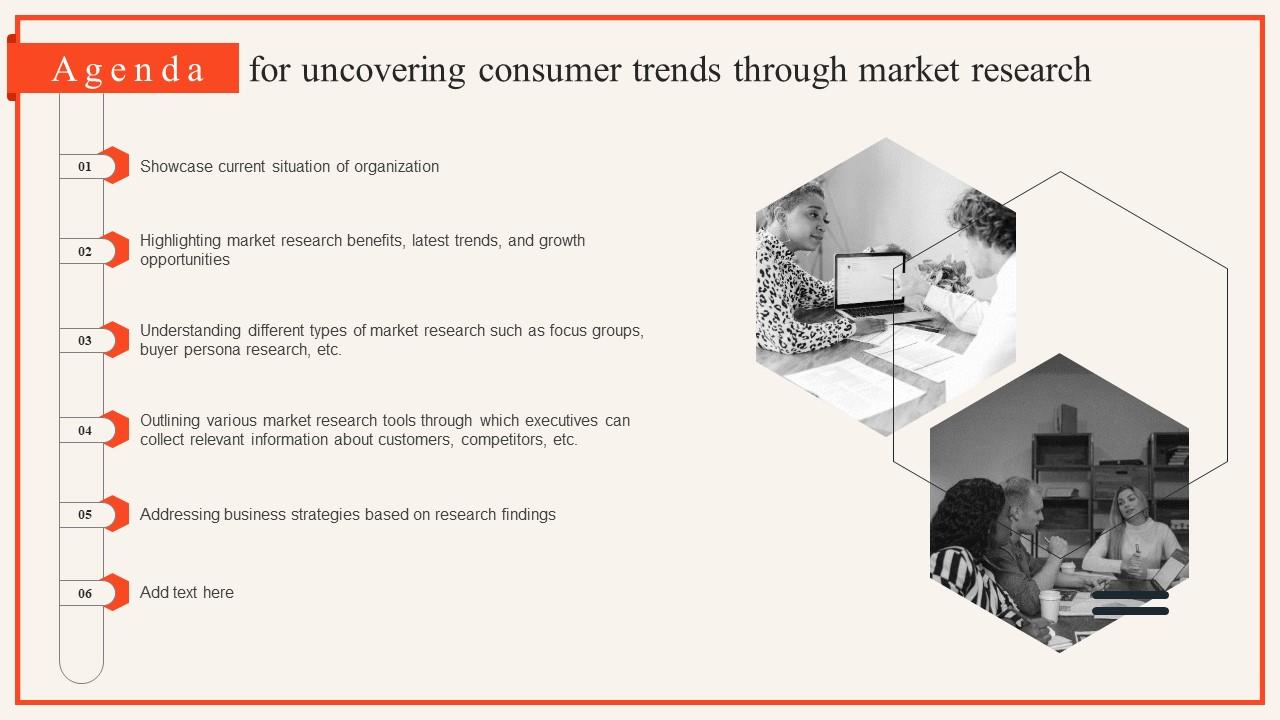
This slide lays out the agenda for uncovering consumer trends through market research. It begins by examining the organization's current standing, then highlights how market research focus areas can uncover new opportunities, reveal the latest trends, and identify areas for growth. It explains different types of market research, like focus groups and buyer persona research. It covers the tools you can use to gather insights about customers, competitors, and the market in general. The final section focuses on how to translate research findings into actionable business strategies. The visual includes a hexagonal graphic with images of people working together, emphasizing the importance of collaboration in the research process.
Template 5: Agenda for Equity Research Report
Want to know how to prepare an equity research report? This slide is for you. It gives details about the key elements of a company’s financial performance. This slide image showcases a representation of how the team gathers for research and discussion. It helps the users to understand and gauge the company’s financial health, and we have gathered analysis and financial modeling. The slide also reiterates how this analysis can help in making decisions on whether to buy or sell for future investments.
[product_image id=275998]
Template 6: Agenda for Visualization Research
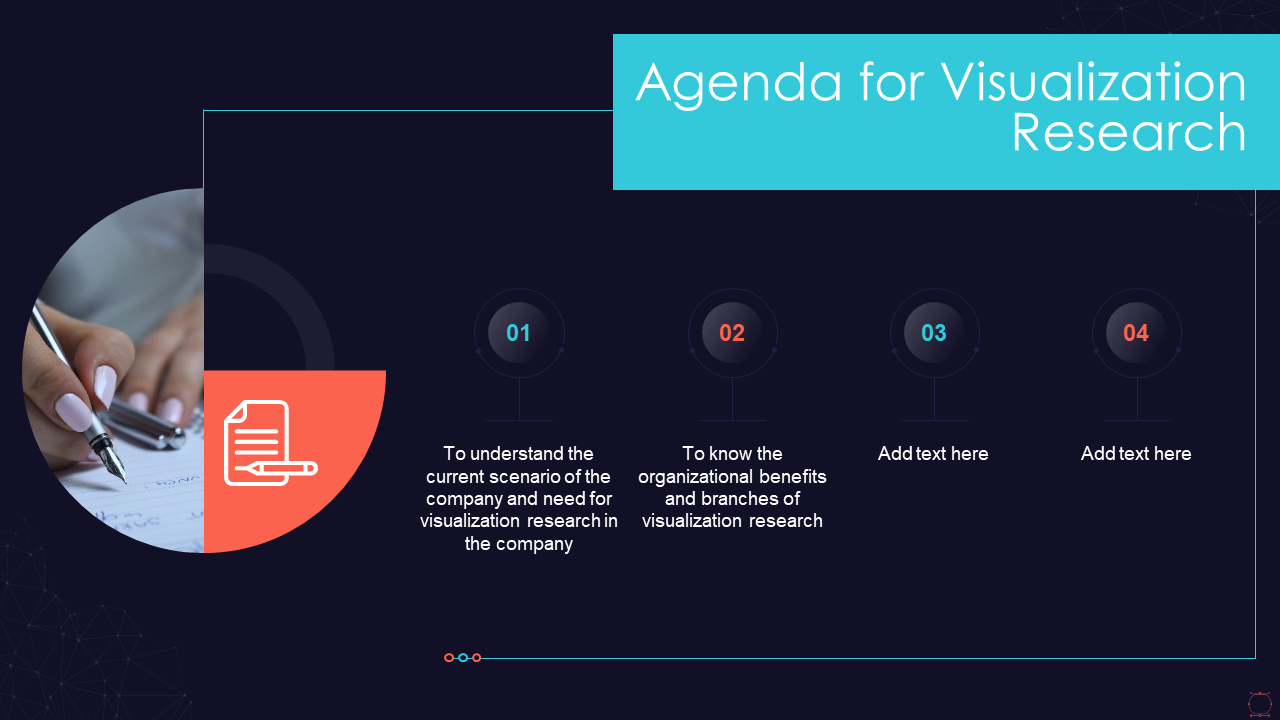
This slide talks about the agenda for visualization research. It begins by examining the company's current situation and why visualization research direction is important. It also explains visualization research's benefits for the organization and the different areas it can impact. There’s room to add more points if needed. The slide features an image of a hand holding a pen over a document on a desk, symbolizing the research process.
Template 7: Developing a Neuroscience Research Agenda
This slide is dedicated to neuroscience. It gives the timeline for developing a neuroscience research agenda. It starts in 2023 with the initiation phase. In this phase, the groundwork is laid out to set up the initiation phase. The year 2024 is all about collaboration, where the top institutions are focused on building strong relationships with them. The year 2025 is all about getting the required funds for specific neuroscience projects. Finally, in 2026, the results phase begins, with plans to publish findings and assess their impact on the field.

Template 8: Future Research Agenda in Nanobiocatalysis
This slide presents the future research agenda for nanobiocatalysis. It talks about how carbon-based nanobiocatalysts can be applied across different industries. It also talks about optimization—finding ways to improve the performance of these catalysts in various processes. The third area is characterization, where the goal is to improve the techniques used to analyze and understand nanobiocatalysts in detail. Ultimately, sustainability is crucial, with a focus on the environmental impact and long-term potential of utilizing these catalysts. The slide also includes an image of a researcher in a lab, working with a microscope and surrounded by lab equipment, which helps set the scientific tone.

Template 9: Agenda for Market Research Report for the Food Industry
Wish to prepare an agenda for a market research report on the food industry? This slide provides you with an overview on the food manufacturing sector, focusing on its contribution to GDP and expected growth rates. The next step involves analyzing the industry using key frameworks, such as SWOT, PESTEL, and Porter's Five Forces. The report also breaks down different subsegments of the food industry—such as meat, dairy, grains, and fruits and vegetables—and examines how each one is performing. It also highlights the major challenges the sector is facing and suggests solutions through the adoption of Industry 4.0 standards. The slide features an image of a large-scale food processing facility, with workers managing the machinery, adding a visual element to complement the content.

Template 10: Agenda-ChatGPT: Overview of Implications in Market Research
This slide examines how ChatGPT can be used in market research, particularly in analyzing large volumes of unstructured data. At the center of the slide, there’s a diagram showing a laptop with charts, graphs, and maps representing data analysis. The surrounding points highlight some key areas: first, it shows how we can process huge volumes of unstructured data like customer feedback and social media posts in real-time; then, it emphasizes the importance of evaluating customer data to personalize marketing efforts based on their suitable requirements; next, it explains how ChatGPT’s ability to understand natural language helps us gain insights into customer sentiment; and finally, it looks at how analyzing consumer data can lead to actionable insights and recommendations. The slide also has spots for adding more content later.

Over to you!
A research agenda is a must to attain progress and innovation in said field. It helps pinpoint key goals, priorities, and methods, making sure efforts are focused on what matters most. Whether in science, technology, or business, having a well-organized agenda ensures that resources are used effectively. It also encourages teamwork and collaboration, bringing everyone together with a common purpose. As research advances, the agenda evolves, remaining flexible to address new challenges and opportunities. Ultimately, a well-defined research agenda is crucial for achieving meaningful results and long-term success.
PS: Check out our top 10 business agenda templates here.
FAQs:
1. What are the 4 major parts of a research plan?
A research plan typically includes four main sections: an introduction about the research problem and objectives, a literature review that facilitates knowledge exploration, a methodology section that explains how the research will be conducted, and an analysis plan that helps interpret the findings.
2. What are the goals of research?
The main goals of the research are to gain more knowledge, resolve many problems, generate new data and their analysis, and develop solutions or theories. Research provides the information necessary to make informed decisions and contributes to progress in various fields.
3. What are the five codes of ethics?
The five key ethical principles in research are honesty, integrity, transparency, respect for participants, and accountability.