

Training roadmap powerpoint presentation slides





Try Before you Buy Download Free Sample Product
 Impress Your
 Audience
 100%
100% Editable
 Save Hours
 of Time


Incorporate these professionally designed Training Roadmap PowerPoint Presentation Slides to intensify your presentation and engage learners to participate in the learning process. Prepare employees and students for the next level of their careers using training roadmap presentation slide designs. These templates will help individuals hone their skills personally and professionally. Add relevant training roadmap PPT templates to guide your employees throughout their journey, know the destination, plan the route, showcase the milestones and achieve the desired result. This training roadmap PowerPoint templates can be used for employee training, manager training, business training plan, and more. Follow a training roadmap to achieve the best possible results. This ready-made training roadmap complete presentation covers templates like interactive learning roadmap, company learning roadmap, four phase learning roadmap, general learning roadmap, and more. These templates are completely customizable. Edit the color, text, icon and font size as per your requirement. Download this presentation slideshow, add your content and you are good to engage your employees in the training session. Our Training Roadmap Powerpoint Presentation Slides believe in being fair. Don't give a chance for any haggling.
People who downloaded this PowerPoint presentation also viewed the following :
Content of this Powerpoint Presentation
What do you think is the success ratio for a practical training session? Can you believe that, according to a study, a practical training session can enhance any organization’s growth by a huge percentage? An effective training session has a 93% success ratio. This number can look interesting even to a seasoned trainer. Wondering, what's the secret ingredient here? The answer is that any session's success depends upon the training material. Therefore, it is essential to create an appealing training presentation to attract potential audiences. An effective presentation should convey a clear message and engage the learner. Unfortunately, around 60% of professionals lack expertise in designing appealing presentations. This emerges as a huge challenge for businesses. What could be the solution here?
SlideTeam professionals have designed these 100% editable and customizable roadmap templates, which are equipped with attractive visuals and graphics and offer ready-to-use solutions.
Let's explore these training plan development roadmaps and see how they can contribute to your growth.
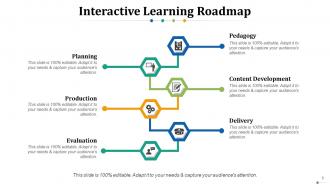
Template 1: Interactive Learning Roadmap Template
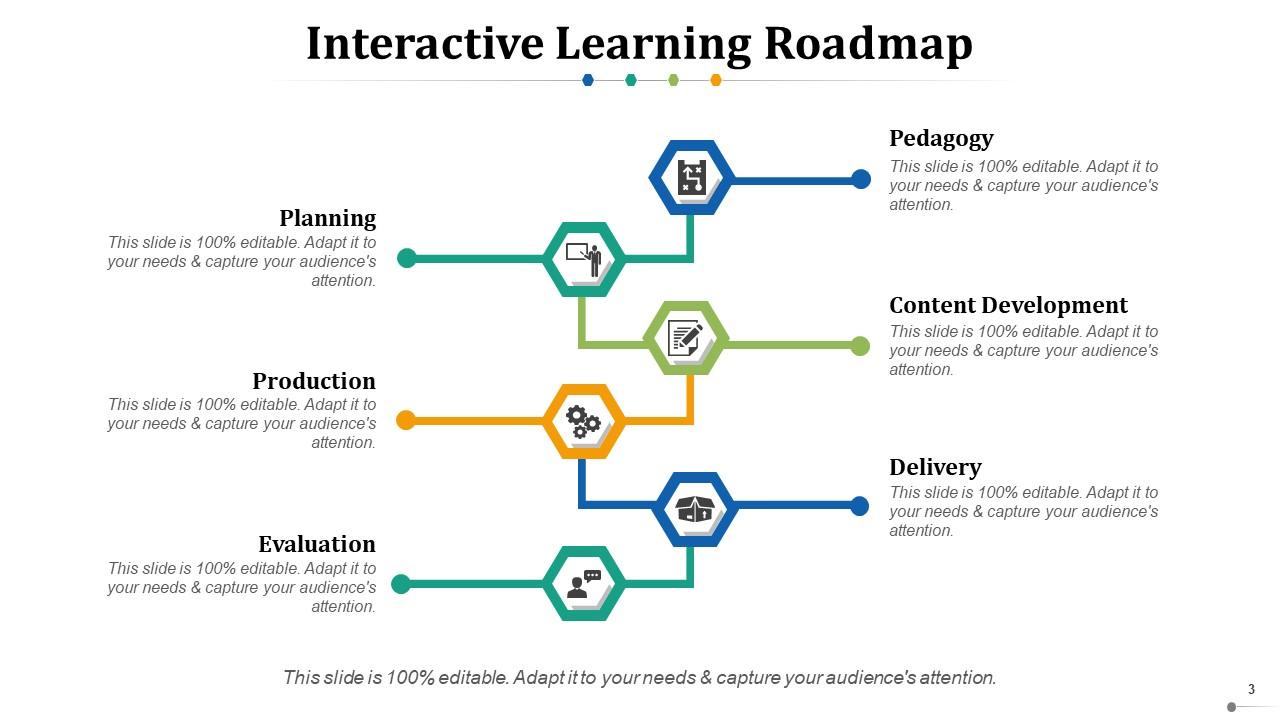
Outline learning objectives for all participants and highlight six crucial stages of interactive learning with this PPT Template. In the planning stage, you can define the objectives and the scope of the session. The next stage is pedagogy, where you explain the teaching methodology and assessment techniques. Similarly, the content development stage provides learners with a brief overview of the content. The last stage is delivery, which informs about the deployment of the learning material.
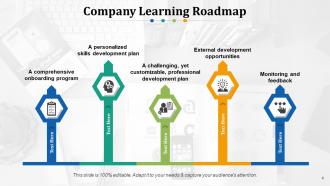
Template 2: Company Learning Roadmap Template
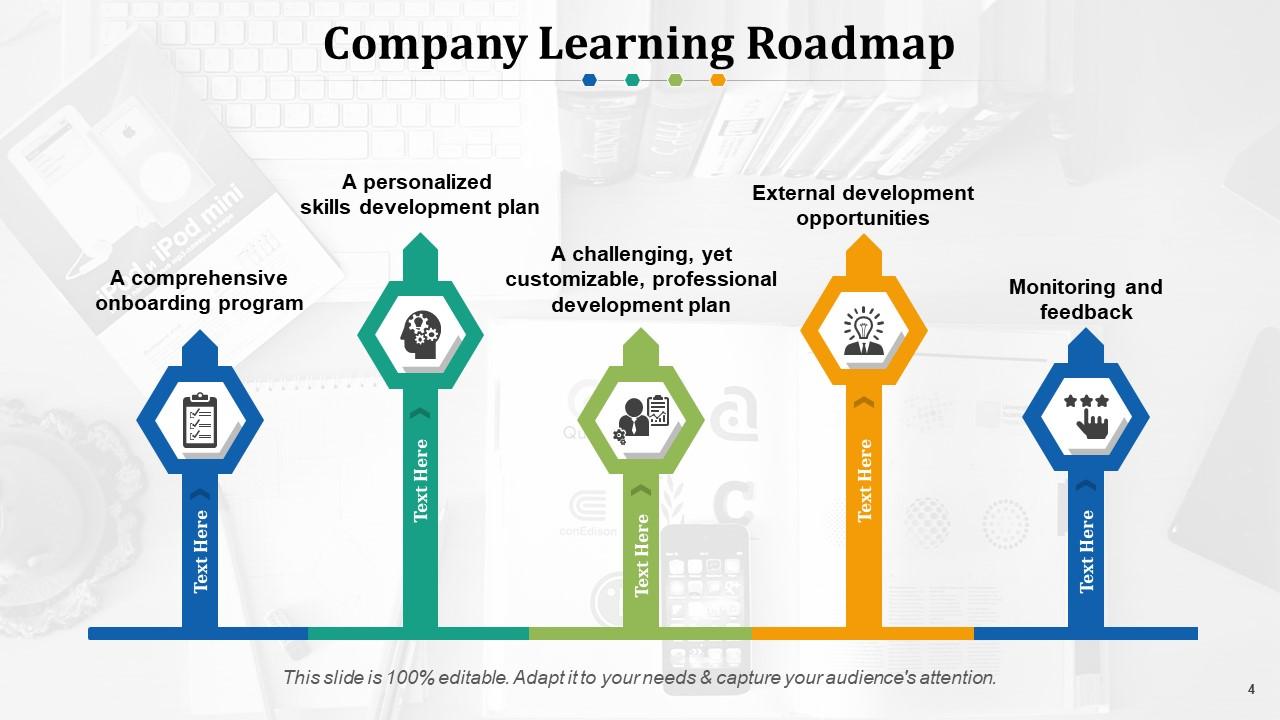
If you need a strategic tool to identify your most valuable asset, then your search ends with this PPT Template. It contains the five foundational elements of a top-class training module. The first must-have on this list of five is an onboarding program that helps new joiners learn about the new environment. A personalized skills development plan is next. The other pillars are a professional development plan, other opportunities employees have for growth, and the required feedback.
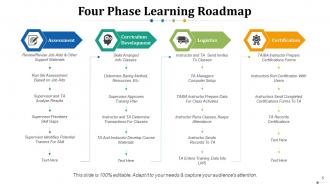
Template 3: Four-Phase Learning Roadmap Template
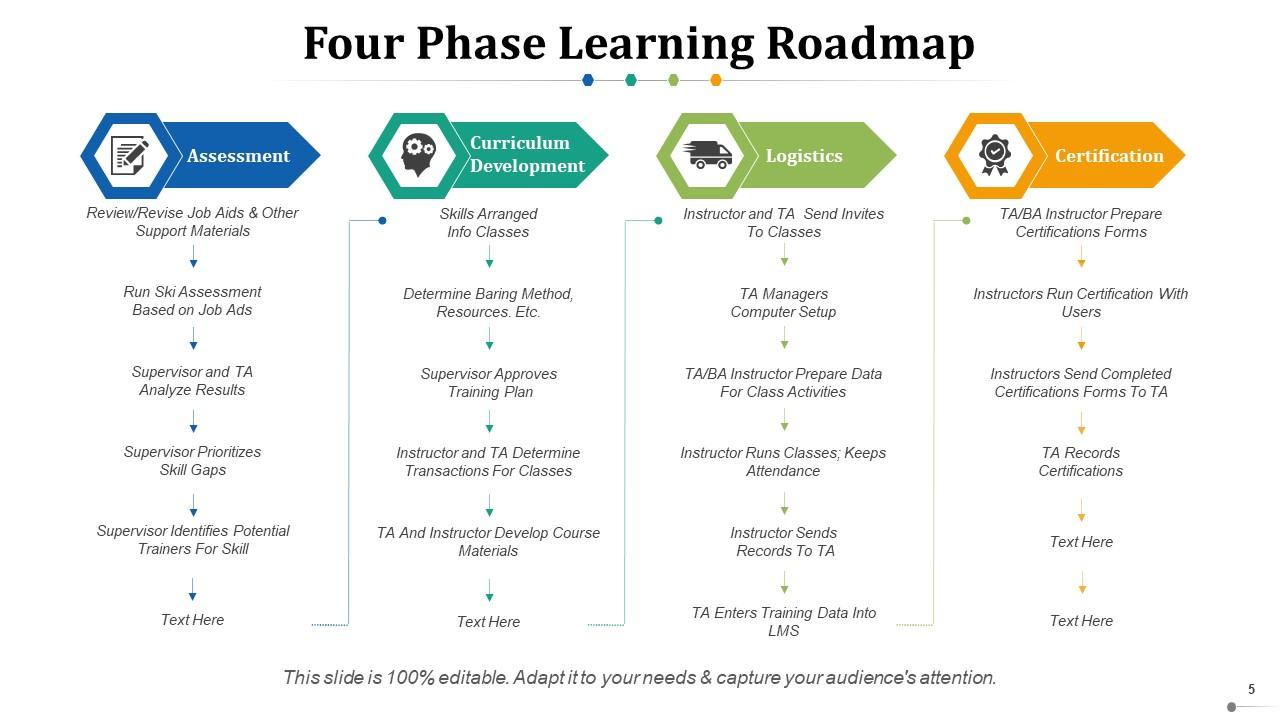
The slide summarizes the four phases any training must have to ensure it is taken seriously, and the market perceives it to have value. The first phase is, of course, assessment of the level of the trainees, and for a business (market). Based on the assessment, curriculum development is taken up to ensure what is on the agenda is needed. Then, the actual logistics of how the training will be delivered is designed, and certification is critical for those in need to actually attend the training. This PPT Template represents each phase in a tabular format, which improves the look and makes it more practical. The key benefit of the slide is that it allows you to discuss each phase in detail, which makes it more engaging.
Template 4: Learning Roadmap for Students Template
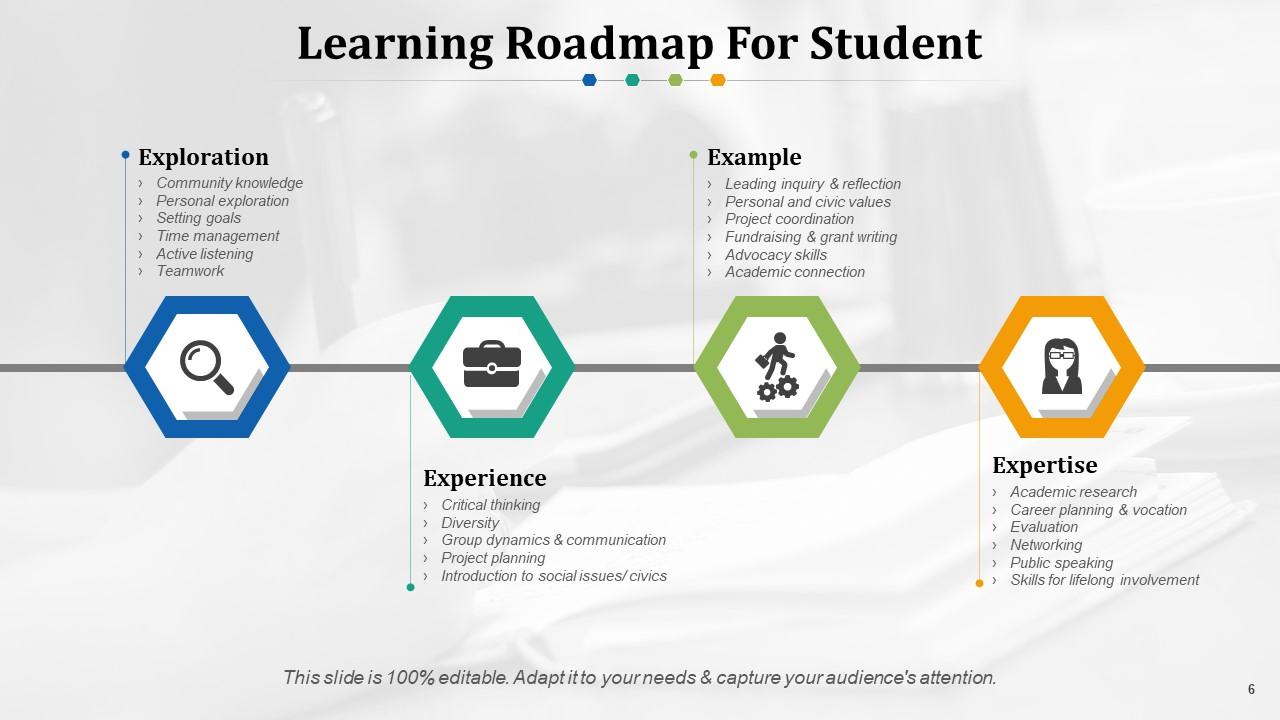
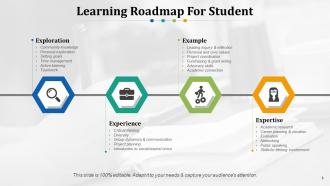
Use this PPT Template as a learning roadmap for students in getting better outcomes from any training. Use this slide to completely understand the 4Es of exploration, experience, example and expertise. For instance, critical thinking experience fuels an aptitude for training and how your perceptions and words would be taken by a group of executives.
Template 5: General Learning Roadmap for All Industry
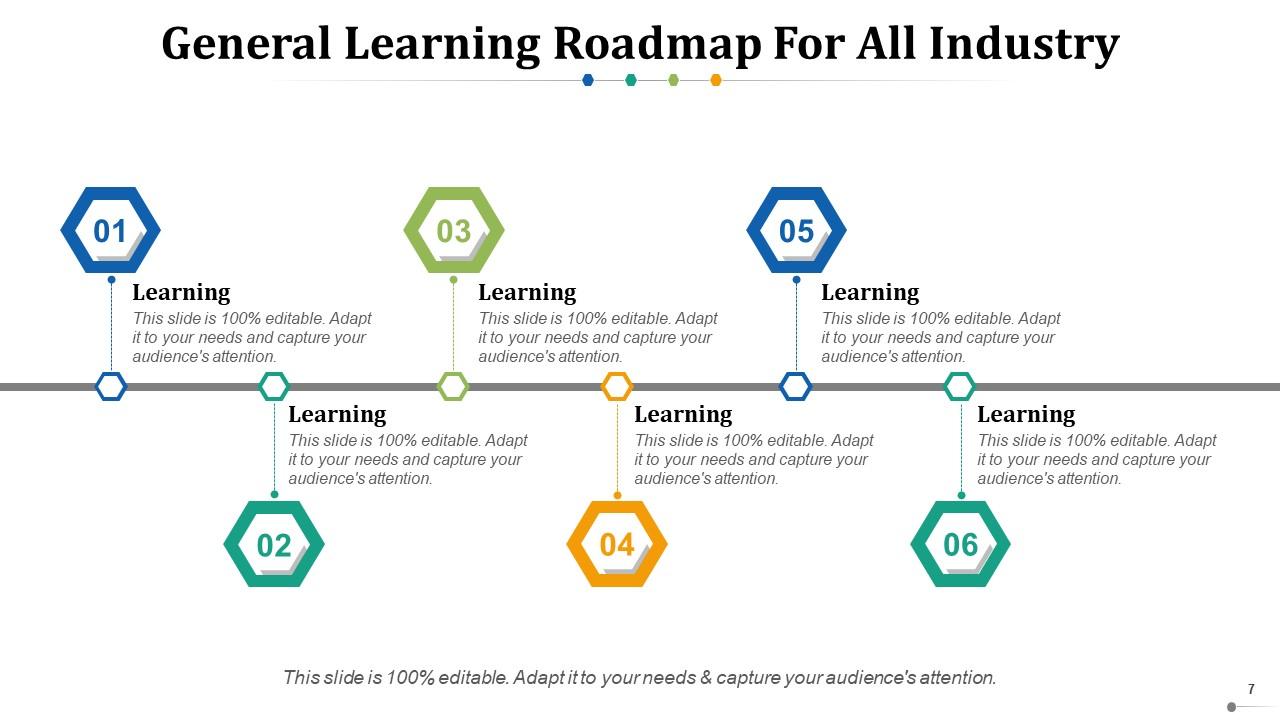
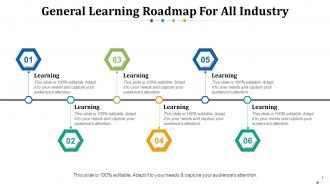
This template helps you create a robust learning roadmap for your team by helping you conduct thorough research and analysis of the best learning resources. You can also use this template to define your team's learning objectives and outcomes. The template divides the entire learning process into six steps to enhance clarity. Furthermore, learners can focus on one aspect at a time without being overwhelmed. Additionally, subdividing the entire learning process helps track progress. So, this template supports employee development and helps businesses retain talent.
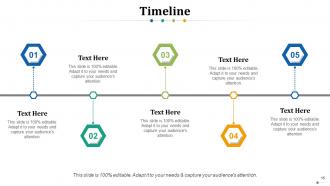
Template 6: Timeline Template
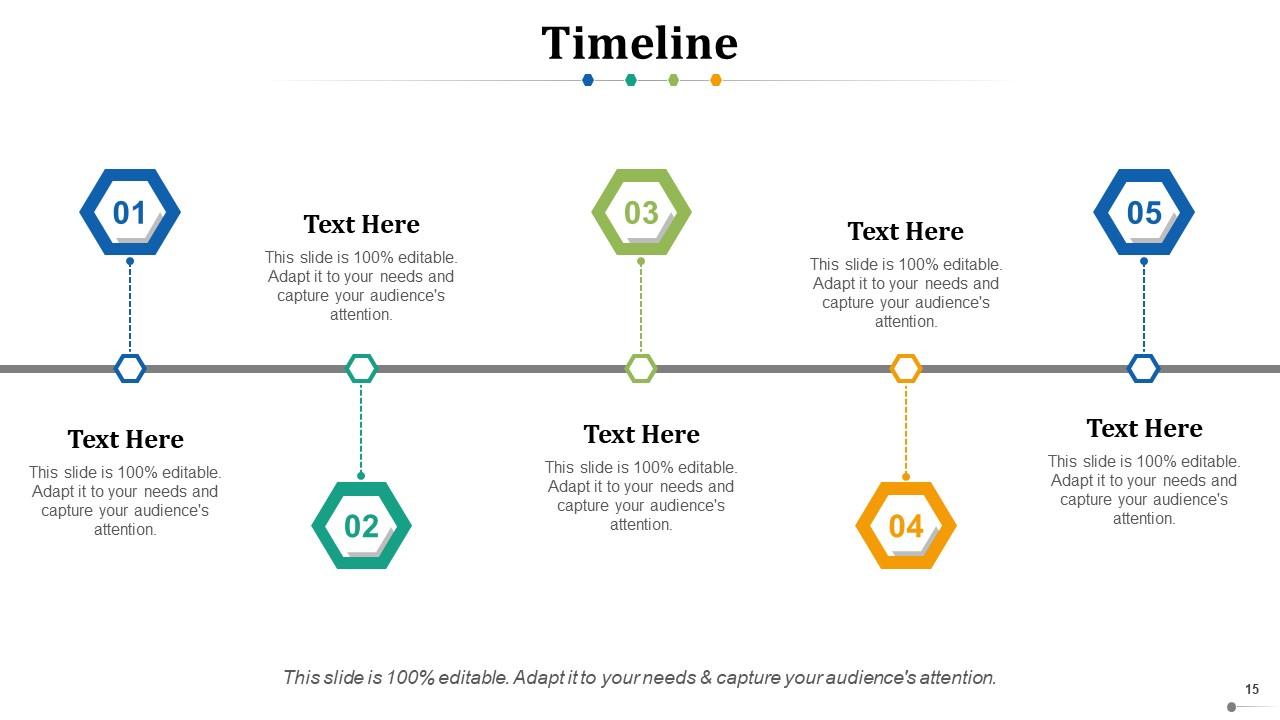
Due to its versatility, this template is a must for any industry. The timeline template plays a significant role in project planning and resource management. It also boosts communication and collaboration between teams. It provides a common ground for discussion, eliminating misunderstandings and conflicts. The important feature of this template is that it allows for a structured framework for planning a project, which streamlines the workflow and minimizes idle time. This template enhances the productivity and efficiency of the workforce.
TRAINING RIGHT IS CRITICAL FOR BUSINESSES
Today, the practical training roadmap is gaining popularity for several reasons. If you are looking for roadmap training templates, then our professionally designed templates will help you project yourself as a leader.
PS Also, if you are looking for a five-year or three-month training roadmap, we have got you covered. So, download these templates and explore the endless possibilities.
Training roadmap powerpoint presentation slides with all 21 slides:
Use our Training Roadmap Powerpoint Presentation Slides to effectively help you save your valuable time. They are readymade to fit into any presentation structure.


FAQs for Training roadmap
Okay so first thing - figure out your end goal, then work backwards to see what steps you need. You'll want clear objectives and a logical order where each skill builds on the last one. Set realistic timelines with milestones you can actually hit. Build in regular check-ins to see how you're doing. Also figure out what resources you need upfront - courses, mentors, whatever. Here's the thing though: I've watched so many people make these gorgeous roadmaps that just sit there unused because they're way too rigid. Make yours flexible enough to adjust as you go. Sometimes you'll discover something way more interesting than your original plan anyway.
Map your training stuff directly to what the business actually needs. Like if they're losing customers, focus on service skills or product knowledge. I've watched companies just dump random courses on people - total waste. Get leadership to tell you which skill gaps are actually hurting results, then tackle those first. Also, don't just track completion rates (boring). Measure things that actually matter to the bottom line. Honestly, most places overcomplicate this. Pick one clear connection between training and business goals, nail that, then expand from there.
Dude, think of employee feedback as your cheat sheet for what people actually need to learn. Skip the guessing game - just ask them directly through surveys or quick one-on-ones. I swear, half the training programs I've seen bomb because managers think they know what skills are missing. Your team will tell you what formats work best for them too. Some people love workshops, others prefer online stuff. Start simple: ask what they want to focus on next quarter. You'll probably be surprised by their answers, but that's the whole point really.
Honestly, tech can totally transform your training roadmap. AI adapts content based on how fast people learn, which is pretty cool. Real-time analytics show you exactly where folks get stuck too. Mobile apps are clutch - I've watched people knock out modules on the train, during lunch breaks, whatever. Don't go crazy with a million different platforms though. Pick one solid LMS first, then add other tools that actually play nice together. The personalization piece is where you'll see the biggest wins. Oh, and those progress dashboards? Game changer for spotting patterns you'd never catch otherwise.
Honestly, ditch the generic training manual approach and use actual examples from your workplace. People zone out during those marathon lecture sessions - break things up with discussions and let them practice right away. Real case studies hit way different than textbook scenarios. Make sure every single point connects to "okay but how does this help me do my job better tomorrow?" If you can't answer that clearly, the content probably needs work. Oh and definitely ask for feedback as you go - I've seen too many trainers just plow ahead when everyone's clearly lost.
Start with mapping current skills against what you actually need for upcoming projects. I do self-assessments plus manager reviews, but honestly people are terrible at rating themselves - they always think they're better than they are lol. Performance data helps balance that out. Look at job descriptions for roles people want and spot the gaps there. Don't just focus on today's needs either - think about where the business is heading. Once you've got that analysis done, rank which skills matter most. That's basically your training roadmap right there.
Look, completion rates and test scores are fine but they're pretty surface-level - just tells you people showed up. What you really need is proof they're actually using this stuff day-to-day. I'd focus on behavior changes and performance improvements that tie back to your business goals. Employee surveys help too, especially confidence levels. Honestly, resist the urge to track everything under the sun. Pick maybe 3-4 solid metrics and stick with those consistently. Otherwise you'll end up with a million spreadsheets and zero insights.
Honestly, just give people options for how they want to learn stuff. Some folks love videos and charts, others would rather listen to podcasts or join discussions. Then you've got the people who need to actually DO things - simulations, workshops, whatever gets their hands moving. Mixed approaches work best anyway (keeps people from zoning out). For each big topic, plan like 2-3 different ways to teach it. Quick survey your team first to see what they prefer. Oh, and build some wiggle room into your timeline since different people will move through material at different speeds. Same destination, different routes.
Honestly, the worst thing you can do is throw everything at your team without checking if they can actually handle it. I've watched so many roadmaps crash because people made them way too rigid - then when priorities change (and they always do), the whole thing becomes pointless. First, figure out what skills you have vs what you actually need. Build in buffer time because stuff always takes longer than expected. Get stakeholders on board early or you'll be fighting uphill later. Oh, and don't just focus on technical stuff - soft skills matter too, even though everyone forgets about them.
Honestly? Check it monthly if you can manage it. I know that sounds like a lot, but hear me out - stuff changes so damn fast now. What looked critical in January might be completely pointless by March. Your team's skills evolve too as people take on new projects. Do the big quarterly reviews for budget and timeline stuff, obviously. But those quick monthly check-ins are where you'll catch problems early. I learned this the hard way when our whole training plan became irrelevant because the industry pivoted. Just throw a recurring reminder on your calendar right now before you forget.
Honestly, just map out which teams you actually work with day-to-day - marketing, sales, whoever. Then build learning stuff around those natural touchpoints instead of forcing it. I'd block maybe one afternoon monthly for cross-functional workshops where everyone teaches their processes. Lunch and learns work great too, though some of the best training happens randomly over coffee anyway (which you can't really schedule). Make it part of quarterly goals so it's not just an afterthought. The trick is keeping it systematic but not overwhelming - nobody wants another mandatory thing eating up their week.
Honestly, start with decent learning management software - nothing fancy, just something that won't drive everyone crazy with crashes and weird glitches. Get your subject matter experts involved early for content creation. Your managers need to actually carve out time to support their teams too, which is harder than it sounds. Budget for some external courses if your internal stuff is lacking. Oh, and this is crucial - make sure executives are genuinely on board, not just giving you lip service. You'll need someone dedicated to coordinate everything. Before spending money though, audit what you've already got lying around.
Honestly, you've gotta run two tracks at once - sounds crazy but it works. Dedicate like 60-70% of your training budget to fixing immediate skill gaps. The rest? Future stuff that aligns with where you're headed in 2-3 years. Here's the sweet spot though - find skills that solve today's problems AND build tomorrow's capabilities. We taught our team data analysis to handle current reporting headaches, but now they're ready for bigger analytics roles down the road. Map out what you need now vs. later and hunt for those overlap opportunities. Trust me, getting caught with half your team's skills outdated is not fun.
Honestly, it depends on what you're trying to teach and who's attending. Virtual training works well for knowledge stuff and when your team is scattered everywhere, but keeping people focused is rough - I swear half my coworkers are checking email during calls. For hands-on skills or team building? Go in-person. Those complex discussions where you need real back-and-forth just hit different face-to-face. Budget matters too since virtual saves travel money but you might need decent tech. I'd start by looking at your actual learning goals first, then pick whatever format makes sense for that content.
Honestly, your leaders will make or break this whole thing. If they don't care, nobody else will either - it's that simple. You need them communicating why this training matters and actually showing up themselves. Can't expect people to take it seriously if the boss is skipping out, right? Also make sure they're giving you the budget and resources you need upfront. Hold people accountable too, otherwise it just turns into another ignored email in everyone's inbox. Oh and get them involved early - way easier than trying to convince them later when things aren't working.
-
Very unique and reliable designs.
-
Illustrative design with editable content. Exceptional value for money. Highly pleased with the product.
-
Illustrative design with editable content. Exceptional value for money. Highly pleased with the product.