


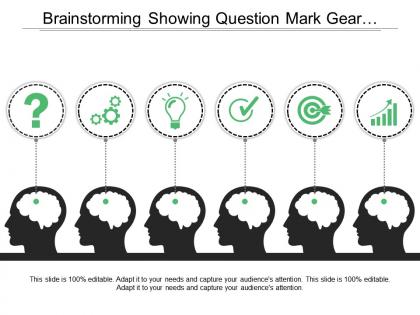
Brainstorming showing question mark gear bulb target icon and bar graph




Try Before you Buy Download Free Sample Product
 Impress Your
 Audience
 100%
100% Editable
 Save Hours
 of Time


Discredit insular attitudes with our Brainstorming Showing Question Mark Gear Bulb Target Icon And Bar Graph. Build a climate of acceptance.
People who downloaded this PowerPoint presentation also viewed the following :
Brainstorming showing question mark gear bulb target icon and bar graph with all 5 slides:
Get your ideas across to the grassroots with our Brainstorming Showing Question Mark Gear Bulb Target Icon And Bar Graph. Ensure each individual is fully informed.


FAQs for Brainstorming showing question mark gear bulb target icon
Honestly, start with a super clear problem statement - that's half the battle right there. Ban phones (trust me on this one, learned it the hard way). Let people go crazy with ideas first, no judgment. I'd give everyone a few minutes to think alone before diving into group chat - stops the loudest person from taking over, you know? Build on each other's stuff instead of shooting things down. Keep the vibe upbeat. Oh, and get someone neutral to run it who doesn't have a horse in the race. Timebox everything or you'll be there forever talking in circles.
Dude, try visual stuff next time you brainstorm. Mind maps and flowcharts show connections you'd totally miss otherwise. I swear sticky notes on a wall work better than most fancy apps sometimes. Your brain spots patterns and weird links between ideas when they're spread out visually. Some people on your team probably think in pictures anyway, not just words. Miro's pretty solid if you want something digital, but honestly? Colored sticky notes are underrated. You'll catch gaps in your thinking and random connections that actually lead somewhere interesting.
Honestly, group dynamics can totally make or break brainstorming. When people feel safe to share weird ideas and everyone gets a chance to talk, the creativity just flows. But bad vibes? Kiss your good ideas goodbye. I've seen sessions where one loud person dominates everything or people clam up because they're scared of looking dumb. Set some ground rules first - like no shooting down ideas immediately. Round-robin works well to get quieter folks talking. Mix up your group sizes too. Sometimes the best stuff comes from the random tangents anyway.
Honestly, digital brainstorming is a game changer. The quiet people on your team? They'll actually speak up when they can drop ideas anonymously. Real-time whiteboards like Miro let everyone build on thoughts visually - way better than those awkward conference room silences. Some folks just can't think with everyone staring at them, you know? I've seen teams double their idea output just by switching to shared docs or Figma boards. Set up a virtual space before your next session. You'll be shocked how much more creative stuff comes out when people aren't competing to talk over each other.
Ugh, creative blocks are the worst! First thing I'd try is literally just changing rooms - sounds dumb but it actually helps. Here's a weird trick that works for me: spend like 10 minutes coming up with the absolute worst ideas possible. It's weirdly freeing and usually gets better stuff flowing after. Also take actual breaks so your brain can work in the background. Try switching perspectives too - like what would some random 8-year-old think of? Or flip it and consider how your competitors might tackle it. The whole point is just breaking whatever mental rut you're stuck in. Start with whatever feels easiest!
Honestly, tight deadlines can actually help with brainstorming - weird but true. Your brain stops overthinking and just starts spitting out ideas. People get less filtered when they're rushed, which is usually good for creativity. But don't go crazy with it. I've watched teams completely choke when given like 5 minutes for something complicated. That's just cruel. You want maybe 15-30 minutes for most stuff? Long enough to get rolling but not so long that everyone starts checking their phones. It's about finding that sweet spot where urgency helps instead of paralyzing everyone.
Oh totally, mixing up your team makes such a huge difference! Different backgrounds = way better ideas. Like, someone from marketing will see problems completely differently than an engineer would. I've been in those sessions where everyone just agrees with each other - honestly kind of a waste of time. But throw in people from different departments or age groups? Suddenly you're catching stuff you'd never notice. The solutions actually work for real people instead of just sounding good on paper. Next time, grab folks from random teams. Trust me on this one.
Honestly, you've gotta make people feel safe to share the random stuff - that's where the good ideas usually hide anyway. I always start by saying "bring me your weirdest thoughts" or something like that. Try having everyone write ideas down first before talking out loud. Helps the quiet thinkers who need a sec to process. Don't let the same people jump in first every time either. Anonymous submissions work great too. Oh, and actually shut down the critics when they start picking things apart too early. Mix up your whole approach basically - different personality types need different ways to contribute, not just whoever talks fastest.
Just write down literally everything - don't filter anything out during the session. Seriously, the weirdest ideas sometimes end up being brilliant later. Sticky notes or shared docs work great so everyone can see what's getting captured. Have someone be the dedicated note-taker if things get crazy fast. Then afterward (and this part's crucial), sort everything into categories and get a clean summary out within 24 hours. Your brain will thank you later when you're trying to remember that random but genius idea from hour three. Make it searchable too - there's nothing worse than knowing you had the perfect solution but can't find it anywhere.
Oh totally! Mind mapping is great because your brain just starts connecting random stuff you wouldn't normally think of together. Round-robin's clutch for getting the quiet people to actually speak up instead of just sitting there. When I'm completely stuck, SCAMPER gives me actual prompts to work with. Free-writing is perfect for shutting up that annoying voice in your head that critiques everything. Each method hits different parts of your brain - some build on existing ideas, others just pump out volume or challenge what you're assuming. Pro tip: switch between like 2-3 formats in one session. Keeps things from getting stale.
So once you've got all those ideas out, group similar ones together - affinity mapping is what they call it but basically you're just looking for patterns. Then do dot voting where everyone gets stickers for their favorites (seriously, grown adults get weirdly excited about stickers). The impact/effort matrix works great too - just plot stuff based on how much bang you'll get versus how much work it takes. Oh, and there's MoSCoW method if you want to get fancy - Must have, Should have, Could have, Won't have. I'd start with dot voting though. Quick and people actually participate.
Dude, your space totally matters for brainstorming! Those awful conference rooms with fluorescent lighting? Creativity goes to die there. Natural light is everything - plus comfy chairs you can actually move around and walls where you can slap up sticky notes. I've watched teams kill it in random lounges or even outside instead of boring meeting rooms. Everyone needs to see each other without feeling cramped. Oh, and make sure there's room to collaborate freely. Seriously, try ditching your usual spot next session - you'll be shocked how much more your team engages.
Ugh, group brainstorming can be such a mess because of weird psychology stuff. People slack off when they think others will do the work (social loafing). Your team probably holds back their wildest ideas too - nobody wants to sound stupid in front of everyone. Plus you get that chaos where everyone's talking over each other, which kills momentum. Oh and conformity pressure makes people play it safe instead of being actually creative. Honestly though, you can fix most of this by making participation expectations super clear upfront and doing silent brainstorming first before the group free-for-all starts.
Honestly, you gotta nail down who's doing what before people scatter. Skip the wishy-washy "let's circle back" nonsense - be specific about deadlines and owners. I always fire off a follow-up email the next day while everyone still remembers what we talked about. Book your check-in meeting right then and there, maybe 2-3 weeks out. Otherwise those brilliant ideas just turn into forgotten Post-its stuck on someone's monitor. Oh, and here's something I learned the hard way - always start your next brainstorm by checking what actually got done from last time. Creates way better accountability.
Honestly, I track it a few ways. Count total ideas and who's actually jumping in versus just sitting there. My favorite metric? How many ideas build off each other - that's when you know people are really vibing. Quality-wise, see which ones survive to the next round and rate them for feasibility/impact. But here's the thing - survey people afterward about whether they felt engaged. That tells you way more than numbers sometimes. The real winner though is tracking what actually gets done in the next month or two. Ideas are worthless if they just die in a Google doc somewhere.
-
Great designs, Easily Editable.
-
Easily Understandable slides.