


Brand Advertising Powerpoint Presentation Slides




Try Before you Buy Download Free Sample Product
 Impress Your
 Audience
 100%
100% Editable
 Save Hours
 of Time


Highlight the key elements that enhance the position of your product by using our content ready Brand Advertising PowerPoint Presentation Slides. You can create a plan to pitch your product amongst your target customers with the help of this visually appealing brand positioning framework PowerPoint graphic. Use product management strategies PPT theme and showcase the benefits of your products that help to retain your existing customers. With the aid of a brand awareness presentation template, you can explain how to influence consumer perception and fulfill their requirements. Take the assistance of this professionally designed brand positioning map PPT visual and display the various campaigns by which you can sell your product. Employ strategic product management PowerPoint layout and display the factors that enhance the unique qualities of your product. Hence, download our ready-to-use Brand Advertisement Powerpoint Presentation Slides.
People who downloaded this PowerPoint presentation also viewed the following :
Content of this Powerpoint Presentation
Slide 1: This slide introduces Brand Advertising. State Your Company Name and begin.
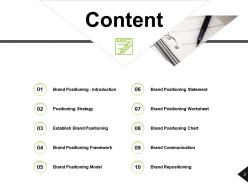
Slide 2: This slide shows Content of the presentation.
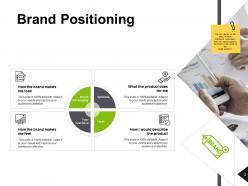
Slide 3: This slide presents Brand Positioning describing- Symbols, Facts, Brand Personality, etc.
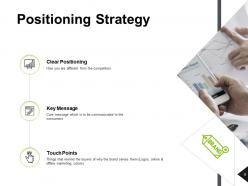
Slide 4: This slide displays Positioning Strategy describing- Clear Positioning, Key Message, Touch Points.
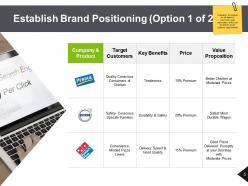
Slide 5: This slide represents Establish Brand Positioning in tabular form.
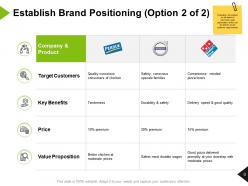
Slide 6: This is an optional slide to Establish Brand Positioning.
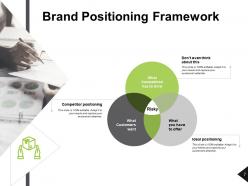
Slide 7: This slide showcases Brand Positioning Framework describing- What Competition has to give, What You have to offer, and What Customers Want.
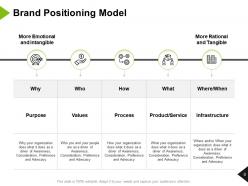
Slide 8: This slide shows Brand Positioning Model describing- Purpose, Values, Product/Service, Infrastructure, Process.
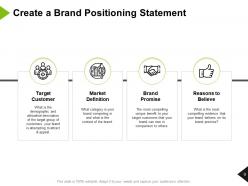
Slide 9: This slide presents Create a Brand Positioning Statement describing- Brand Promise, Reasons to Believe, Market Definition, Target Customer.
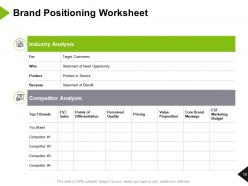
Slide 10: This slide displays Brand Positioning Worksheet with industry analysis and competitor analysis.
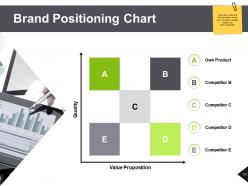
Slide 11: This slide showcases Brand Positioning Chart.
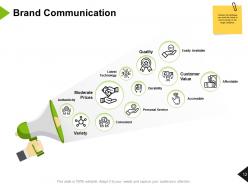
Slide 12: This slide represents Brand Communication describing- Customer Value, Personal Service, Accessible, Authenticity, Quality, Variety, Latest Technology, etc.
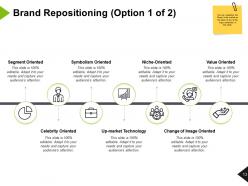
Slide 13: This slide shows Brand Repositioning describing- Value Oriented, Change Of Image Oriented, Niche-oriented, Up-market Technology, Symbolism Oriented, Celebrity Oriented, Segment Oriented.
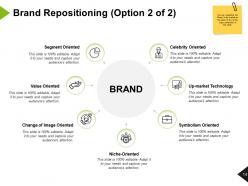
Slide 14: This is an optional slide for Brand Repositioning.
Slide 15: This slide displays Brand Marketing Icons.
Slide 16: This slide reminds about a 15 minutes Coffee Break.
Slide 17: This slide is titled as Additional Slides for moving forward.
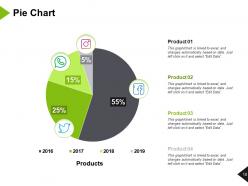
Slide 18: This slide displays Pie Chart with data in percentage.
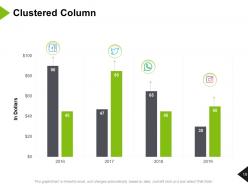
Slide 19: This slide shows Clustered Column chart with two products comparison.
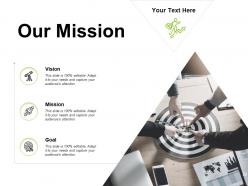
Slide 20: This is Our Mission slide with related imagery and text.
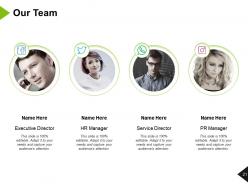
Slide 21: This is Our Team slide with names and designation.
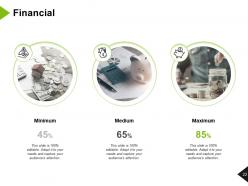
Slide 22: This is a Financial slide. Show your finance related stuff here.
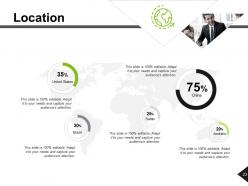
Slide 23: This is a Location slide with maps to show data related with different locations.
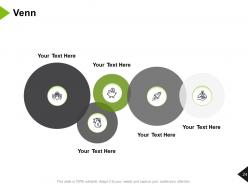
Slide 24: This is a Venn slide with text boxes.
Slide 25: This is a Thank You slide with address, contact numbers and email address.
Brand Advertising Powerpoint Presentation Slides with all 25 slides:
Use our Brand Advertising Powerpoint Presentation Slides to effectively help you save your valuable time. They are readymade to fit into any presentation structure.

FAQs for Brand Advertising
Okay so three things you gotta get right: solid brand identity that actually sets you apart, messaging that's consistent everywhere, and really knowing your audience's problems and what they care about. So many people totally skip the research part and just guess - don't do that lol. Whatever creative stuff you do needs to connect emotionally but still sound like *you*, whether that's through stories, being funny, or whatever vibe fits. Track brand awareness and how people feel about you over time, not just sales right away. I'd start by checking where your brand feels off or inconsistent across different places.
Okay so here's the thing - people don't remember specs, they remember stories. Like, nobody cares that your app is "20% faster" but they'll totally remember how it saved someone's morning commute disaster. Stories let customers picture themselves actually using your stuff. Complex products suddenly make sense. Boring ones become interesting (which honestly, most products need help with). Your audience connects emotionally instead of just reading bullet points. They're way more likely to tell their friends about a good story than features. Next campaign? Skip the product specs. Focus on how you solved someone's real problem instead.
Dude, social media is where brands actually connect with people now instead of just shouting ads at them. You can get crazy specific with targeting and talk directly to customers through comments and DMs. The content spreads naturally when it's good too. Honestly, TikTok brand accounts are kind of addictive to watch? But yeah, focus on being real and consistent rather than constantly trying to sell stuff. Pick maybe 2-3 platforms where your people actually spend time - don't spread yourself too thin. The analytics you get back are pretty solid for tweaking your approach.
Track your conversions and click-through rates first - that's the easy stuff. Direct sales attribution from campaigns too. Brand awareness is honestly way harder to measure. You'll need surveys or brand lift studies to see if people actually remember your ads. Social listening tools help with sentiment changes, but they're kind of a pain to set up properly. Get your baseline metrics before launching anything, then compare performance across channels. Google Analytics and Facebook Pixel are must-haves if you don't have them yet. Oh, and test different creative approaches - some will flop completely.
Colors are huge for how people see your brand - like, red screams urgency while blue feels trustworthy. Your whole visual vibe sets the personality before anyone reads anything. I've watched companies totally flip their image just by changing their color scheme (wild how much that matters). If your visuals don't match what your audience expects, you'll just confuse them. Quick fix: look at your current colors compared to competitors and see if they're actually hitting the right message for your goals.
Your target audience's age and income totally change everything about your approach. Gen Z wants that raw, authentic stuff on TikTok and Insta. Boomers? They're still scrolling Facebook and watching TV - hit them with clear benefits. Here's the thing though - income matters just as much. Rich people want premium vibes, everyone else cares about getting bang for their buck. I always tell people to stalk your audience's social media habits first (sounds creepy but it works). Then match their vibe. Different generations literally speak different languages when it comes to marketing.
Honestly, storytelling is your best bet here. Nike doesn't just sell shoes - they make you feel like you can conquer the world. Same with Coca-Cola and that whole "share a moment" vibe they've got going. Skip the boring product specs and focus on visuals, music, and stories that hit people in the feels. Real customer stories work amazingly well too. Figure out what emotion you want tied to your brand first - nostalgia? Joy? That sense of belonging everyone craves? Then build everything around triggering that specific feeling. It's way more effective than you'd think.
Okay so for slogans, you want something super short that gets stuck in people's heads - like "Just Do It" level catchy. Test it on friends who don't know your business and see if they remember it a few days later. That's honestly the best way to know if it works. Make sure it actually fits what you're selling though, not just random words that sound good together. Oh and once you pick one, stick with it everywhere for at least a year. I see people change their slogan every few months and wonder why nobody remembers it. Consistency is everything with this stuff.
Think of influencer marketing as putting a human face on your regular ads. Your brand messages that would normally go in TV commercials? Now they're coming from people audiences actually trust and follow. Smart brands don't treat this as some totally separate strategy - that's where a lot of companies mess up honestly. You're basically amplifying what you already do through someone else's credibility. Short sentences work here. The cool part is you get real storytelling power but with that authentic vibe that only happens when actual people recommend your stuff to their followers.
Honestly, the AI targeting stuff is getting scary good - brands can predict what you'll buy before you even think about it. Everyone's using voice search now, so that's huge for optimization. AR and VR ads look amazing but they're still pretty expensive for most companies. Oh, and programmatic advertising keeps getting better at those real-time auctions. Interactive content is where it's at though - polls, quizzes, shoppable posts all get way better engagement. But here's the big thing: you need to start collecting your own customer data ASAP. Third-party cookies are basically dead, so if you don't have your own data platform yet, you're gonna be screwed.
You've gotta stay on top of what's happening culturally - social stuff, politics, generational shifts. Your messaging needs to feel current, not like you're stuck in 2015. Brands that ignore cultural movements just sound totally out of touch. Remember when everyone was obsessed with being "authentic"? That was peak early 2010s social media madness. Monitor what people are actually talking about and adapt your voice accordingly. Don't lose your brand identity, but make sure you're speaking the same language as your audience. Google Alerts is honestly a good starting point for tracking industry trends.
Okay so basically three main things to watch out for. First, don't make claims you can't actually prove - like saying your energy drink cures hangovers or whatever. Second, be careful who you're targeting. Kids and people struggling financially? Yeah, don't exploit them. And third - this one's huge - think about the bigger picture. Are you pushing weird beauty standards or making people feel crappy about themselves? Nobody wants to be that brand everyone hates. Oh, and represent people authentically instead of just checking diversity boxes. Honestly just ask yourself: would I be annoyed if someone advertised to my family this way?
Get yourself a proper brand style guide first - logo rules, colors, fonts, how you talk to people, all that stuff. Actually follow it though! Can't tell you how many companies spend forever making these things then completely ignore them (drives me nuts). Have your team check in regularly to make sure nobody's going rogue with the messaging. Nothing should go live without someone approving it fits your brand. Oh, and make the guide super easy to find - if people have to hunt for it, they won't use it. Document everything clearly and you'll be golden.
Honestly, user-generated content is like hitting the marketing jackpot. Real customers posting about your stuff feels way more genuine than whatever polished ads you'd create. People trust other people way more than brands - it's just human nature. The best part? You're basically getting free marketing since customers are doing the work for you. Way cheaper than hiring influencers or spending hours on content creation. Oh, and audiences actually engage with this stuff because they see themselves in regular people, not some perfect Instagram model. Start with a branded hashtag and just ask customers to share their experiences.
Look at what your top competitors are doing first - their messaging, who they target, how they look. Then do the opposite, honestly. Find the gap they're all missing and own it completely. Apple did this perfectly when everyone was cramming features into everything and they went super clean instead. Dove found their lane with real women while beauty brands kept pushing airbrushed perfection. The trick is committing to whatever angle you pick. Can't half-ass it or jump around - has to show up everywhere consistently. What space are your competitors leaving wide open?
-
Very unique, user-friendly presentation interface.
-
Easily Editable.
-
Colors used are bright and distinctive.