

Brand Positioning Bulls Eye Template For Fast Food Chain




Try Before you Buy Download Free Sample Product
 Impress Your
 Audience
 100%
100% Editable
 Save Hours
 of Time


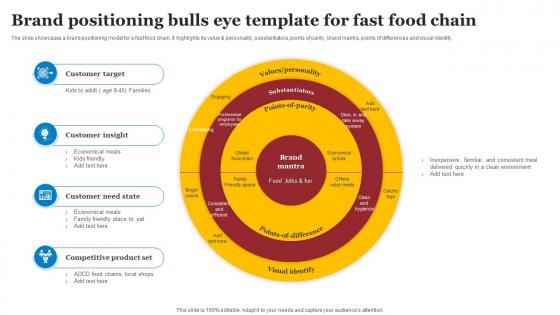
The slide showcases a brand positioning model for a fast food chain. It highlights its value and personality, substantiators, points of parity, brand mantra, points of differences and visual identity.
People who downloaded this PowerPoint presentation also viewed the following :
Brand Positioning Bulls Eye Template For Fast Food Chain with all 6 slides:
Use our Brand Positioning Bulls Eye Template For Fast Food Chain to effectively help you save your valuable time. They are readymade to fit into any presentation structure.






FAQs for Brand Positioning Bulls Eye Template For
A brand positioning bulls eye template helps marketers systematically define their brand's core identity, target audience, competitive differentiation, and value proposition in concentric circles of strategic importance. This visual framework enables companies to align messaging across channels, clarify market positioning, and ensure consistent brand communication, ultimately delivering stronger customer connections and competitive advantage in increasingly crowded marketplaces.
Businesses can effectively identify their unique selling proposition using the bulls eye template by mapping core brand values in the center ring, competitive differentiators in the middle ring, and target audience benefits in the outer ring. This strategic visualization helps organizations like retail companies and financial services firms systematically evaluate their market position, refine messaging clarity, and ultimately deliver more compelling value propositions that resonate with customers while strengthening competitive advantage.
A brand positioning bulls eye template should include target audience demographics, core brand values, unique value proposition, competitive differentiators, and key messaging pillars. These elements work together by defining customer needs, articulating brand benefits, and establishing market position, with many organizations finding that this strategic framework streamlines marketing efforts while delivering consistent messaging and stronger competitive advantage.
The bulls eye template assists in visualizing target market differentiation by creating concentric circles that map audiences from core customers to peripheral prospects, enabling clear segmentation based on engagement levels, purchase behavior, and strategic value. This visual framework helps organizations identify their most profitable customer segments, prioritize resource allocation across different market tiers, and develop targeted messaging strategies, ultimately delivering more focused marketing efforts and improved conversion rates across diverse audience segments.
Customer feedback plays a crucial role in validating and refining each layer of the bulls eye template, from core brand essence to outer messaging strategies, ensuring positioning resonates authentically with target audiences. Through systematic feedback collection, companies can adjust their competitive differentiation, value propositions, and communication approaches, with many organizations finding that customer insights ultimately enhance market relevance and drive stronger brand loyalty.
Brands can use the bulls eye template to create consistent core messaging hierarchies that translate seamlessly across email campaigns, social media, advertising, and content marketing channels. By establishing their primary value proposition at the center and supporting messages in outer rings, marketing teams ensure unified brand communication while adapting tactical execution for each platform's unique requirements and audience expectations.
Best practices for filling out the brand positioning bulls eye template include conducting thorough market research, defining clear target demographics, articulating unique value propositions, analyzing competitor positioning, and establishing measurable brand attributes. These strategic elements work together by creating focused messaging frameworks, ensuring consistent brand communication, and differentiating market presence, with many organizations finding that systematic template completion ultimately delivers stronger brand clarity and competitive positioning advantage.
The bulls eye template helps refine brand segmentation by creating concentric circles that prioritize audiences from core loyalists to potential prospects, enabling precise resource allocation and messaging strategies. This visual framework allows marketers to identify high-value customer segments, tailor communications for each audience tier, and optimize marketing spend, with retail and financial services companies finding that structured segmentation ultimately delivers higher conversion rates and stronger brand loyalty.
Common pitfalls include being too generic with messaging, failing to validate assumptions with market research, overcomplicated positioning statements, and neglecting competitor analysis. Many organizations find that rushing through target audience definition or creating positioning without customer input undermines effectiveness, ultimately requiring repositioning efforts that could have been avoided through thorough initial strategic planning and validation.
The bulls eye template facilitates internal stakeholder alignment by providing a shared visual framework that clearly delineates core brand elements, target audiences, and strategic priorities in concentric circles. This structured approach enables marketing teams, executives, and departments to collaborate more effectively on brand decisions, while ensuring consistent messaging across all touchpoints, ultimately delivering unified brand execution and stronger competitive positioning in increasingly crowded markets.
Brands can adapt the bulls eye template for competitive analysis by mapping competitors' positioning across concentric circles, identifying market gaps, analyzing messaging strategies, benchmarking value propositions, and assessing target audience overlap. This strategic approach enables organizations to visualize competitive landscapes, uncover differentiation opportunities, and refine their positioning, with many companies finding enhanced market clarity and competitive advantage.
The bulls eye template enhances brand communication by creating visual hierarchy that places core value propositions at the center, supported by key benefits, differentiators, and supporting messages in concentric circles. This structured approach enables marketing teams to prioritize messaging consistency across channels, streamline campaign development, and ensure stakeholder alignment, with many organizations finding that centralized value communication delivers stronger brand recognition and more compelling customer experiences.
**INPUT**: What industries or types of businesses benefit most from using a brand positioning bulls eye template? **OUTPUT**: Industries with complex value propositions, including technology, healthcare, financial services, retail, and professional consulting, benefit most from brand positioning bulls eye templates. These frameworks streamline strategic messaging by clarifying core values, target audiences, and competitive advantages, with many organizations finding that structured positioning enhances market differentiation and accelerates customer acquisition across competitive landscapes. **Word count: 54 words**
Brands should revisit their positioning strategy using the bulls eye template quarterly for tactical adjustments and annually for comprehensive reviews, with additional assessments during major market shifts, competitive changes, or product launches. This regular evaluation enables organizations to maintain relevance in increasingly dynamic markets, ensuring their core value proposition, target audience alignment, and competitive differentiation remain sharp and strategically advantageous.
Design tools that assist in creating visually appealing brand positioning bulls eye templates include Canva, Adobe Creative Suite, PowerPoint, Lucidchart, and Miro, along with specialized template platforms like SlideTeam. These platforms streamline template creation by offering pre-built frameworks, customizable graphics, and collaborative features, with many marketing teams finding that professional templates ultimately deliver consistent brand messaging and enhanced stakeholder presentations.
-
Amazing product with appealing content and design.
-
Their designing team is so expert in making tailored templates. They craft the exact thing I have in my mind…..really happy.