


Building Credit Card Promotional Campaign Strategy Powerpoint Presentation Slides Strategy CD V





Try Before you Buy Download Free Sample Product
 Impress Your
 Audience
 100%
100% Editable
 Save Hours
 of Time


The Building Credit Card Promotional Campaign Strategy is a powerful approach aimed at attracting, converting, and retaining potential customers for credit card businesses. This Customer acquisition presentation serves as a valuable tool in addressing critical marketing challenges. Moreover, the Loyalty program deck begins with a comprehensive company overview, including a SWOT analysis, target audience segmentation, and customer profiles. Furthermore, the Customer experience deck illustrates critical issues faced by the organization, such as low customer acquisition rate, high customer churn rate, and poor customer experience. Additionally, the Personal email marketing PPT showcases impactful marketing strategies and recommends using sign-up bonuses, personalized email marketing, and cost optimization. Also, the high customer churn rate template, targeted retention and loyalty programs, social media engagement, and budget management suggest practical solutions. Lastly, Sign up bonuses and rewards Powerpoint enhances customer experiences means implementing print media advertisement, running limited-time promotional campaigns, and employing seasonal marketing. This 100 percentage editable and customizable template, compatible with Google Slides, offers a comprehensive and practical guide to executing credit card promotional campaigns and enhancing business performance successfully. Download it now to elevate your credit card marketing endeavors.
People who downloaded this PowerPoint presentation also viewed the following :
Content of this Powerpoint Presentation
Slide 1: This slide displays the title Building Credit Card Promotional Campaign Strategy.
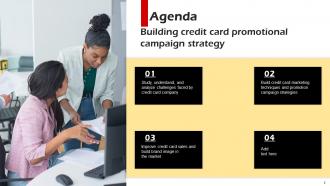
Slide 2: This slide displays the title Agenda.
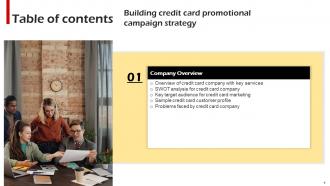
Slide 3: This slide exhibit table of content.
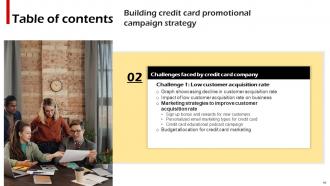
Slide 4: This slide exhibit table of content that is to be discuss further.
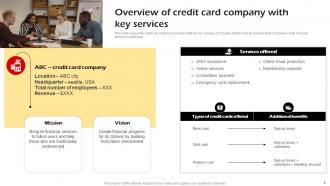
Slide 5: This slide represents outline for credit card company with its key services.
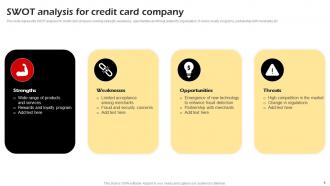
Slide 6: This slide represents SWOT analysis for credit card company covering strength, weakness, opportunities and threat related to organization.
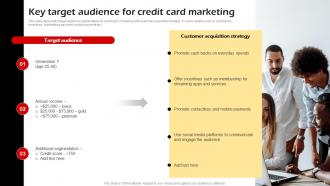
Slide 7: This slide represents target audience segmentation for credit card marketing with customer acquisition strategy.
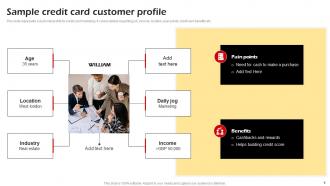
Slide 8: This slide represents a customer profile for credit card marketing.
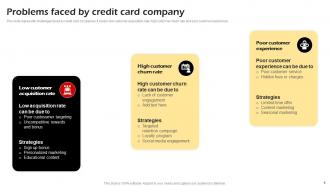
Slide 9: This slide represents challenges faced by credit card companies.
Slide 10: This slide exhibit table of content that is to be discuss further.
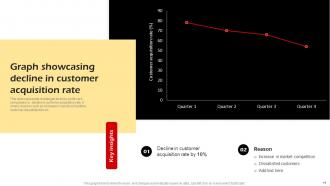
Slide 11: This slide represents challenges faced by credit card companies i.e., decline in customer acquisition rate.
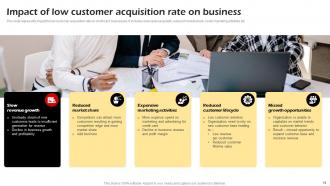
Slide 12: This slide represents impact for low customer acquisition rate on credit card businesses.
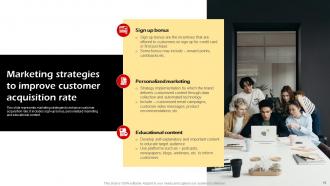
Slide 13: This slide represents marketing strategies to enhance customer acquisition rate.
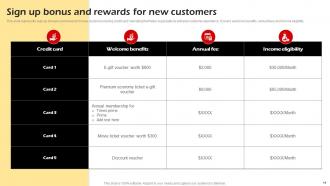
Slide 14: This slide represents sign-up bonuses and rewards for new customers during credit card marketing that helps organizations enhance customer experience.
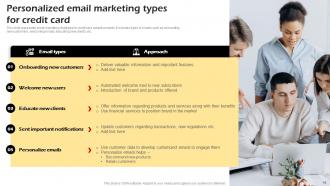
Slide 15: This slide represents email marketing strategies for credit card advertisements.
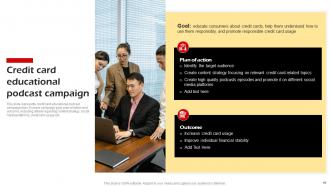
Slide 16: This slide represents credit card educational podcast campaign plan.
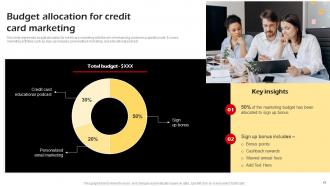
Slide 17: This slide represents budget allocation for credit card marketing with the aim of enhancing customer acquisition rate.
Slide 18: This slide exhibit table of content that is to be discuss further.
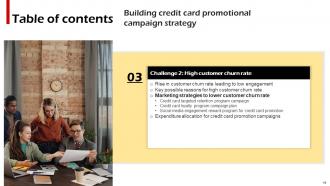
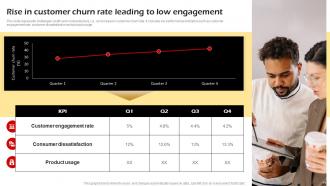
Slide 19: This slide represents challenges credit card companies face, i.e., an increase in customer churn rate.
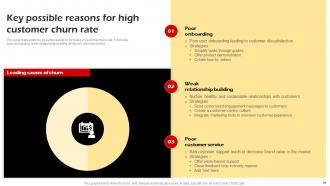
Slide 20: This slide represents key possible reason for increase in customer churn rate.
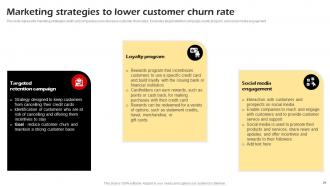
Slide 21: This slide represents marketing strategies credit card companies use to decrease customer churn rates.
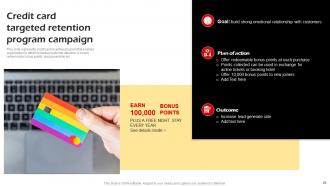
Slide 22: This slide represents credit card incentive program that enables organization to attract potential customer attention.
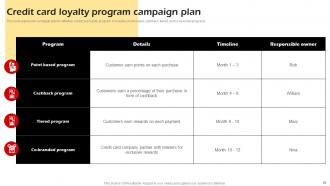
Slide 23: This slide represents campaign plan for effective credit card loyalty program.
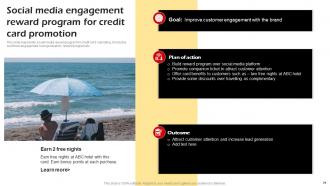
Slide 24: This slide represents social media reward program for credit card marketing.
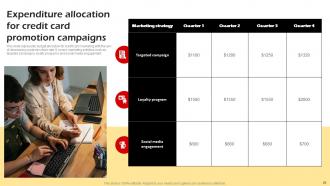
Slide 25: This slide represents budget allocation for credit card marketing with the aim of decreasing customer churn rate.
Slide 26: This slide exhibit table of content that is to be discuss further.
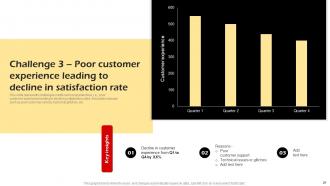
Slide 27: This slide represents challenges credit card companies face, i.e., poor customer experience leading to declining satisfaction rates.
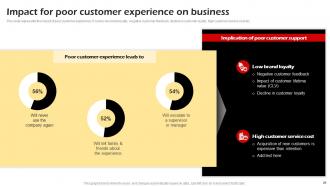
Slide 28: This slide represents the impact of poor customer experience.
Slide 29: This slide represents marketing strategies used by credit card companies to improve customer experience.
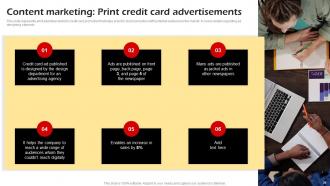
Slide 30: This slide represents print advertisements for credit card promotion that helps brand to build connection with potential audience in the market.
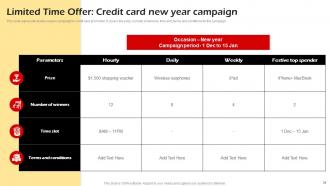
Slide 31: This slide represents festive season campaign for credit card promotion. It covers the prize, number of winners, time slot, terms and conditions for the campaign.
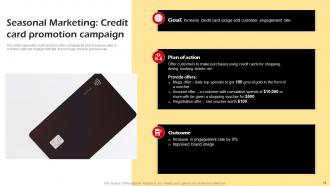
Slide 32: This slide represents credit card promotion campaign for end-of-season sales. It includes customer engagement rate, brand image, rewards and bonuses.
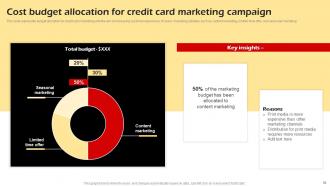
Slide 33: This slide represents budget allocation for credit card marketing with the aim of increasing customer experience.
Slide 34: This slide exhibit table of content that is to be discuss further.
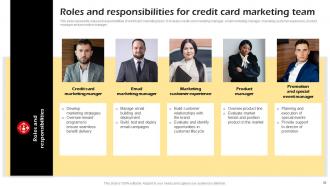
Slide 35: This slide represents roles and responsibilities of credit card marketing team.
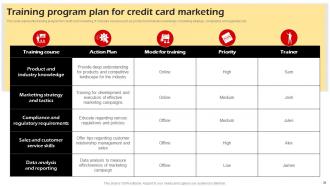
Slide 36: This slide represents training program for credit card marketing.
Slide 37: This slide exhibit table of content that is to be discuss further.
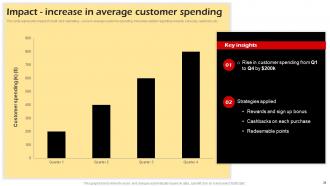
Slide 38: This slide represents impact of credit card marketing – a rise in average customer spending.
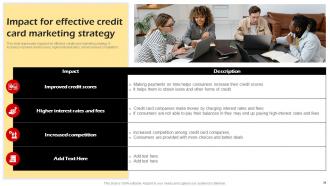
Slide 39: This slide represents impact of an effective credit card marketing strategy.
Slide 40: This is the icons slide.
Slide 41: This slide presents title for additional slides.
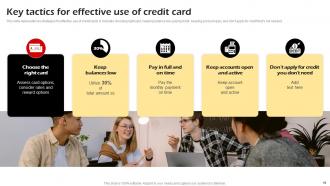
Slide 42: This slide represents key strategies for effective use of credit cards.
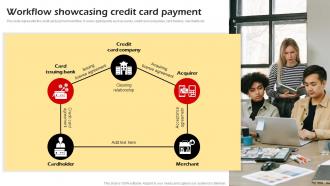
Slide 43: This slide represents the credit card payment workflow. It covers participants such as banks, credit card companies, card holders, merchants etc.
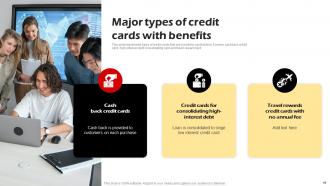
Slide 44: This slide represents types of credit cards that are issued to cardholders.
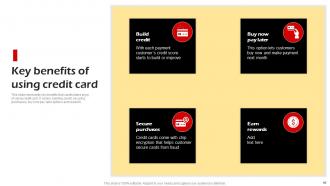
Slide 45: This slide represents key benefits that cardholders enjoy of using credit card.
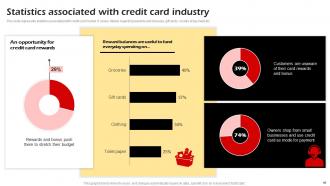
Slide 46: This slide represents statistics associated with credit card market.
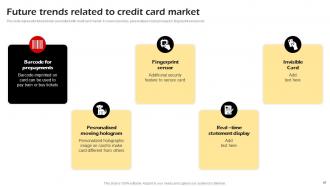
Slide 47: This slide represents future trends associated with credit card market. It covers barcodes, personalized moving hologram, fingerprint sensors etc.
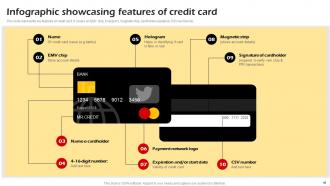
Slide 48: This slide represents key features of credit card. It covers an EMV chip, hologram, magnetic chip, cardholder signature, CSV number etc.
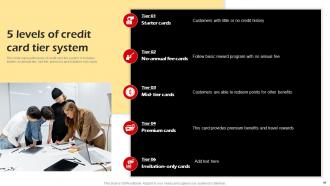
Slide 49: This slide represents levels of credit card tier system. It includes starter, no annual fee, mid-tier, premium, and invitation-only cards.
Slide 50: This is thank you slide & contains contact details of company like office address, phone no., etc.
Building Credit Card Promotional Campaign Strategy Powerpoint Presentation Slides Strategy CD V with all 55 slides:
Use our Building Credit Card Promotional Campaign Strategy Powerpoint Presentation Slides Strategy CD V to effectively help you save your valuable time. They are readymade to fit into any presentation structure.









FAQs for Building Credit Card Promotional Campaign Strategy Powerpoint Presentation Slides
Key metrics for credit card promotional campaigns include application conversion rates, cost per acquisition, activation rates, customer lifetime value, and campaign ROI across different channels. These metrics enable financial institutions to optimize targeting strategies, reduce acquisition costs, and enhance campaign effectiveness, with many banks finding that tracking both immediate conversions and long-term customer profitability ultimately delivers sustainable competitive advantage.
Customer segmentation enhances credit card promotion targeting by analyzing demographics, spending patterns, credit scores, and financial behaviors to create tailored campaigns. Banks can deliver personalized offers like cashback cards for frequent shoppers, travel rewards for business professionals, and secured cards for credit builders, ultimately increasing conversion rates and customer satisfaction while reducing marketing costs.
Digital marketing channels, direct mail, partnership marketing, referral programs, and social media advertising prove most effective for reaching potential credit card customers. Banks and financial institutions increasingly find success through targeted online campaigns, strategic partnerships with retailers, and personalized direct mail, ultimately delivering higher conversion rates and better customer acquisition costs.
Seasonal trends significantly influence credit card promotional strategies by aligning offers with consumer spending patterns, targeting holiday purchases, back-to-school expenses, and travel seasons. Financial institutions strategically time cashback bonuses, reward multipliers, and sign-up incentives around peak spending periods like Black Friday or summer vacations, ultimately maximizing customer acquisition and transaction volumes while enhancing cardholder engagement.
Customer feedback plays a pivotal role in refining credit card campaigns by identifying pain points, preferred rewards categories, communication preferences, and promotional timing effectiveness. Through surveys, focus groups, and digital analytics, financial institutions can optimize their messaging, enhance reward structures, and personalize offerings, ultimately delivering more targeted campaigns that resonate with customer needs and drive higher engagement rates.
Storytelling in credit card promotions creates emotional connections by showcasing real customer journeys, financial milestones achieved, and transformative life moments enabled by smart financial choices. Banks like Chase and Capital One leverage narrative-driven campaigns featuring customers achieving dreams, overcoming challenges, and building financial confidence, ultimately transforming transactional relationships into trusted partnerships that drive long-term loyalty and engagement.
Young adults typically respond to offers emphasizing cashback on everyday purchases, no annual fees, student-friendly approval criteria, mobile-first experiences, and rewards for popular spending categories like dining, entertainment, and online shopping. Financial institutions find success by highlighting financial education resources, credit-building benefits, and seamless digital integration, while positioning cards as tools for establishing financial independence rather than debt accumulation.
Data analytics refines credit card promotional strategies by analyzing customer spending patterns, identifying high-value segments, and predicting campaign performance across demographics. Through predictive modeling and behavioral analysis, financial institutions can personalize offers, optimize timing, and target specific customer profiles, ultimately delivering higher conversion rates and reduced acquisition costs while maximizing campaign ROI.
Credit card promotional compliance considerations include Truth in Lending Act (TILA) disclosures, CARD Act restrictions on marketing to students, fair lending requirements, state usury laws, and transparent fee structures. These regulations streamline consumer protection by mandating clear APR disclosure, limiting deceptive practices, and ensuring equitable access, with many financial institutions finding that proactive compliance ultimately enhances customer trust and reduces regulatory risk.
Partnerships with influencers significantly expand credit card promotional reach by accessing established audiences, building authentic trust through personal endorsements, and creating engaging content across multiple platforms. Financial institutions increasingly leverage micro and macro-influencers to demonstrate real-world card benefits, showcase lifestyle integration, and drive applications among targeted demographics, ultimately delivering broader market penetration and enhanced brand credibility.
Common pitfalls include unclear terms and conditions, targeting the wrong demographics, over-promising rewards without sustainable economics, neglecting regulatory compliance, and failing to differentiate from competitors. These mistakes often result from inadequate market research and rushed campaign launches, with many financial institutions finding that thorough testing, transparent communication, and strategic reward structuring ultimately deliver higher conversion rates and stronger customer relationships.
Brands integrate their identity into credit card promotions through strategic messaging alignment, visual consistency across campaigns, and reward structures that mirror core values. Financial institutions like Chase reflect premium positioning through exclusive travel benefits, while community banks emphasize local partnerships and personalized service, ultimately strengthening brand differentiation and customer loyalty in competitive markets.
Digital marketing enhances credit card promotion visibility through targeted social media advertising, search engine optimization, email campaigns, influencer partnerships, and personalized content delivery. These strategies enable financial institutions to reach specific demographics with tailored messaging, track campaign performance in real-time, and optimize conversion rates, ultimately delivering higher customer acquisition and engagement across multiple digital touchpoints.
Gamification techniques integrate into credit card campaigns through rewards challenges, spending milestones, points competitions, tier advancement systems, and interactive mobile experiences. Banks like Chase and American Express leverage these approaches by creating cashback challenges, monthly spending goals, and loyalty level progressions, ultimately delivering higher customer engagement, increased card usage, and enhanced retention rates while making financial management more interactive and rewarding.
Best practices for designing credit card promotional materials include clear value proposition placement, strategic color psychology, mobile-first responsive design, compelling call-to-action buttons, and regulatory compliance integration. These design elements streamline customer decision-making by enhancing readability, building trust through professional aesthetics, and minimizing cognitive load, with many financial institutions finding that cohesive visual branding ultimately delivers higher conversion rates and stronger brand recognition.
-
The designs are very attractive and easy to edit. Looking forward to downloading more of your PowerPoint Presentations.
-
Excellent design and quick turnaround.