

Building messaging canva identifying product usp content marketing schedule




Try Before you Buy Download Free Sample Product
 Impress Your
 Audience
 100%
100% Editable
 Save Hours
 of Time


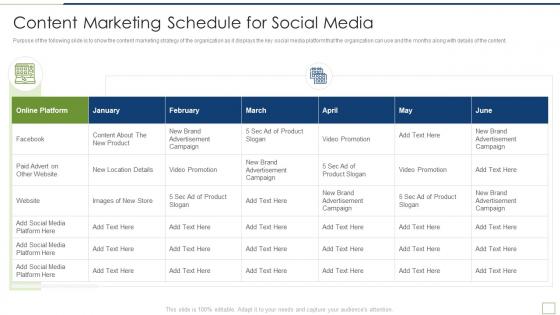
Purpose of the following slide is to show the content marketing strategy of the organization as it displays the key social media platform that the organization can use and the months along with details of the content.
People who downloaded this PowerPoint presentation also viewed the following :
Building messaging canva identifying product usp content marketing schedule with all 6 slides:
Use our Building Messaging Canva Identifying Product USP Content Marketing Schedule to effectively help you save your valuable time. They are readymade to fit into any presentation structure.





FAQs for Building messaging canva identifying product usp
A Messaging Canvas serves as a strategic framework for aligning communication efforts across stakeholders, ensuring consistent brand voice, target audience identification, and key message prioritization throughout marketing campaigns. This structured approach enables organizations to streamline their messaging strategy, reduce communication gaps, and deliver cohesive brand experiences across multiple channels, ultimately enhancing market positioning and customer engagement effectiveness.
A Messaging Canvas enhances alignment by establishing unified communication frameworks, shared terminology, clear stakeholder expectations, consistent project objectives, and standardized update protocols across all teams. Through centralized messaging strategies, project teams streamline coordination, reduce miscommunication, and maintain strategic focus, with many organizations finding that structured communication frameworks ultimately deliver faster project completion and improved cross-departmental collaboration.
A Messaging Canvas should include target audience definition, core value proposition, key benefits, supporting evidence, competitive differentiation, and primary call-to-action. These elements work together by aligning messaging across channels, clarifying audience needs, and strengthening brand positioning, with many marketing teams finding that structured canvases ultimately deliver more consistent campaigns and improved audience engagement.
A Messaging Canvas differs from traditional messaging frameworks by providing visual, collaborative structure that maps key messages, audiences, and channels in one integrated view, while traditional frameworks often rely on linear documents or static templates. This canvas approach enables cross-functional teams to iterate messaging strategies more dynamically, streamline stakeholder alignment, and adapt communications across multiple touchpoints, ultimately delivering more cohesive and responsive brand messaging.
A Messaging Canvas can effectively serve multiple target audiences by creating distinct sections or versions for each segment, allowing businesses to tailor core value propositions, pain points, and communication channels while maintaining brand consistency. Many organizations use audience-specific messaging frameworks to customize their approach for different demographics, industries, or customer personas, ultimately delivering more personalized experiences and stronger market penetration across diverse segments.
Visual elements in a Messaging Canvas improve message retention through color coding for priority differentiation, strategic typography for emphasis, icons for concept association, and spatial organization for logical flow. These design components help audiences process information more efficiently, create memorable visual anchors, and establish clearer message hierarchies, ultimately enhancing comprehension and recall across presentations, marketing materials, and strategic communications.
Measuring Messaging Canvas effectiveness involves tracking engagement rates, conversion metrics, brand recall surveys, message consistency across channels, and audience response alignment with intended positioning. Through A/B testing different messaging elements, companies can optimize click-through rates, lead generation, and customer acquisition costs, with many marketing teams finding that cohesive messaging frameworks deliver 25-40% higher campaign performance.
Common pitfalls include being overly generic without audience specificity, creating inconsistent messaging across channels, focusing on features rather than customer benefits, and neglecting competitive differentiation. Many organizations find that rushing the process without stakeholder alignment, using internal jargon instead of customer language, and failing to test messages ultimately undermines their strategic communication effectiveness.
A Messaging Canvas adapts to digital marketing by structuring content across channels, defining audience personas, aligning value propositions with platform-specific formats, and mapping customer journey touchpoints. Through strategic customization, marketers streamline campaign consistency, enhance targeting precision, and optimize conversion funnels across social media, email, and paid advertising, ultimately delivering cohesive brand experiences and measurable ROI improvements.
Customer feedback plays a crucial role in validating messaging effectiveness, identifying resonance gaps, refining value propositions, and ensuring audience alignment within a Messaging Canvas. Through surveys, focus groups, and engagement analytics, organizations can test messaging clarity, emotional impact, and competitive differentiation, ultimately delivering more compelling communications that drive higher conversion rates and stronger market positioning.
Storytelling techniques integrate into a Messaging Canvas by structuring narrative arcs around customer journeys, incorporating emotional hooks within value propositions, and developing character-driven personas that resonate with target audiences. Through compelling opening statements, conflict-resolution frameworks, and outcome-focused conclusions, organizations create more engaging messaging strategies that connect with customers on both rational and emotional levels, ultimately delivering stronger brand recall and conversion rates.
Tools for creating Messaging Canvases include Miro, Mural, Figma, Canva, and Microsoft Visio, along with collaborative platforms like Google Workspace and Notion. These digital solutions streamline messaging development by enabling real-time collaboration, template customization, and seamless integration with existing workflows, with many marketing teams finding that cloud-based platforms accelerate campaign alignment and reduce revision cycles significantly.
A Messaging Canvas assists crisis communication planning by organizing key messages, target audiences, communication channels, and response protocols into a unified framework. This strategic approach enables organizations to maintain consistent messaging across departments, respond rapidly during emergencies, and preserve brand integrity, with many companies finding that pre-developed canvases significantly reduce response time while ensuring stakeholder confidence.
Successful Messaging Canvases include Airbnb's "Belong Anywhere" framework emphasizing community and authentic experiences, Slack's workplace transformation messaging focused on seamless collaboration, and Tesla's sustainable innovation positioning that revolutionized automotive marketing. These strategic frameworks streamline brand communication, enhance customer engagement, and deliver consistent messaging across channels, with many organizations finding that well-crafted canvases significantly improve market positioning and competitive advantage.
A Messaging Canvas should be revisited at key project milestones, typically every 2-3 months or during significant strategic shifts, market changes, and campaign launches. Through regular reviews, marketing teams can adapt messaging to evolving customer insights, competitive landscapes, and business priorities, with many organizations finding that quarterly updates ensure consistent brand communication and maximize campaign effectiveness across channels.
-
Amazing product with appealing content and design.
-
Excellent work done on template design and graphics.