

Business Exit Plan And Its Need For The Stakeholders Powerpoint Presentation Slides






Try Before you Buy Download Free Sample Product
 Impress Your
 Audience
 100%
100% Editable
 Save Hours
 of Time


Our Business Exit Plan And Its Need For The Stakeholders Powerpoint Presentation Slides are topically designed to provide an attractive backdrop to any subject. Use them to look like a presentation pro.
People who downloaded this PowerPoint presentation also viewed the following :
Content of this Powerpoint Presentation
Slide 1: This slide introduces Business Exit Plan and Its Need for the Stakeholders. State your company name and begin.
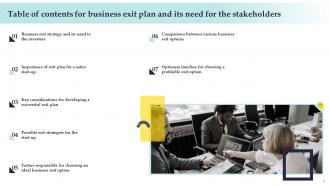
Slide 2: This slide shows Table of Content for the presentation.
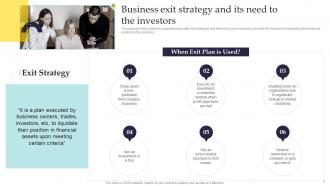
Slide 3: This slide presents Business exit strategy and its need to the investors.
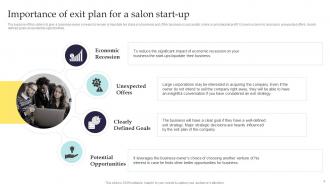
Slide 4: This slide displays Importance of exit plan for a salon start-up.
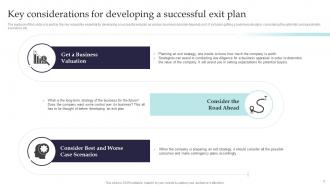
Slide 5: This slide represents Key considerations for developing a successful exit plan.
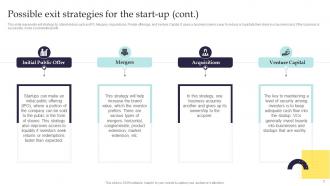
Slide 6: This slide showcases Possible exit strategies for the start-up.
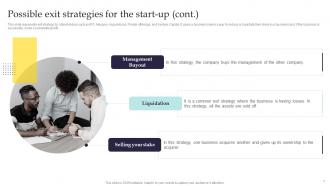
Slide 7: This is another slide continuing Possible exit strategies for the start-up.
Slide 8: This slide shows Factors responsible for choosing an ideal business exit option.
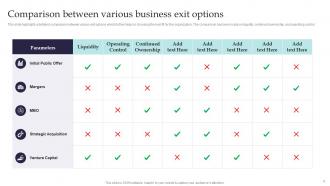
Slide 9: This slide presents Comparison between various business exit options.
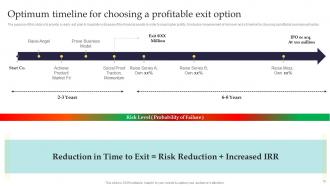
Slide 10: This slide displays Optimum timeline for choosing a profitable exit option.
Slide 11: This is a Thank You slide with address, contact numbers and email address.
Business Exit Plan And Its Need For The Stakeholders Powerpoint Presentation Slides with all 16 slides:
Use our Business Exit Plan And Its Need For The Stakeholders Powerpoint Presentation Slides to effectively help you save your valuable time. They are readymade to fit into any presentation structure.








FAQs for Business Exit Plan And Its Need For The Stakeholders
Key components include succession planning, business valuation, financial preparation, legal documentation, and timeline development. These strategic elements work together by identifying potential buyers or successors, optimizing company value, and ensuring smooth ownership transitions, with many business owners finding that comprehensive exit planning ultimately delivers higher sale prices and reduced tax liabilities.
Business owners can assess company value through professional business appraisals, financial statement analysis, market comparables research, asset valuations, and cash flow projections. These comprehensive evaluation methods enable strategic planning by identifying value drivers, addressing weaknesses, and optimizing operations, with many owners finding that early assessment delivers higher exit valuations and smoother transitions.
Succession planning serves as the operational backbone of exit strategies by identifying future leaders, developing talent pipelines, ensuring knowledge transfer, and maintaining business continuity during ownership transitions. Through strategic succession frameworks, organizations streamline leadership handovers, minimize operational disruptions, and preserve stakeholder confidence, with many companies finding that well-executed succession plans significantly increase valuation and buyer interest.
Tax implications significantly influence exit planning through timing strategies, structural decisions, capital gains considerations, and succession planning methods. Strategic tax planning enables business owners to minimize liabilities through installment sales, employee stock ownership plans, or charitable remainder trusts, with many finding that proper structuring can preserve 20-40% more value for stakeholders.
Common mistakes include waiting too long to start planning, failing to obtain proper business valuations, neglecting to develop management teams, overlooking tax implications, and not diversifying personal wealth beyond the business. These oversights can significantly reduce sale prices, create operational vulnerabilities, and limit exit options, with many owners finding that starting planning 3-5 years early ultimately delivers better outcomes and more strategic flexibility.
Business owners can prepare employees for a transition by communicating transparently about timeline and changes, providing comprehensive training on new processes, identifying and developing internal leaders, and ensuring knowledge transfer through detailed documentation. Through structured transition planning, organizations minimize disruption while maintaining operational continuity, with many finding that early employee engagement reduces uncertainty and preserves team morale during ownership changes.
**INPUT**: What methods can be used to maximally increase business valuation before the sale? **OUTPUT**: Valuation enhancement methods include streamlining operations, strengthening financial documentation, diversifying revenue streams, improving customer retention rates, and optimizing management systems. These strategic approaches deliver measurable results by reducing operational costs, demonstrating predictable cash flows, and showcasing scalability potential, with many business owners finding that comprehensive preparation increases sale valuations by twenty to forty percent. [Word count: 58 words]
Selling to competitors typically involves strategic buyers seeking synergies, market consolidation, and operational efficiencies, often resulting in higher valuations due to strategic value. Third-party sales to financial buyers or unrelated companies focus more on standalone financial performance and growth potential, with many business owners finding that competitor acquisitions deliver premium pricing while third-party sales offer greater operational independence and cultural preservation.
Market conditions significantly influence exit timing by affecting company valuations, buyer demand, financing availability, and industry multiples. During favorable conditions with strong economic growth, robust capital markets, and high sector interest, businesses typically achieve premium valuations and attract multiple buyers, while challenging markets may require patience or strategic adjustments to maximize exit value.
Legal counsel proves essential during exit processes by navigating complex regulatory requirements, structuring transactions optimally, and protecting stakeholder interests through comprehensive due diligence. Experienced attorneys streamline negotiations, ensure compliance with securities laws, and minimize liability exposure, with many business owners finding that professional legal guidance ultimately delivers smoother transitions and maximized exit valuations.
Business owners can leverage professional advisors by assembling teams including investment bankers, tax attorneys, accountants, business brokers, and succession consultants to navigate complex exit processes. These specialists streamline valuations, optimize tax structures, and identify qualified buyers, with many owners finding that coordinated advisory teams deliver significantly higher sale prices and smoother transitions.
Alternative exit strategies for family-owned businesses include management buyouts, employee stock ownership plans (ESOPs), strategic acquisitions by industry partners, private equity partnerships, and partial recapitalization structures. These approaches enable family owners to maintain varying degrees of control while accessing liquidity, with many finding that ESOPs and management buyouts preserve company culture and employee relationships while delivering competitive valuations.
Emotional factors significantly impact exit planning by creating attachment to legacy, fear of letting go, and resistance to succession decisions. Business owners often struggle with identity transitions and family dynamics, which can delay critical planning decisions, complicate valuations, and hinder objective strategic choices, ultimately affecting exit timing and financial outcomes.
**INPUT**: What financing options are available for buyers in an acquisition scenario? **OUTPUT**: Acquisition financing options include bank loans, SBA financing, seller financing, private equity partnerships, and asset-based lending structures. These funding mechanisms enable buyers by reducing upfront capital requirements, spreading payment terms, and leveraging existing business assets, with many successful acquisitions combining multiple sources to optimize cash flow and minimize financial risk while accelerating deal completion.
Technology significantly enhances exit valuations by streamlining due diligence through automated data rooms, improving financial transparency with cloud-based systems, and demonstrating operational scalability through integrated platforms. These digital capabilities accelerate buyer evaluation processes while showcasing systematic efficiencies, with many acquirers finding that tech-enabled businesses command premium valuations due to reduced operational risk and enhanced growth potential.
-
This design is not only aesthetically pleasing but it has many uses making the cost worthwhile. The graphics look stunning, and you can edit them as per your needs.
-
The templates are the best in class. Very clear and innovative graphics! I am excited to explore and download more presentations.