


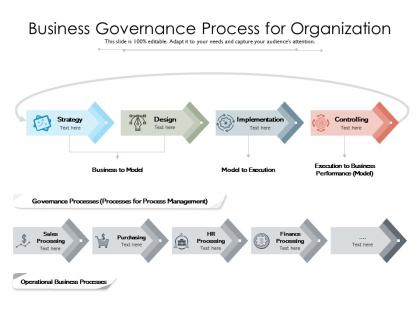
Business governance process for organization




Try Before you Buy Download Free Sample Product
 Impress Your
 Audience
 100%
100% Editable
 Save Hours
 of Time


Handicaps won't deter you with our Business Governance Process For Organization. They can bridge the biggest gaps.
People who downloaded this PowerPoint presentation also viewed the following :
Business governance process for organization with all 2 slides:
Handle affairs with our Business Governance Process For Organization. They are adept at clearing the air.


FAQs for Business governance
Effective business governance principles include accountability, transparency, fairness, responsibility, and strategic oversight of organizational decisions and resources. These principles work together by establishing clear leadership structures, ensuring stakeholder protection, and maintaining ethical standards, with many corporations finding that strong governance frameworks ultimately deliver enhanced investor confidence, regulatory compliance, and sustainable competitive advantage.
Corporate governance focuses on managing private companies through board oversight, shareholder rights, executive accountability, and profit maximization within regulatory frameworks. Public governance involves managing government entities through democratic processes, public accountability, transparency requirements, and citizen welfare prioritization, with many organizations finding that while corporate governance emphasizes competitive advantage and stakeholder returns, public governance balances multiple constituencies and societal outcomes.
Board members provide strategic oversight, risk management, executive accountability, stakeholder representation, and regulatory compliance guidance to ensure effective organizational governance. Through regular performance evaluations, policy development, and financial oversight, directors enable transparent decision-making, ethical operations, and sustainable growth, with many organizations finding that engaged boards deliver enhanced investor confidence and competitive advantage.
Businesses can assess governance effectiveness through comprehensive audits examining board composition, risk management processes, compliance mechanisms, stakeholder engagement, and decision-making transparency. Through regular evaluations, independent assessments, and stakeholder feedback, organizations identify gaps, streamline oversight procedures, and enhance accountability structures, ultimately delivering improved operational efficiency and stronger investor confidence.
Business governance significantly enhances stakeholder trust and engagement by ensuring transparency, accountability, and ethical decision-making across all organizational levels. Through clear oversight structures, regular reporting, and stakeholder communication protocols, companies build credibility with investors, employees, and customers, while robust governance frameworks ultimately deliver improved reputation, stronger relationships, and sustained competitive advantage in increasingly scrutinized markets.
Technology enhances transparency in business governance by automating reporting processes, providing real-time access to financial data, and creating digital audit trails that track all organizational decisions and transactions. Through cloud-based governance platforms and AI-powered analytics, organizations streamline compliance monitoring, enable stakeholder access to performance metrics, and deliver comprehensive oversight capabilities, ultimately building greater trust and accountability.
Common governance implementation challenges include resistance to change, unclear accountability structures, inadequate communication across departments, insufficient training resources, and competing operational priorities. These obstacles often stem from organizational silos and cultural factors, with many institutions finding that phased rollouts, executive sponsorship, and cross-functional governance committees help streamline adoption while ensuring sustainable policy integration.
Regulatory requirements fundamentally shape business governance strategies by mandating specific oversight structures, compliance frameworks, risk management protocols, and transparency standards across operations. Through adherence to these regulations, organizations streamline decision-making processes, enhance stakeholder accountability, and minimize legal exposure, while ultimately delivering stronger operational integrity and competitive advantage in increasingly regulated markets.
Business governance and CSR are strategically interconnected, with governance frameworks establishing accountability structures, ethical standards, and stakeholder engagement processes that guide CSR initiatives. Through integrated governance systems, organizations streamline sustainability reporting, enhance stakeholder transparency, and align social responsibility with business objectives, ultimately delivering measurable community impact while strengthening competitive advantage.
Effective governance contributes to risk management by establishing clear oversight structures, implementing comprehensive risk assessment frameworks, and ensuring accountability at all organizational levels. Through robust board oversight and strategic risk committees, organizations can identify potential threats early, allocate resources more efficiently, and maintain regulatory compliance, ultimately delivering enhanced operational resilience and stakeholder confidence.
Internal audits strengthen business governance by providing independent assessments of risk management, internal controls, compliance processes, and operational efficiency across organizations. Through systematic evaluations, companies identify governance gaps, ensure regulatory adherence, and enhance decision-making transparency, with many enterprises finding that regular audits ultimately deliver improved accountability, reduced operational risks, and stronger stakeholder confidence.
Diversity and inclusion within leadership significantly enhance governance outcomes by bringing varied perspectives, reducing groupthink, and improving risk assessment and decision-making processes. Through diverse leadership teams, organizations achieve better strategic oversight, enhanced stakeholder representation, and more comprehensive problem-solving capabilities, with many companies finding that inclusive governance ultimately delivers stronger financial performance and competitive advantage.
Effective governance training best practices include role-specific curriculum development, interactive case study methodologies, regular compliance assessments, clear escalation protocols, and continuous reinforcement programs. These approaches enhance employee understanding by connecting theoretical frameworks to real-world scenarios, establishing accountability mechanisms, and creating sustainable learning cultures, with many organizations finding that integrated training significantly reduces compliance risks while strengthening operational transparency.
Small businesses can implement governance structures by establishing advisory boards, creating clear role definitions, implementing financial controls, developing documented policies, and conducting regular performance reviews. Through scalable frameworks like quarterly board meetings and standardized reporting processes, smaller organizations streamline decision-making, enhance accountability, and build investor confidence, ultimately delivering improved operational efficiency and strategic oversight similar to larger corporations.
Organizations can evaluate governance success through board effectiveness assessments, regulatory compliance rates, risk management metrics, stakeholder satisfaction scores, and financial performance indicators. These measurements enable companies to streamline decision-making processes, enhance transparency, and minimize operational risks, with many finding that comprehensive governance metrics ultimately deliver improved investor confidence and competitive advantage.
No Reviews