


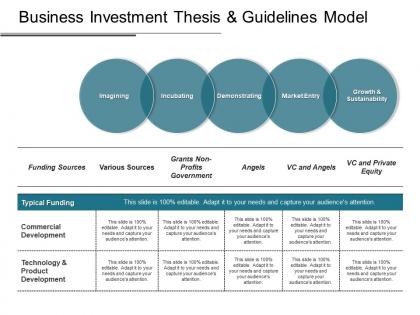
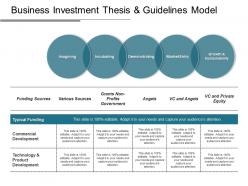
Business investment thesis and guidelines model




Try Before you Buy Download Free Sample Product
 Impress Your
 Audience
 100%
100% Editable
 Save Hours
 of Time


Examine the incident with our Business Investment Thesis And Guidelines Model. Find out how to avoid injury.
People who downloaded this PowerPoint presentation also viewed the following :
Business investment thesis and guidelines model with all 5 slides:
Shake hands with destiny with our Business Investment Thesis And Guidelines Model. They allow you to get a firm grip.


FAQs for Business investment thesis
Okay so you need four main things: the problem you spotted, how you're gonna tackle it, market size plus timing, and what returns you expect vs risks. Honestly, timing is where everyone screws up - they find amazing companies but buy at the worst possible moment. Also set your timeframe upfront and pick like 2-3 metrics to track if you're actually right. Oh and here's the thing - if you can't explain it in under two minutes, it's probably too complicated. I learned that the hard way.
Look, market research is literally the backbone of any decent investment decision. It helps you figure out if your gut instincts about a company are actually right or total BS. I dig into market size, who the competitors are, how customers actually behave - all that stuff. Honestly, without doing your homework first, you're just throwing money at pretty charts and hoping for the best. I always try to pull from different sources too - industry reports, competitor deep-dives, customer feedback, whatever I can find. Oh and start broad with the big trends, then zoom into the specific company details.
Look, risk assessment is basically everything when you're building an investment case. First thing I do is list out the 3-5 biggest things that could totally screw me over. Then I ask myself: does the upside actually make these risks worth it? Because honestly, every good opportunity has some nasty downsides lurking around. Your whole thesis needs to tackle these head-on and explain why you think they're either manageable or - and this sounds weird but hear me out - why they're actually the exact risks you want to be taking. Otherwise you're just throwing money at a good story.
Honestly, earnings calls are where you'll catch the good stuff early - CEOs basically spill their plans before anyone else notices. I dig through regulatory filings and patent apps too, plus watch how much competitors are dumping into R&D. Trade publications are boring as hell but worth it. Social listening shows you what consumers actually want (not what companies think they want). Following the right industry people on Twitter helps with real-time vibes. The magic happens when you start seeing the same pattern pop up everywhere - that's when you know you're onto something real.
Look at revenue growth, profit margins, and cash flow first - those are your bread and butter. ROI and debt-to-equity ratios tell you if they're actually healthy or just putting on a show. Don't get sucked into vanity metrics like I did early on, total waste of time. Focus on whether they've got real competitive advantages that'll stick around. TAM sounds impressive but only matters if they can actually grab market share. Oh, and sector-specific stuff depends on what you're investing in - tech companies need different KPIs than manufacturing. Start basic, then get fancy.
Look, your investment thesis can't be some document you write once and forget about. Markets change constantly - growth assumptions, competition, regulations, all of it. I'm guilty of this too sometimes, but sticking to old ideas just because you wrote them down is stupid. Every quarter or so, actually sit down and ask if your reasoning still makes sense. Some stuff is just market noise, but real changes? You gotta adapt. Don't be stubborn when the facts shift. I learned this the hard way honestly.
Don't fall in love with your first idea - I've seen so many people ignore data that proves them wrong. Also avoid being super vague like "AI is changing everything." That's not analysis, it's just hoping. Keep your models simple enough to explain to your mom. Seriously, if you can't break it down simply, you probably don't understand it either. Short-term trends won't last forever, and you can't just pretend competitors don't exist because you're rooting for one company. Always test your assumptions against real data. Be wrong fast and pivot.
Dude, stories are everything when pitching investors. Raw data just makes their eyes glaze over, but a good narrative? That sticks. Look at Netflix - they didn't pitch "streaming video service." They said "imagine never driving to Blockbuster again." Boom. You can almost feel the relief, right? Your pitch needs that same flow: problem, solution, opportunity, all connected. Don't ditch the numbers obviously, but wrap them in something investors can actually picture. I always tell people to open with a real customer frustration or that perfect market timing moment. Makes everything click.
Dude, you gotta check out the competition before investing in any company. Otherwise you're flying blind. Look at who they're fighting against and what actual advantages they have - not just what their marketing says. I've watched solid companies get demolished because nobody bothered studying the competitive landscape first. Plus it helps you catch industry shifts early, which is honestly where the real money gets made. My rule? Always map out who's battling for market share before putting cash down. Trust me, it'll save you from getting burned later when some competitor comes out of nowhere.
Look, you need 2-3 solid exit paths with actual timelines and valuations. IPO, acquisition, buyout - whatever fits your business. Most founders totally blow this off but investors are literally obsessed with how they'll get paid back. Do your homework on comparable exits and figure out who might want to buy you. Timeline's usually 3-7 years, nothing crazy. Oh and make sure your exit multiples actually match up with the returns you're promising - I've seen people mess that up constantly. It sounds boring but it's honestly make-or-break stuff.
So first figure out what you actually care about - like do you hate tobacco companies or really want clean energy stuff? Most brokers have ESG filters now which is honestly a game changer. Set those criteria upfront when you're screening investments. Look for companies that hit your values boxes AND make financial sense - don't just pick something because it sounds good if the numbers are trash. Board diversity, environmental impact, labor practices, whatever matters to you. It's way more doable than people think once you get the filters set up right.
Dude, there's a bunch of ways to check if your investment idea actually makes sense. Bloomberg and FactSet are solid if you've got the budget, otherwise Yahoo Finance works fine for basic stuff. Industry reports from McKinsey or Deloitte give you the big picture context. Honestly though, don't ignore doing your own research - surveys, talking to experts, checking out competitors. That's where you find the real insights sometimes. PitchBook's great for market sizing too. But here's the thing - just pick 2 or 3 tools and stick with them. I've seen people try to use everything and end up using nothing well.
Honestly, your emotions will mess up your investment ideas faster than anything else. We all get attached to stocks and ignore obvious warning signs - I've done it too many times. You'll anchor on whatever info you see first, get cocky after making some money, or freak out when markets tank. Those mental shortcuts? They make you see what you want to see instead of what's actually there. Build in some reality checks where you argue against yourself. Find people who disagree with your thesis and actually listen to them before you commit.
Honestly, getting your colleagues to tear apart your investment ideas is one of the best things you can do. They'll catch stuff you're completely blind to - assumptions you didn't even realize you were making, risks that somehow flew under your radar. Sometimes they know industries way better than you do too, which is clutch. The trick is finding people who'll actually challenge you instead of just being polite. I'd set up regular reviews where you have to defend your thesis. Sounds brutal but your reasoning gets so much tighter afterward. Trust me on this one.
Look, scenario planning is what keeps you from getting totally blindsided. Map out three cases - base, best, and worst - with real assumptions about competition and market stuff. I've watched people get crushed because they only thought about everything going perfectly. Each scenario needs different return expectations and timelines so you can actually test if you still believe in the investment. Honestly, the worst case scenario is usually more helpful than the rosy one. Check back on these quarterly when new info comes in.
-
Great quality slides in rapid time.
-
Great product with effective design. Helped a lot in our corporate presentations. Easy to edit and stunning visuals.