


Business Key Priorities For People Operations Management





Try Before you Buy Download Free Sample Product
 Impress Your
 Audience
 100%
100% Editable
 Save Hours
 of Time


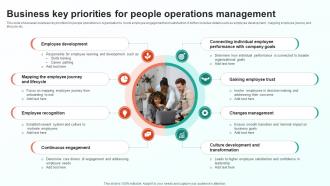
This slide showcases business key priorities for people operations in organization to boost employee engagement and satisfaction. It further includes details such as employee development , mapping employee journey and lifecycle etc.
People who downloaded this PowerPoint presentation also viewed the following :
Business Key Priorities For People Operations Management with all 9 slides:
Use our Business Key Priorities For People Operations Management to effectively help you save your valuable time. They are readymade to fit into any presentation structure.








FAQs for Business Key Priorities For
Key People Operations metrics include employee engagement scores, retention rates, time-to-hire, performance ratings, and training completion rates. These measurements enable organizations to streamline talent acquisition, enhance workforce productivity, and minimize turnover costs, with many companies finding that strategic focus on these indicators ultimately delivers improved operational efficiency and competitive advantage in talent management.
Technology best streamlines People Operations through automated onboarding workflows, AI-powered candidate screening, integrated HRIS platforms, self-service employee portals, and data analytics dashboards. These solutions enhance efficiency by reducing manual tasks, accelerating hiring cycles, and improving employee experiences, with many organizations finding that strategic automation ultimately delivers faster processes and better resource allocation.
Employee engagement serves as a foundational driver for People Operations strategies, influencing talent retention, performance management, cultural development, and organizational productivity initiatives. Through engagement data and feedback systems, organizations streamline workforce planning, enhance career development programs, and deliver personalized employee experiences, with many companies finding that engaged teams significantly reduce turnover costs while accelerating business outcomes.
People Operations supports diversity and inclusion through comprehensive recruitment strategies, inclusive policy development, bias training programs, equitable performance management systems, and diverse leadership development initiatives. These approaches streamline organizational culture transformation by fostering belonging, reducing workplace disparities, and enhancing employee engagement, with many companies finding that strategic D&I investments ultimately deliver improved retention rates and competitive talent advantages.
Emerging trends in People Operations include AI-driven talent analytics, employee experience platforms, flexible work infrastructure, skills-based hiring approaches, and predictive retention modeling. These technologies streamline recruitment processes, enhance workforce planning, and deliver personalized employee experiences, with many organizations finding that strategic combinations of these trends ultimately provide significant competitive advantages in talent acquisition and retention.
Data analytics improves People Operations decision-making by identifying workforce trends, predicting turnover risks, and optimizing talent acquisition strategies through comprehensive data analysis. These insights enable HR teams to make evidence-based decisions about compensation, performance management, and resource allocation, ultimately delivering improved employee retention and strategic workforce planning advantages.
Effective onboarding within People Operations frameworks includes structured orientation programs, mentorship assignments, role-specific training modules, cultural integration activities, and continuous feedback mechanisms. These approaches streamline employee integration by establishing clear expectations, accelerating productivity timelines, and enhancing retention rates, with many organizations finding that comprehensive onboarding reduces turnover costs while delivering stronger employee engagement and faster time-to-contribution across departments.
People Operations should address retention through competitive compensation packages, flexible work arrangements, comprehensive professional development programs, recognition systems, and strong manager training. These strategic approaches enhance employee satisfaction by creating growth opportunities, improving work-life balance, and fostering positive workplace cultures, with many organizations finding that investing in employee experience ultimately delivers reduced turnover costs and sustained competitive advantage.
People Operations fosters continuous learning through comprehensive development programs, mentorship initiatives, skills assessments, cross-functional training opportunities, and knowledge-sharing platforms. These strategic approaches streamline talent development by identifying growth areas, facilitating internal mobility, and creating learning pathways, with many organizations finding that systematic development programs enhance employee engagement, retention rates, and ultimately deliver competitive advantage through improved capabilities.
Feedback loops can be integrated through regular pulse surveys, structured one-on-one meetings, anonymous suggestion systems, performance review cycles, and digital feedback platforms. These mechanisms enable continuous communication by identifying engagement gaps, addressing concerns proactively, and aligning employee expectations with organizational goals, with many companies finding that systematic feedback integration significantly improves retention and workplace satisfaction.
People Operations can enhance remote work environments through flexible scheduling policies, robust digital communication platforms, virtual team-building initiatives, comprehensive remote onboarding processes, and performance management systems designed for distributed teams. These strategies streamline collaboration by establishing clear communication protocols, fostering engagement through regular check-ins, and supporting work-life balance, with many organizations finding that structured remote frameworks ultimately deliver improved productivity and employee satisfaction.
Conflict resolution techniques can be incorporated through structured mediation processes, clear escalation protocols, training managers in de-escalation methods, implementing peer feedback systems, and establishing neutral HR intervention frameworks. These approaches streamline workplace disputes by promoting early intervention, fostering collaborative problem-solving, and maintaining team cohesion, with many organizations finding that proactive conflict management significantly enhances employee satisfaction and productivity.
Performance management best practices include setting clear expectations, conducting regular check-ins, providing continuous feedback, aligning goals with business objectives, and implementing fair evaluation processes. These approaches enhance employee engagement, productivity, and retention by fostering transparent communication, identifying development opportunities, and recognizing achievements, with many organizations finding that structured performance frameworks ultimately deliver stronger talent outcomes and competitive advantage.
People Operations can better support mental health and well-being by implementing comprehensive employee assistance programs, flexible work arrangements, mental health training for managers, wellness resources, and regular check-ins. These initiatives streamline support delivery through proactive outreach, accessible counseling services, and stress management workshops, with many organizations finding that strategic well-being investments ultimately enhance productivity, reduce turnover, and deliver stronger employee engagement across all departments.
A strong employer brand through People Operations attracts top talent, reduces recruitment costs, and enhances employee retention by showcasing company culture, values, and growth opportunities. Organizations with compelling employer brands experience significantly lower turnover rates and faster hiring cycles, with companies like Google and Salesforce demonstrating how strategic People Operations initiatives ultimately deliver competitive advantage in talent acquisition.
-
The service is fast, and I could access any presentation after buying the subscription. I don’t think I’ll ever have to worry about a presentation in my life.
-
“Immediate response, professional support, and effective solutions that were customized and immediately provided. Well done- Thank you!”