

Business Readiness Deliverables With Planning Phase




Try Before you Buy Download Free Sample Product
 Impress Your
 Audience
 100%
100% Editable
 Save Hours
 of Time


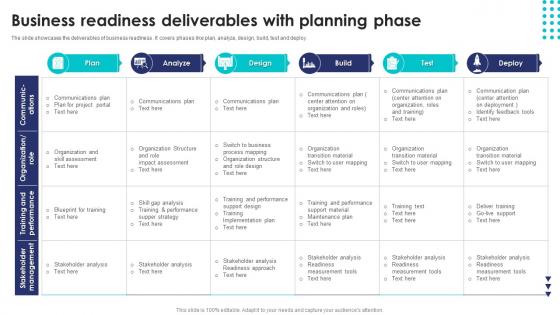
The slide showcases the deliverables of business readiness. It covers phases like plan, analyze, design, build, test and deploy.
People who downloaded this PowerPoint presentation also viewed the following :
Business Readiness Deliverables With Planning Phase with all 6 slides:
Use our Business Readiness Deliverables With Planning Phase to effectively help you save your valuable time. They are readymade to fit into any presentation structure.





FAQs for Business Readiness Deliverables
Honestly, it's all about getting four things sorted: operations, money stuff, your team, and strategy. Document your processes so everything isn't just in your head - trust me, buyers hate when nothing's written down. Clean up your books and make sure you've got steady cash flow. Don't be the person who has to approve every tiny decision either. Your team needs to function without you micromanaging constantly. Having a solid growth plan helps too, shows you're not just winging it. I'd start with whichever area feels most chaotic right now and work from there.
Start with a readiness check covering three things: your people, processes, and tech capabilities. Survey folks about how they handle change, map current workflows to find bottlenecks, and see where your technology's lacking. Honestly? Most companies are way overconfident here - it's like saying you're marathon-ready after jogging once around the block. Look at your change management track record too. Past projects finish on time? Those patterns reveal what needs work first. Actually, this step's probably more telling than the surveys if we're being real about it.
Honestly, good training is what separates companies that can roll with changes from ones that totally panic when something unexpected hits. Your team needs to actually know their jobs - not just fake it till they make it. I'd focus on the ongoing stuff rather than just that first-week orientation garbage. Figure out where your biggest skill gaps are first. Those are the spots that'll bite you later. Build your programs around fixing those specific problems. When people really understand their roles, you can switch directions faster and won't stress about coverage when someone calls out sick.
Honestly, tech makes business prep so much easier these days. You can automate risk assessments and get all your important docs in one place. Cloud platforms are clutch - your team can grab emergency protocols from anywhere. Plus automated backups save your butt if things go sideways. AI tools actually predict problems before they happen (which still blows my mind tbh). Communication apps keep everyone in the loop during chaos. Project management software tracks all your prep work too. I'd start by figuring out where you're most vulnerable, then find tools that fix those specific issues first. Way more manageable that way.
Track the numbers first - completion rates, system adoption, efficiency gains, budget stuff. But honestly? The soft metrics matter way more. Survey your people about change readiness and resistance levels. Communication effectiveness too. Resistance tells you everything completion rates can't. Get a baseline before you start, then check monthly. Timeline milestones and risk progress are obvious ones to watch. Oh, and leadership alignment scores - forgot that one. You need both hard data and the touchy-feely stuff to actually see if things are working.
Honestly, your company culture is like the foundation of a house - everything else crumbles without it. Teams that are open to feedback and actually collaborate? They'll crush any change initiative. But if you're dealing with that "we've always done it this way" mentality, good luck getting anyone on board. I've watched brilliant strategies totally flop because nobody bothered checking if people would actually embrace the changes. Leadership has to listen, not just talk. Oh, and people need to feel safe speaking up when stuff isn't working. Culture trumps strategy every single time.
Dude, seriously over-communicate during readiness - like, way more than feels normal. People are clueless about what's happening unless you tell them constantly. Set up regular check-ins and maybe some shared dashboards so everyone can actually see the progress. Don't just rely on email though, mix it up with meetings and whatever else works. Oh, and create clear escalation paths for when stuff inevitably breaks. I've watched so many projects crash because someone thought others would magically know what was going on. Assign specific people to own the communication piece too, otherwise things just disappear into the void.
Honestly, people will fight you on everything - change makes everyone cranky. Communication becomes a mess too, nobody knows what's happening when. You'll think something takes 2 weeks but it actually takes 6, especially when you're asking folks to juggle their normal work plus all this new stuff. Budget and time constraints hit different when you're in the thick of it. Oh, and maintaining daily operations while flipping everything upside down? Good luck with that one. Start talking to people way sooner than feels necessary and pad your timeline like crazy.
Honestly, get your basics locked down first - financials, processes, and a value prop that actually sets you apart. Cash flow needs to be predictable. Your team should know their roles cold. Most small businesses totally blow past this foundation work and then can't figure out why they're spinning their wheels. Stay tight with customers too - they'll spot problems way before your numbers do. Oh, and make sure you can pivot fast when things shift (which they will). I'd audit this stuff monthly so small issues don't snowball into disasters.
Yeah, leadership makes or breaks this stuff honestly. If they're not really bought in, forget it - everyone else will sense that fake energy from a mile away. You need them setting clear vision and actually backing it up with resources. People are always watching to see if the higher-ups believe their own hype, you know? The tough calls about priorities? That's on them too. My take - get your leadership team genuinely excited about it first. Their commitment trickles down fast, and without that foundation you're basically pushing water uphill.
Dude, market research is basically your safety net before dumping cash into a product launch. It shows you if there's actual demand and what problems people really need solved. You'll figure out your competition and find the right price point too. I swear, so many startups think they can just wing it and then act shocked when nobody buys their stuff. The research also helps you nail the timing and messaging. Focus groups are solid - even my cousin did some basic surveys for her bakery and it saved her from making terrible flavors nobody wanted. Way better than guessing and hoping for the best.
So there's a few good ways to figure this out. ADKAR is probably my favorite - I've seen it work really well at companies around your size. Kotter's 8-Step thing is solid too, especially if you're doing major changes. Then there's the Readiness Assessment Matrix that looks at people, processes, tech, all that stuff. Honestly though? Pick one and run with it. Don't try mixing frameworks because that just makes everything messy and slows you down. Also check if your industry has specific financial readiness models - some do, some don't, but worth looking into.
Look, customer feedback is basically your business GPS and smoke detector combined. You'll catch issues before they blow up into real problems. Plus you spot opportunities that would've flown right under your radar otherwise. Honestly, the companies crushing it right now? They're the ones actually listening to what people tell them. Makes pivoting way easier when the market shifts. Use that intel for product tweaks, service upgrades, whatever needs fixing. I'd say track patterns weekly if you can - the trends that pop up will surprise you. It's like having insider info but totally legit.
First, figure out what could actually break your business - tech crashes, supply chain mess, whatever. Then write down exactly what everyone should do when stuff hits the fan. Assign specific people to handle different parts and nail down how you'll communicate. Here's the thing though: most companies write these plans and then never look at them again, which is totally pointless. You've got to run drills every few months or it's useless. Keep everything simple - if your team can't figure out their role in 30 seconds during chaos, you've overcomplicated it.
Okay so scenario planning is basically just making up 3-4 "what if" stories for your business. Best case, worst case, and a couple realistic ones in between. Then figure out how each would mess with your money, operations, and staff. Most businesses don't bother because it seems like busy work, but honestly? It's a lifesaver when everything goes sideways. The trick is spotting the warning signs early so you're not scrambling later. Just pick one big uncertainty you're dealing with and sketch out two scenarios this week. Don't overthink it.
-
Amazing variety of PowerPoint slides. Really helpful in designing professional presentations.
-
The customer care of SlideTeam is very responsive. I was having a payment issue and they fixed it for me in no time.