


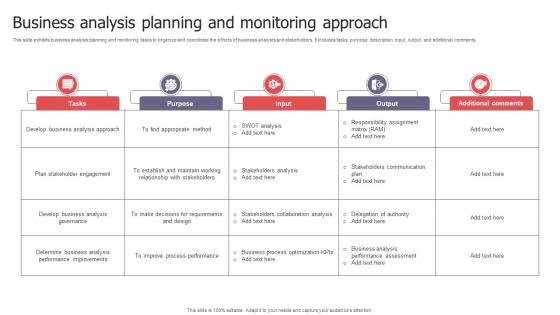
Business Analysis Planning And Monitoring Approach




Try Before you Buy Download Free Sample Product
 Impress Your
 Audience
 100%
100% Editable
 Save Hours
 of Time


This slide exhibits business analysis planning and monitoring tasks to organize and coordinate the efforts of business analysts and stakeholders. It includes tasks, purpose, description, input, output, and additional comments.
People who downloaded this PowerPoint presentation also viewed the following :
Business Analysis Planning And Monitoring Approach with all 6 slides:
Use our Business Analysis Planning And Monitoring Approach to effectively help you save your valuable time. They are readymade to fit into any presentation structure.





FAQs for Business Analysis Planning
So you'll want both the technical stuff and people skills - they're equally important tbh. Technical means requirements gathering, process mapping, data analysis, documentation. Basically breaking down messy business problems into chunks that make sense. Communication is huge though - you're constantly translating between business people and tech teams who might as well speak different languages. Critical thinking helps you find actual root causes instead of just surface issues. Oh and stakeholder management is brutal sometimes because everyone thinks their priority is THE priority. I'd focus on whatever feels shakier for you first.
Honestly, data analytics changed everything for me - no more guessing what customers actually want or randomly fixing stuff that might not even be broken. You start seeing real patterns instead of just going with your gut (which, let's be honest, is wrong way more than we'd like to admit). The cool part is catching problems early and spotting opportunities you'd totally miss otherwise. Like, I avoided some pretty expensive mistakes just by looking at the numbers first. Pick something you're trying to decide on right now and see what data you can find about it. Even simple stuff helps.
Dude, stakeholder communication can totally make or break your project. I've watched so many good ideas crash because nobody told the right people what was happening - it's brutal. You'll catch misaligned expectations way earlier if you keep everyone in the loop. Plus when changes come up (and they always do), people won't freak out if they understand the reasoning. Set up regular check-ins with your key people now. Document the big decisions. Honestly, sometimes the politics matter more than the actual solution, which is annoying but true.
Mix a few different approaches for the best results. Stakeholder interviews are your go-to - they help you dig into what people actually need vs what they think they want. Document workshops are solid when you've got multiple people who need to figure things out together (honestly, the free food doesn't hurt either). Watch people do their actual work too. You'd be surprised how much stuff comes up that they never mention in interviews. Keep documentation straightforward - user stories, process flows, requirement matrices. The trick is matching your method to who you're working with and how complex the project is.
Honestly, SWOT analysis is like taking a step back and getting real about your business situation. You'll spot your strengths and figure out what's actually holding you back internally. Plus you can map out opportunities you're probably overlooking and threats that might catch you off guard later. I always think the best part is when you start connecting everything together - like using your strengths to go after those opportunities while covering your weak spots. It's basically having that brutally honest conversation with yourself that nobody wants but everyone needs. Get people from different departments involved though, they'll see stuff you miss.
Honestly, Agile completely flips the whole BA thing on its head. You're not stuck writing those giant requirements docs that nobody reads anyway. Short sprints become your best friend - you get feedback constantly and can pivot when things change. And trust me, they always change. Working prototypes let you test ideas for real instead of just guessing what'll work. The dev teams actually want you around since you're part of their daily groove now. Oh, and user stories are so much easier than traditional requirements once you get the hang of them. Try switching to those first - it's a game changer.
Honestly, just stick with tools your team already knows instead of making everyone learn new stuff. Jira or Azure DevOps are solid for tracking requirements and user stories. I'm obsessed with making diagrams in Visio or Lucidchart - probably spend way too long on them, but stakeholders eat that visual stuff up. Excel is still the go-to for quick data analysis and pivot tables. For documentation, Confluence or SharePoint work fine. Short version: don't overcomplicate it. Pick maybe 3-4 tools max and actually use them well instead of hoarding software licenses.
You'll want to track the obvious stuff first - did you hit deadlines, stay in scope, keep stakeholders happy. But that's honestly just the bare minimum. The real test? Whether you actually fixed what you set out to fix. Revenue up? Costs down? Processes running smoother? I always compare results against whatever promises I made in the original business case - that's where the truth lives. Set up check-ins after launch too, not just right away but like 3-6 months out. Things look different once the dust settles.
Dude, the worst part is when requirements keep changing and nobody can agree on anything. Document everything and get people to actually sign off before you start - trust me on this one. Coffee meetings with stakeholders are clutch because they'll tell you what they really need vs what's in the official brief. Visual stuff like wireframes work way better than walls of text (people are lazy readers tbh). Oh and set up weekly check-ins or scope creep will absolutely destroy your timeline. It really is like herding cats sometimes but these tricks help.
So you start really wide when kicking things off - basically anyone who might care about your project. Then it narrows down as you get into planning and actually doing the work. The beginning is all about figuring out what people want and setting expectations (this is honestly where projects live or die relationship-wise). Once you're executing, switch to regular check-ins and handling changes. At the end, you're collecting approvals and doing those "what went wrong" sessions. Main thing? Match your communication to the phase. Don't dump tons of details early on, but also don't disappear when people need updates.
Dude, customer feedback is like your business reality check. All your internal metrics might look great, but if customers are saying something totally different? Listen to them. I've watched companies crash because they ignored what people were actually telling them. It shows you the gap between what you think you're delivering vs what's really happening. Short surveys work better than those endless questionnaires nobody fills out. You'll spot new opportunities and problems you'd never catch otherwise. Don't just wait for complaints either - ask people proactively when things are going well too.
Oh dude, you're actually in a perfect spot for change management! Your stakeholder analysis skills? Gold for figuring out who'll fight the changes and who's on board. Plus you already know how to map processes, which is literally half the battle when showing what needs to shift. BAs catch ripple effects everyone else misses - I swear it's like a superpower. Since you get both the tech and business sides, creating training stuff becomes way easier. Honestly, just volunteer to document current state first. That's always step one anyway, and once you're in there, you'll see how natural the transition feels.
Honestly, business analysis is like being a detective for missed opportunities. You dig into what your company does versus what customers actually want - that gap is where innovation lives. I love the part where you get to question all those "we've always done it this way" sacred cows. Map out your processes, look for weird patterns in the data, and suddenly you'll see inefficiencies that could turn into game-changers. The trick is asking better questions and connecting random dots between departments. Pick one annoying process at work and document it - I bet three improvement ideas pop up immediately.
Honestly, document where you're at right now with actual data - no guessing. Map out where you want to be with specific outcomes you can measure. I always spend forever on this part but whatever, it pays off. Figure out what's missing between point A and B, then rank those gaps by what'll make the biggest difference and what's actually doable. Get other people involved because they'll catch stuff you totally missed. Make an action plan with who's doing what and when. Oh and use visuals - charts make everything so much easier when you're explaining it to the boss later.
Honestly, half the BAs I know don't even really grasp what their company's actual goals are - which is wild when you think about it. So first step: figure that out by talking to leadership and reading those strategic docs (boring but necessary). When you're in stakeholder meetings, literally ask "how does this tie back to our main objectives?" Make those connections super obvious in your analysis. I always start project kickoffs by saying exactly which goal we're supporting. Sounds simple but it works. Connect everything back to the bigger picture when you're presenting requirements.
-
What a stunning collection of customizable templates! Really a time-saver..
-
Use of icon with content is very relateable, informative and appealing.