


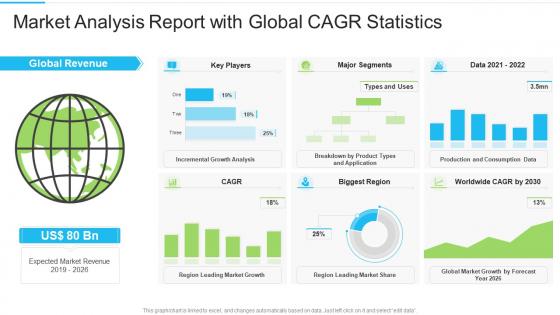
Market analysis report with global cagr statistics




Try Before you Buy Download Free Sample Product
 Impress Your
 Audience
 100%
100% Editable
 Save Hours
 of Time


Our Market Analysis Report With Global CAGR Statistics are topically designed to provide an attractive backdrop to any subject. Use them to look like a presentation pro.
People who downloaded this PowerPoint presentation also viewed the following :
Market analysis report with global cagr statistics with all 2 slides:
Use our Market Analysis Report With Global CAGR Statistics to effectively help you save your valuable time. They are readymade to fit into any presentation structure.
FAQs for Market analysis report with
Start with market size - everything else builds off that foundation. Then dig into your competition (strengths, weaknesses, the usual). Customer demographics matter too, plus how they actually behave vs what surveys say. Pricing analysis is pretty straightforward but necessary. Don't sleep on regulatory stuff either - that can bite you later. Industry reports are solid, though I'd mix in some primary research if you have time. Oh, and make sure you're looking ahead, not just current data. Future projections are where you'll find the real opportunities. Any major barriers to entry are worth flagging too.
Consumer behavior is basically what drives all your market forecasts - it's the whole engine behind demand predictions. So when you're seeing shifts like more online shopping, people caring about sustainability, or demographic changes, those directly translate into what products will sell and which markets grow or shrink. It's honestly crazy how a TikTok trend can completely reshape industry forecasts now. But here's the thing - you gotta separate temporary fads from actual lasting changes when you're building models. I'd say track maybe 3-5 key behavioral indicators consistently instead of chasing every shiny new trend.
Look, competitive analysis is basically how you figure out where you stand against everyone else going after your customers. Without it, you're flying blind on market opportunities and threats. I always start by mapping out my top 5 competitors - what they're charging, where they're crushing it, where they suck. It's actually pretty entertaining to dig into their weaknesses! But the real value is spotting gaps you can jump into. Plus it'll tell you if your assumptions about what customers want are total garbage or not. Trust me, you don't want to find that out the hard way.
Honestly? I'd say every quarter minimum, but it really depends on your industry speed. Tech moves crazy fast so maybe monthly check-ins make sense. Manufacturing though - you could probably swing twice a year and be fine. The thing is, you want to catch shifts in customer stuff, what competitors are doing, all that before it hits you out of nowhere. Oh and definitely do quick scans when you hear weird industry chatter or notice something funky happening. Set whatever rhythm works for your business pace. Just trust your gut when something feels off and dive deeper.
For market data, I'd hit up IBISWorld or Statista first - expensive but solid stuff. Government databases are actually amazing and free, which most people don't realize. Your own customer data is sitting right there too - dig into those purchase patterns and support tickets. Surveys work great but man, they're annoying to set up properly. Trade associations usually have decent info that your competitors probably miss. I'd honestly mix like 2-3 of these approaches so you're not putting all your eggs in one basket. Focus groups can be goldmines if you've got the patience for them.
Honestly, SWOT is a game changer for market reports. You're not just looking at external market stuff anymore - you're actually connecting it to what your company can realistically pull off. The internal strengths/weaknesses piece is what most people skip, but that's where the magic happens. It helps you catch opportunities you'd totally miss otherwise. Plus threats that could sneak up on you. I'd definitely try structuring one section around it - makes your recommendations way more solid. It's like... instead of just saying "here's what's happening out there," you're saying "here's what we can actually do about it."
Honestly, Tableau and Power BI are where it's at for market analysis - way better than Excel once you get the hang of them. Excel's fine for simple stuff though. Google Data Studio is actually pretty decent if you want something free, plus it plays nice with other Google apps. Python's matplotlib and seaborn are solid too if you're into coding (which I know you dabble in). I'd probably just start with whatever your team already uses. Then see what's missing. Upgrading later based on budget makes more sense than going all-in right away.
Look, demographic changes are basically goldmines if you pay attention. Older populations? Hello healthcare tech and accessibility stuff. Younger folks are obsessed with anything sustainable or digital-first - honestly sometimes to a fault but whatever works. Remote work totally flipped where people live and spend their cash, which created whole new markets nobody saw coming. Different age groups have different spending power now too. The trick is spotting these patterns in your area before everyone else jumps on it. I'd start tracking what's happening locally first.
So market segmentation is basically chopping up your audience into groups that actually make sense. Way better than just saying "customers want this" - you can be like "millennials in cities want X but older folks in small towns want Y." Makes your reports so much more useful for planning stuff. You'll spot which segments make you the most money and figure out their different problems. Oh and you might catch opportunities you'd totally miss otherwise. It's honestly night and day compared to generic analysis. Try splitting your data into 2-3 groups next time and see what patterns pop up.
Okay so first thing - don't use old data or just pick stats that prove your point. Keep your scope tight too, because I've watched people try to cover everything and their reports become totally useless. Nobody wants to read through pages of corporate speak either. Always cite your sources properly (obviously). Oh and don't make crazy predictions unless you actually have evidence. I'd start with an outline before jumping in. Also verify your main findings with two different sources at least - saves you from looking stupid later.
Look, the economic climate basically controls everything in market analysis. Consumer spending, business decisions - it all flows from there. Strong economy means people feel confident and spend more, so markets go up. Recession hits? Everyone gets scared and stops buying stuff. You gotta check GDP growth, unemployment numbers, inflation rates before you start any analysis. I always pull the latest economic data first - saves you from looking like an idiot later when your trends don't make sense. It's honestly pretty predictable once you get the hang of it.
Honestly, I'd start with market share trends and customer acquisition costs - those two will tell you the most about where you actually stand. Revenue growth is obviously huge too, that's your main indicator. CAC shows how much you're bleeding to get new customers, which... yeah, that matters a lot. If you've got solid data on customer lifetime value, definitely grab that since it works perfectly with CAC. Those four should be your foundation. Once you nail those down, you can get into the weedy stuff like churn rates or breaking things down by customer segments, but don't overcomplicate it right away.
Honestly, AI and machine learning are game-changers for processing huge datasets - way faster than doing it manually. Social media sentiment analysis shows you what people actually think about stuff. Predictive analytics help forecast trends, which is pretty clutch. Blockchain can verify your data's legit, and VR lets you do cool immersive consumer testing (though that might be overkill depending on your business). My advice? Don't go crazy trying everything at once. Pick whatever solves your biggest headache with data right now, then build from there.
Okay so three big things to watch out for. Get proper consent before you collect anything personal - and be upfront about what you're doing with their data. GDPR is pretty much the standard everywhere now, not just Europe. Don't write biased questions that push people toward certain answers (you know those awful surveys that are clearly fishing for something). Your sampling can't discriminate against groups either. Oh and protect sensitive stuff obviously. I'd also mention any limitations in your methods upfront - people appreciate the honesty. Basically just think about whether you'd be cool with someone doing this research on you.
Honestly, social media is like a goldmine for market research. Set up social listening for your industry terms and competitor names first - that's your starting point. The built-in analytics are decent, but tools like Hootsuite give you way deeper insights. You'll spot trends before they blow up just by watching engagement patterns. What's crazy is how much demographic data you can pull from this stuff. Monitor competitor mentions, track which hashtags actually work, and check sentiment around your industry. Different content hits different audience segments - that data's super valuable. It's basically a free focus group that never stops running.
-
Content of slide is easy to understand and edit.
-
Best way of representation of the topic.