


Market Intelligence Report Analysis For Product Planning




Try Before you Buy Download Free Sample Product
 Impress Your
 Audience
 100%
100% Editable
 Save Hours
 of Time


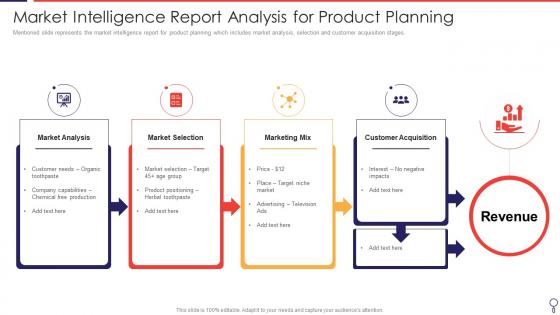
Mentioned slide represents the market intelligence report for product planning which includes market analysis, selection and customer acquisition stages.
People who downloaded this PowerPoint presentation also viewed the following :
Market Intelligence Report Analysis For Product Planning with all 6 slides:
Use our Market Intelligence Report Analysis For Product Planning to effectively help you save your valuable time. They are readymade to fit into any presentation structure.





FAQs for Market Intelligence Report Analysis
Market intelligence delivers enhanced decision-making capabilities, competitive positioning insights, risk mitigation strategies, customer behavior understanding, and revenue growth opportunities. Through systematic data analysis and trend monitoring, organizations streamline strategic planning, minimize market uncertainties, and accelerate product development cycles, with many enterprises finding that comprehensive intelligence frameworks ultimately provide sustainable competitive advantages in increasingly dynamic business environments.
Companies can effectively gather competitor data through social media monitoring, industry reports, customer feedback analysis, patent filings, and competitor website tracking. These market intelligence approaches enable organizations to benchmark pricing strategies, identify market gaps, and anticipate competitive moves, with many businesses finding that systematic competitor analysis ultimately delivers strategic advantages and faster market response capabilities.
Big data revolutionizes market intelligence by enabling real-time analysis of consumer behavior, competitive positioning, market trends, and predictive forecasting across vast datasets. Through advanced analytics platforms, organizations streamline decision-making processes, enhance customer segmentation strategies, and identify emerging opportunities faster than competitors, with many retail and financial services companies finding that data-driven insights deliver significant competitive advantages.
Small businesses can leverage market intelligence through free tools like Google Analytics, social media insights, industry reports from government sources, and competitor analysis platforms with freemium models. These cost-effective solutions enable startups and SMEs to track consumer behavior, monitor competitive positioning, and identify market opportunities, ultimately delivering strategic insights that enhance decision-making and competitive advantage without significant financial investment.
Organizations should prioritize data privacy compliance, transparent collection methods, respect for competitor confidentiality, and adherence to industry regulations when gathering market intelligence. These ethical practices enhance credibility and minimize legal risks, with many companies finding that responsible intelligence-gathering ultimately delivers sustainable competitive advantages while building stakeholder trust and long-term market relationships.
Market intelligence helps identify emerging consumer behavior trends by analyzing social media sentiment, purchase patterns, demographic shifts, and competitor activities across multiple touchpoints. Through advanced analytics and real-time data monitoring, retailers and consumer brands can detect preference changes, seasonal variations, and lifestyle shifts early, enabling proactive product development and marketing strategies that capture market opportunities before competitors.
Effective market intelligence frameworks for startups include Porter's Five Forces for competitive analysis, SWOT analysis for strategic positioning, TAM-SAM-SOM for market sizing, customer journey mapping, and competitive benchmarking tools. These frameworks enable startups to assess market viability, identify opportunities, and minimize risks by providing structured approaches to understanding customer needs, competitive landscapes, and market dynamics, ultimately delivering data-driven entry strategies that enhance chances of successful market penetration.
AI and machine learning integration enhances market intelligence capabilities by automating data collection, identifying complex patterns, and generating predictive insights from vast datasets. These technologies streamline analysis across financial services, retail, and manufacturing sectors, enabling organizations to anticipate market trends, optimize pricing strategies, and deliver faster competitive intelligence, ultimately transforming reactive decision-making into proactive strategic advantage.
Businesses should focus on metrics including competitive positioning accuracy, market trend prediction rates, customer insight actionability, revenue impact from intelligence-driven decisions, and time-to-market improvements. These measurements enable organizations to assess intelligence quality, strategic decision enhancement, and operational efficiency gains, with many companies finding that tracking both leading indicators and business outcomes ultimately delivers measurable competitive advantage.
Geographic Information Systems (GIS) enhance market intelligence by providing spatial data analysis, demographic mapping, competitor location tracking, customer distribution patterns, and territory optimization capabilities. Through location-based insights, businesses can identify underserved markets, optimize supply chains, and make data-driven expansion decisions, with retail chains and service providers finding that geographic analysis delivers significant competitive advantages in market positioning.
Common mistakes include relying on outdated information, ignoring contextual factors, over-interpreting small sample sizes, confirmation bias, and failing to cross-reference multiple data sources. These interpretation errors lead organizations to misallocate resources, pursue ineffective strategies, and miss competitive opportunities, with many companies finding that structured analytical frameworks and diverse perspectives ultimately deliver more accurate insights and strategic decision-making.
Market intelligence supports product development by identifying consumer preferences, competitive gaps, emerging trends, and unmet market needs through comprehensive data analysis. This strategic insight enables companies to create targeted products, reduce development risks, and accelerate time-to-market, with many organizations finding that intelligence-driven innovation delivers higher success rates and stronger competitive positioning.
Social media analytics contribute to market intelligence by monitoring customer sentiment, tracking competitor activities, identifying emerging trends, analyzing consumer behavior patterns, and measuring brand perception across platforms. Through real-time data collection and sentiment analysis, companies can anticipate market shifts, optimize product positioning, and enhance customer engagement strategies, ultimately delivering competitive advantage and more responsive marketing approaches.
Businesses ensure compliance by implementing data anonymization techniques, obtaining proper consent for data collection, conducting regular privacy audits, and establishing clear data governance frameworks. Through GDPR-compliant analytics platforms and privacy-by-design methodologies, companies in sectors like financial services and healthcare streamline intelligence gathering while minimizing regulatory risks, ultimately delivering competitive insights and maintaining customer trust.
Recommended market intelligence tools include analytics platforms like Tableau and Power BI, social listening software such as Brandwatch and Hootsuite Insights, competitive intelligence solutions like Crayon and Klenty, survey tools including SurveyMonkey, and CRM systems like Salesforce. These technologies streamline data collection, automate trend analysis, and enhance reporting accuracy, with many organizations finding that integrated platforms deliver faster insights and more strategic decision-making capabilities.
-
Happy to found you SlideTeam. You guys are value for money. Amazing slides.
-
I discovered some really original and instructive business slides here. I found that they suited me well.