

Market intelligence report powerpoint presentation slides




Try Before you Buy Download Free Sample Product
 Impress Your
 Audience
 100%
100% Editable
 Save Hours
 of Time


Introducing our Market Intelligence Report PowerPoint Presentation Slides to make your task easy and time-efficient. These online marketing PowerPoint templates are a fantastic tool for entrepreneurs, organizations, and any other professionals. Employ these artificial intelligence PPT slides to understand evolving science, technology, and new methodologies. Research and review the various marketing options by taking aid of this thorough and content-specific e-marketing PPT presentation and draft a summary of the business plan or strategy. Take advantage of this cost-benefit surveying IoT analytics PPT slideshow to analyze your company’s hardware, network, professional services, and platform to exhibit the industry value trends. Analyze the data, statistics, and finance in a time-efficient manner by understanding the operations of the internet in marketing through this informative PPT design. Easily study the trends related to the industry and the forces that drive the industry with the help of these networking PPT templates. Download these completely adaptable internet marketing PPT graphics to convey your mission, vision, and objectives by giving it your orientation.
People who downloaded this PowerPoint presentation also viewed the following :
Content of this Powerpoint Presentation
Slide 1: This slide introduces Market Intelligence Report. State Your Company Name and begin.
Slide 2: This slide shows Agenda of Market Intelligence Report.
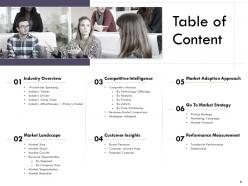
Slide 3: This slide presents Table of Content describing- Industry Overview, Market Landscape, Competitive Intelligence, etc.
Slide 4: This slide displays Table of Contents highlighting Industry Overview.
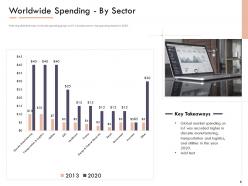
Slide 5: This slide illustrates worldwide spending graph on IOT.
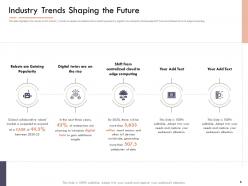
Slide 6: This slide represents Industry Trends Shaping the Future.
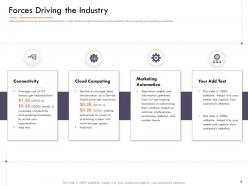
Slide 7: This slide showcases Major driving forces of the industry like connectivity, cloud computing and marketing automation.
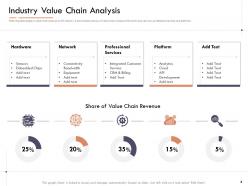
Slide 8: This slide shows Industry Value Chain Analysis.
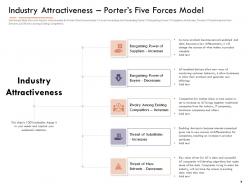
Slide 9: This slide presents Industry Attractiveness – Porter’s Five Forces Model.
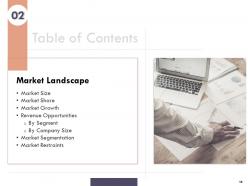
Slide 10: This slide displays Table of Contents highlighting Market Landscape.
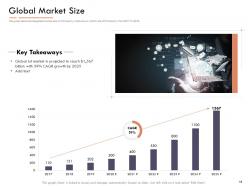
Slide 11: This slide shows Global Market Size with the help of graphs and charts.
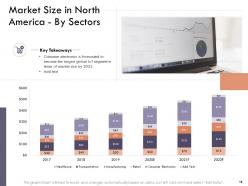
Slide 12: This slide shows Market Size in North America - By Sectors.
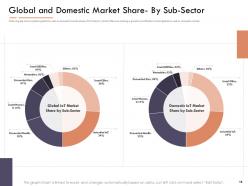
Slide 13: This slide shows Global and Domestic Market Share- By Sub-Sector.
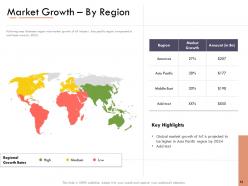
Slide 14: This slide presents Market Growth – By Region.
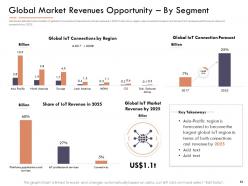
Slide 15: This slide displays Global Market Revenues Opportunity – By Segment.
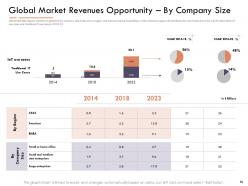
Slide 16: This slide represents Global Market Revenues Opportunity – By Company Size.
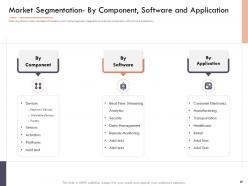
Slide 17: This slide shows Market Segmentation- By Component, Software and Application.
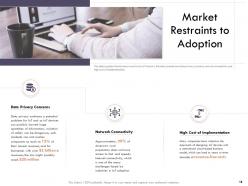
Slide 18: This slide shows Market Restraints to Adoption.
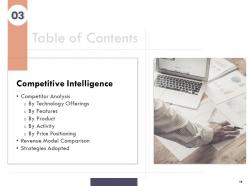
Slide 19: This slide presents Table of Contents highlighting Competitive Intelligence.
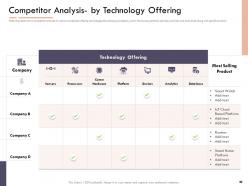
Slide 20: This slide displays Competitor Analysis- by Technology Offering.
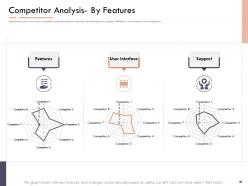
Slide 21: This slide represents Competitor Analysis- By Features.
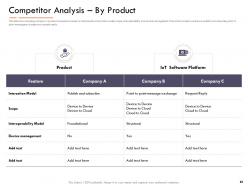
Slide 22: This slide shows leading company’s product comparison based on features like interaction model, scope, interoperability and device management.
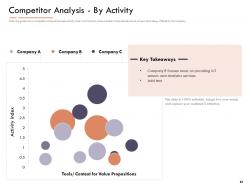
Slide 23: This slide shows Competitor Analysis - By Activity.
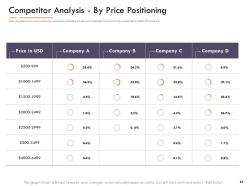
Slide 24: This slide presents Competitor Analysis - By Price Positioning.
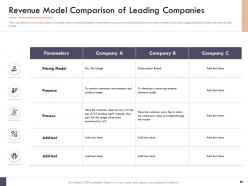
Slide 25: This slide displays Revenue Model Comparison of Leading Companies.
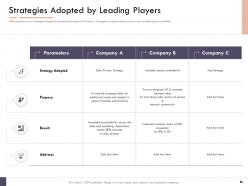
Slide 26: This slide represents Strategies Adopted by Leading Players.
Slide 27: This slide showcases Table of Contents highlighting Customer Insights.
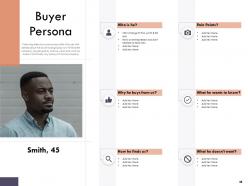
Slide 28: This slide shows persona profile of buyer with details about the buyer background, how he finds the company, etc.
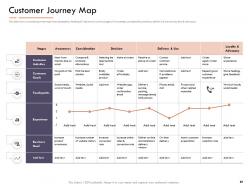
Slide 29: This slide presents customer journey map most adopted by leading IoT players. It covers stages of awareness, consideration, decision, delivery & use and loyalty & advocacy.
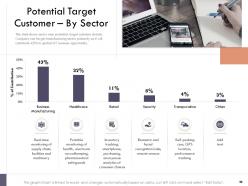
Slide 30: This slide displays sector wise potential target customer details. Company can target manufacturing sector primarily as it will contribute 42% to global IoT revenue opportunity.
Slide 31: This slide represents Table of Contents highlighting Market Adoption Approach.
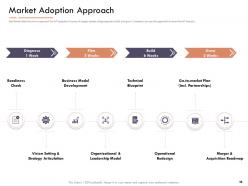
Slide 32: This slide showcases Market Adoption Approach.
Slide 33: This slide shows Table of Contents highlighting Go To Market Strategy.
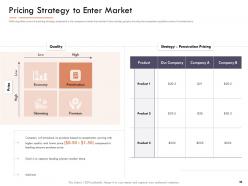
Slide 34: This slide presents the pricing strategy adopted by the company to enter the market.
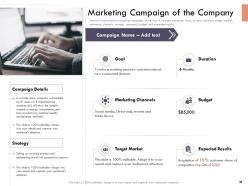
Slide 35: This slide displays Marketing Campaign of the Company.
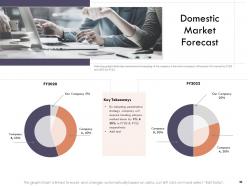
Slide 36: This slide represents Domestic Market Forecast.
Slide 37: This slide showcases Table of Contents highlighting Performance Measurement.
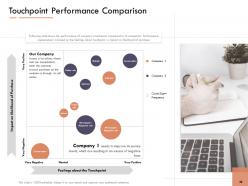
Slide 38: This slide shows the performance of company’s touchpoint compared to its competitor.
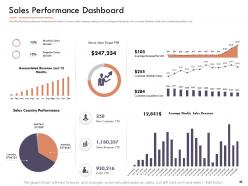
Slide 39: This slide shows Sales Performance Dashboard.
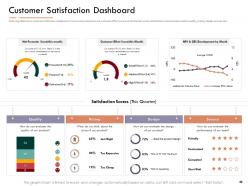
Slide 40: This slide displays Customer Satisfaction Dashboard.
Slide 41: This slide represents Market Intelligence Report Icons.
Slide 42: This slide is titled as Additional Slides for moving forward.
Slide 43: This is About Us slide to show company specifications etc.
Slide 44: This is Our Team slide with names and designation.
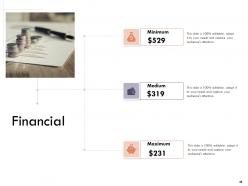
Slide 45: This is a Financial slide. Show finance related stuff here.
Slide 46: This slide shows Post it Notes. Post your important notes here.
Slide 47: This slide shows 30 60 90 Days Plan with text boxes.
Slide 48: This is a Thank You slide with address, contact numbers and email address.
Market intelligence report powerpoint presentation slides with all 48 slides:
Use our Market Intelligence Report Powerpoint Presentation Slides to effectively help you save your valuable time. They are readymade to fit into any presentation structure.



FAQs for Market intelligence report
Honestly, you just need four things to make market intel actually useful. Define what decisions you're trying to make first - sounds obvious but most people skip this step. Then figure out your data sources (internal sales stuff plus outside research). The process part is huge - set up regular collection so you're not panicking every quarter trying to pull reports together. Oh and make sure people actually read what you send them, otherwise what's the point? I've seen so many teams drown in data but never answer the basic questions their CEO is asking. Just pick one burning question to start with and build from there.
You want to cast a wide net - social media buzz, what competitors are doing, patent stuff, industry reports, customer complaints. The real trick is catching weak signals before they blow up and everyone's scrambling. I've watched teams completely whiff on massive shifts because they only read the obvious quarterly reports or whatever. Mix automated tools with actual human eyeballs to connect the dots. Also, don't just collect this stuff and let it sit there gathering dust - actually review it regularly and do something with what you find. Otherwise you're just hoarding data for no reason.
So competitor analysis is like your secret weapon for figuring out the market - seriously, it's a game changer. You're tracking who's doing what, their pricing strategies, customer feedback, all that good stuff. Helps you spot opportunities everyone else missed and see what's coming down the pipeline. I swear, some companies would save themselves so much drama if they just paid attention to their competition. Don't make it a one-and-done thing though. Set up Google alerts for your main rivals and scroll through their social media once a month. You'll catch trends way earlier than most people.
Start with Google Analytics - it's free and shows you the basics. For social stuff, Hootsuite or Brandwatch let you track what people are saying about your industry. SurveyMonkey's great for surveys when you need real data from people. Oh, and SEMrush or Ahrefs are honestly game-changers for seeing what competitors are doing (kind of addictive once you start digging). Your CRM probably has useful customer pattern data you're not using yet. Google Trends is surprisingly helpful too. Don't go crazy though - pick like 2-3 tools max or you'll never actually use any of them consistently.
Honestly, you've got to pull from multiple sources and check everything twice. I made this mistake once where we built an entire campaign off one bogus survey - total disaster. Grab data from industry reports, customer interviews, competitor research, whatever you can find. Then cross-reference it all. Sample sizes matter too, so dig into the methodology before trusting anything. Set up checkpoints where you're testing your assumptions against actual market feedback. Oh, and always have someone else review your conclusions before you present - fresh eyes catch things you'll miss when you're too deep in the weeds.
Honestly, just don't do anything shady or illegal - that's the biggest thing. Public data and legit surveys are totally fine. Never try bribing people or hacking for insider info though. I've watched companies totally shoot themselves in the foot doing sketchy competitive research. When you're talking to customers or contacts, be upfront about who you are. My rule of thumb? If you'd be pissed at competitors for doing it to you, then skip it. Trust me, getting sued isn't worth whatever intel you think you'll get.
Honestly, market intelligence is what keeps you from building stuff nobody wants. Customer feedback, usage data, competitor research - that's your reality check before you commit resources to features. I've watched so many teams get excited about "innovative" ideas that totally flopped because they never validated demand first. The trick is baking these insights into your sprint planning from day one, not scrambling to find justification later. Set up regular touchpoints with whoever handles your market research. Way better than flying blind on gut instinct - though sometimes you still gotta trust your intuition a bit.
Look at both leading and lagging indicators to see if your market intelligence is actually doing its job. Decision-making speed is huge - are you making strategic moves faster now? Then check forecast accuracy and competitive response times. Revenue impact matters most, but honestly that takes forever to surface. Track how often teams use your reports too (pointless if they're collecting digital dust). I'd also measure how frequently insights turn into real business actions. Pick maybe 3-4 metrics that connect to your goals and review monthly. Don't go overboard with tracking everything.
Dude, market research doesn't have to break the bank. Google Trends is your best friend - shows you what people are actually searching for. Stalk your competitors' social media too (legally, obviously lol). Their posts basically tell you their whole strategy. Free surveys work great, and honestly most customers love giving their opinion when you ask nicely. Trade associations publish tons of basic industry data for free if you dig around. I'd pick one method first though. Spend like 30 minutes weekly just collecting info and you'll start seeing patterns pretty quick.
Social media's basically changed everything for market research. You can see what people actually think about your stuff in real-time instead of waiting weeks for survey results. Twitter and Reddit especially - people are brutally honest there, which is perfect. Yeah, there's tons of junk to sift through, but you'll catch competitor launches and industry drama as it happens. I'd start with basic keyword alerts for your main competitors. LinkedIn's solid too for B2B insights. Honestly, traditional market research feels so slow now compared to just monitoring what people are saying online. The unfiltered feedback hits different than formal surveys.
Honestly, it depends what industry you're in because they all care about different stuff. Tech companies obsess over patents and who's launching what next - kinda makes sense with how fast everything moves. Healthcare is more about regulatory drama and clinical trials since patient safety is huge. Retail? They're digging into consumer patterns and supply chains. Where you get your data changes too. Tech folks hang out in developer forums tracking product drops. Retail digs through sales numbers and store traffic. You really just need to focus on whatever actually drives success in your specific sector.
Ugh, data overload is the worst - you'll drown in numbers if you're not careful. Half the datasets are incomplete or straight-up ancient, and some vendors just send garbage quality stuff. Cross-referencing multiple sources saves your butt though. The tricky part? Don't mistake correlation for actual causation, even when your boss wants answers yesterday. Oh and watch out for your own biases creeping in. I always get tempted to find patterns that prove what I already think is true. Document everything so you can explain your logic later when people inevitably question it.
Honestly, most teams treat market intel like homework - they do it, then shove it in a drawer. Don't be those people. From the start, connect your insights to actual goals. Found a pricing gap? Build that into your revenue targets right away. Someone needs to own turning research into real recommendations each quarter. We always ask "what did we learn that should shift our strategy?" during reviews. The key is creating moments where intelligence changes decisions, not just sits there looking pretty in slide decks nobody opens again.
Lead with your main point - busy people want the "so what" right away. Different audiences care about different things, so tailor accordingly. Sales wants revenue impact, finance wants cost implications. Visuals are your friend here because walls of text are brutal to get through. Structure everything with clear next steps, not just "here's what we found." Include your methodology so they trust the data. But honestly? The best insights come from actual conversations. Present in person when you can - people will push back and ask questions you didn't think of. That's where the real magic happens.
Market intelligence totally changes how you segment customers. Instead of basic demographics, you can add in buying behaviors and what competitors they're checking out. You'll find these weird micro-segments - like people who only switch brands when the economy tanks or get swayed by TikTok ads specifically. The targeting gets crazy precise because you know the *why* behind purchases, not just the who. Sometimes I think traditional segmentation is basically guessing at this point. You can predict when they'll actually convert too. Try overlaying your current segments with competitor data first - that's where the gold is.
-
Awesomely designed templates, Easy to understand.
-
Thanks for all your great templates they have saved me lots of time and accelerate my presentations. Great product, keep them up!
-
Much better than the original! Thanks for the quick turnaround.
-
Enough space for editing and adding your own content.
-
Very unique, user-friendly presentation interface.
-
It saves your time and decrease your efforts in half.
-
Visually stunning presentation, love the content.