

Business strategy powerpoint templates





Try Before you Buy Download Free Sample Product
 Impress Your
 Audience
 100%
100% Editable
 Save Hours
 of Time


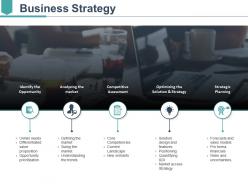
We present to you our Business Strategy PowerPoint Template. This PPT slideshow is perfect when you want to present to your viewers every bit planning of your business. This business template consists of a five-stage process and the stages are identification of opportunities, analyzing the market, competitive assessment, optimizing the solution and strategy, and strategic planning. A business proposal is best explained to its workers if they know the working of the company in and out, by downloading our PowerPoint presentation we assure you accomplishment of this goal. Our business professionals have made this deck of five skillfully designed slides just for you. You can use this presentation if you want to present information related to the marketing, business strategies, sales, management, communication, production, employment related issues etc. If you use and download this pre-designed slideshow you will outshine and excel in the competitive market achieving the goals of your establishment. Your workers will be able to work more effectively if information is delivered to them in a better and easy-going method. The PPT template consists of five symbols to represent each stage. So download this PPT slide of proficiently presented slides to impress you clients. Accurately extrapolate current events with our Business Strategy Powerpoint Templates. Be able to interpret the future.
People who downloaded this PowerPoint presentation also viewed the following :
Business strategy powerpoint templates with all 5 slides:
Commemorate iconic individuals with our Business Strategy Powerpoint Templates. Focus on their exemplary contributions.
FAQs for Business
Start with vision/mission stuff, then dive into market analysis and who you're actually targeting. Competitive landscape is huge - can't skip that. SWOT analysis too, plus you need realistic budget numbers (seriously, so many people mess this up and regret it). Map out your key objectives with actual measurable goals, not fluffy nonsense. Action plans with deadlines are essential. Success metrics matter. Honestly? Keep it simple or nobody will use the damn thing. Do a one-page version first, then expand later if you need to. Regular check-ins help you stay on track.
Honestly, business strategy templates are game-changers for speed. Your team gets a solid framework instead of reinventing the wheel every single time. No more endless debates about formatting - you dive straight into actual strategy work. Everyone using the same structure makes comparing ideas so much cleaner, and you'll catch logical gaps faster. I've watched teams literally halve their planning time with this approach. The trick is finding templates that fit your industry vibe, then adapting them as you figure out what clicks. Oh, and don't go crazy with customization right away - start simple.
Honestly, traditional templates are just static files - PDFs or Word docs you fill out once and that's it. Digital ones let you actually interact with them though. You can click around, test different scenarios, update stuff in real-time and watch how it affects your whole strategy. The collaboration thing is huge too - your team can all work on it at once instead of that annoying email chain passing versions around. I mean, traditional templates work fine if you just need something basic. But digital ones actually grow with your business and keep everyone on the same page way better.
Charts and infographics are total game-changers for getting buy-in on your strategy. People just get it faster when they can see data instead of reading through walls of text. I swear, even the most boring PowerPoint can grab attention with decent visuals. Colors and icons help too - there's something about our brains that just connects better with images. Your stakeholders will actually stay focused during meetings (miracle, right?). Plus it's so much easier to share diagrams across different teams than forwarding around dense documents. Just throw one visual into each major section and you'll see what I mean.
Honestly, just focus on swapping out the parts that matter for your industry. The competitive analysis bit needs your actual competitors, not some generic examples. Financial projections are usually the messiest part to fix - like, SaaS numbers make zero sense for retail. Timeline stuff varies wildly too. Tech moves at warp speed while manufacturing crawls along. Keep the basic structure but gut all the examples and KPIs. Replace them with what actually drives your industry. Oh, and don't trust any template assumptions without checking your real market data first. Most templates are pretty cookie-cutter.
Think of SWOT as your reality check before diving into strategy stuff. It's just a 2x2 grid where you map out what you're good at, what sucks, plus outside opportunities and threats. Honestly, most people rush through this part, but don't. Take time with each box because everything else builds off it. Your strengths might reveal opportunities you hadn't thought about. Weaknesses show you what to fix first. The external stuff keeps you grounded in what's actually happening in your market. Pretty straightforward once you get going.
Honestly, templates are a game-changer for getting teams aligned. Everyone's literally working from the same playbook - same goals, metrics, timelines, all that stuff. No more departments going rogue with their own random planning methods (trust me, I've seen that disaster). You can actually compare what different teams are doing and catch overlaps before they become problems. Plus it forces people to think through the important stuff consistently. My advice? Don't overthink it. Pick something simple and test it with just two departments first - see how it goes before rolling it out everywhere.
Don't treat templates like fill-in-the-blank worksheets - that's how you end up cramming your business into boxes that make zero sense. I've seen people literally force their strategy to match some random template instead of the other way around. Pick one that's actually close to your industry first. Then gut whatever doesn't work for your market. Templates are more like rough blueprints than holy commandments, you know? The real work happens when you're adapting sections to match what's actually happening with your competitors and customers. Otherwise you're just doing fancy Mad Libs.
Honestly, most templates suck at explaining this part. Start by picking KPIs that actually match what you're trying to achieve - revenue growth, customer acquisition costs, whatever makes sense for your goals. I'd measure both the quick wins (pipeline stuff) and the bigger picture results. Set up your baseline numbers right now, before you change anything. Otherwise you'll have no clue if it's working later. Monthly check-ins work pretty well, quarterly if things move slower in your industry. The trick is tracking leading indicators too, not just final results. That way you can course-correct before you're totally off track.
Build feedback loops right into your template from the start. Don't just get input from executives - talk to people actually doing the work too. Those frontline perspectives are gold, honestly. Set up regular checkpoints and create specific sections for stakeholder comments. Track everything with version control so you can see how things evolved. Here's what really matters though: always circle back to show people how their input shaped decisions. Otherwise they'll stop caring. Quick tip - add a "feedback integration log" to whatever you're using now. Forces you to actually document and act on what people tell you instead of just collecting it.
Oh man, this is so true from experience - what kills it in Germany totally bombs in Japan. Your super direct, data-heavy template that US teams love? It'll come across way too aggressive for relationship-focused cultures. Some places are all about hierarchy while others need everyone to agree first (which honestly drove me crazy on a project last year). Language matters huge. So does how you structure decisions and even the visual layout. My advice? Ask your regional teams what actually feels right to them before you roll anything out globally. Don't just assume your template works everywhere.
PowerPoint or Google Slides work great for presentations. Excel's your friend for data-heavy planning stuff. Miro and Lucidchart are solid if your team's into visual collaboration - there's something weirdly addictive about moving those digital sticky notes around together. Cascade and ClearPoint have more advanced strategy features, but honestly? They're kind of a pain to learn. My advice: stick with whatever tools you're already comfortable with first. You can always upgrade to the fancy specialized software later once you've got your strategy process down pat.
Build review cycles right into your process - quarterly at minimum, though monthly works way better with how crazy things move now. During these sessions, ask what assumptions in your template are getting stale and what new stuff you should track. Treat templates like living docs, not some sacred text. Watch what successful competitors do differently too - their pivots usually signal market shifts before you read about them anywhere else. Oh, and just add "template relevance check" to your next planning meeting agenda. Easy starting point.
So Netflix used the Business Model Canvas when they switched from mailing DVDs to streaming - helped them map out their whole value shift. Amazon did something similar with strategic planning templates during their expansion beyond books (which honestly blew my mind how systematic they were about it). Then there's Airbnb, who used platform business templates to figure out their two-sided marketplace thing. Point is, these companies didn't just guess. They picked frameworks that actually matched their problems. You don't need to use every template out there - just find the one that fits your specific situation.
Yeah, totally use those corporate templates! Just ignore all the fancy business-speak nonsense. Most of them actually have good bones once you strip away the sections about managing 15 different divisions (which, obviously you don't need). Focus on the real questions: who are you targeting? What makes you different? What are your top 3-5 goals this year? The SWOT stuff and competitor analysis parts are usually gold - just make them way smaller in scope. Honestly, half these templates are overkill even for big companies. Scale everything down to match what you're actually dealing with and you'll be fine.
-
Editable templates with innovative design and color combination.
-
Nice and innovative design.