


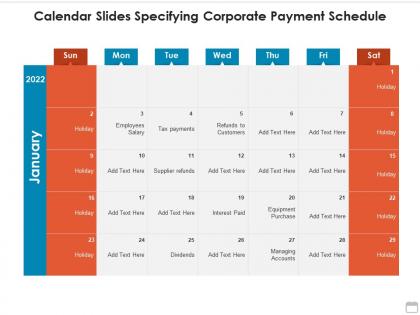
Calendar slides specifying corporate payment schedule




Try Before you Buy Download Free Sample Product
 Impress Your
 Audience
 100%
100% Editable
 Save Hours
 of Time


Our Calendar Slides Specifying Corporate Payment Schedule are topically designed to provide an attractive backdrop to any subject. Use them to look like a presentation pro.
People who downloaded this PowerPoint presentation also viewed the following :
Calendar slides specifying corporate payment schedule with all 2 slides:
Use our Calendar Slides Specifying Corporate Payment Schedule to effectively help you save your valuable time. They are readymade to fit into any presentation structure.
FAQs for Calendar slides specifying
Key components include payment due dates, vendor information, approval workflows, cash flow projections, and automated reminders. These elements work together by streamlining accounts payable processes, minimizing late payment penalties, and optimizing working capital management, with many finance teams finding that well-structured calendars ultimately deliver improved vendor relationships and enhanced operational efficiency.
A corporate payment schedule calendar improves cash flow management by providing visibility into upcoming payments, enabling strategic timing of expenditures, and preventing cash shortages through predictive planning. This systematic approach allows businesses to optimize working capital, negotiate better payment terms with vendors, and maintain adequate reserves, ultimately delivering enhanced financial stability and operational efficiency across organizations.
When designing payment schedules for stakeholders, consider payment frequency preferences, cash flow cycles, regulatory compliance requirements, stakeholder priority levels, and seasonal business variations. These factors enable organizations to balance liquidity management with relationship maintenance, ensuring suppliers receive timely payments while employees and contractors experience predictable compensation cycles, ultimately delivering improved stakeholder satisfaction and operational efficiency.
Payment terms and due dates significantly impact vendor relationships by affecting cash flow stability, trust levels, and partnership quality within corporate schedules. Favorable terms, such as net-30 or early payment discounts, strengthen supplier loyalty and negotiating power, while delayed payments can strain relationships, reduce service quality, and limit future collaboration opportunities, ultimately affecting operational efficiency and competitive advantage.
Technology enhances corporate payment schedule calendars through automated payment processing, real-time cash flow tracking, integration with accounting systems, predictive analytics, and mobile accessibility. These software tools streamline financial operations by reducing manual errors, providing instant visibility into upcoming obligations, and enabling strategic cash management, with many finance teams finding that automated scheduling delivers improved accuracy and operational efficiency.
Companies should track metrics including days sales outstanding (DSO), cash conversion cycle, payment processing time, vendor satisfaction scores, and cost per transaction to assess payment schedule efficiency. These measurements enable organizations to identify bottlenecks, optimize cash flow timing, and reduce administrative costs, with many financial departments finding that strategic monitoring ultimately delivers improved supplier relationships and enhanced working capital management.
Companies can adjust payment schedules through flexible terms, staggered payment options, contingency clauses, automated adjustment triggers, and regular financial reviews. These approaches enable organizations to maintain cash flow stability during market volatility, with many financial institutions finding that strategic payment flexibility ultimately delivers improved vendor relationships and operational resilience.
A corporate payment schedule calendar serves as the foundation for accurate budgeting and financial forecasting by mapping cash outflows, identifying seasonal payment patterns, and enabling strategic resource allocation. This systematic approach helps organizations anticipate liquidity needs, optimize working capital management, and maintain financial stability, with many finance teams finding that structured payment scheduling ultimately delivers enhanced forecasting accuracy and improved cash flow predictability.
Businesses ensure contractual compliance through payment schedule calendars by incorporating contract terms, automated deadline tracking, and milestone-based payment triggers directly into their systems. These calendars enable organizations to monitor vendor agreements, client deliverables, and regulatory requirements systematically, while providing audit trails and early warning notifications, ultimately minimizing breach risks and maintaining strong business relationships.
Common challenges include coordinating complex payment cycles, managing cash flow timing, ensuring regulatory compliance, integrating with existing financial systems, and maintaining accuracy across multiple departments. These implementation hurdles often require significant process restructuring, staff training, and technology upgrades, with many organizations finding that initial setup complexity ultimately delivers streamlined operations and improved financial transparency.
Corporate payment schedule calendars integrate with financial management systems through API connections, data synchronization protocols, and automated workflow triggers that enable seamless information flow between platforms. This integration streamlines accounts payable processes, enhances cash flow forecasting, and minimizes manual data entry errors, with many organizations finding that connected systems ultimately deliver improved financial visibility and operational efficiency across departments.
Visual aids like Gantt charts and timelines enhance payment schedule calendars by improving clarity, enabling quick identification of payment deadlines, and facilitating better cash flow visualization across multiple vendors and projects. These tools streamline financial planning for organizations by reducing missed payments, enhancing stakeholder communication, and providing comprehensive oversight of payment obligations, ultimately delivering improved operational efficiency and stronger vendor relationships.
Companies can communicate payment schedules effectively through automated email notifications, dedicated vendor portals, standardized payment calendars, and regular account manager check-ins. These approaches streamline transparency by providing real-time status updates, clear milestone documentation, and proactive deadline reminders, with many organizations finding that consistent multi-channel communication reduces disputes and strengthens vendor relationships.
Best practices for reviewing corporate payment schedules include conducting monthly reconciliations, analyzing cash flow patterns, updating vendor terms quarterly, implementing automated alerts for payment deadlines, and establishing regular stakeholder meetings to assess scheduling effectiveness. These systematic approaches streamline financial operations by identifying bottlenecks, optimizing cash management, and ensuring compliance, with many organizations finding that consistent reviews ultimately enhance vendor relationships and reduce operational costs.
A payment schedule calendar helps mitigate late payment risks by providing centralized visibility into due dates, automated reminders, and cash flow forecasting capabilities. Through systematic tracking and alerts, organizations streamline payment processes, avoid costly penalty fees, and maintain strong vendor relationships, while finance teams can proactively manage liquidity and reduce compliance risks across multiple payment obligations.
-
Out of the box and creative design.