


Candidate Evaluation Form For Job Promotion Interview




Try Before you Buy Download Free Sample Product
 Impress Your
 Audience
 100%
100% Editable
 Save Hours
 of Time


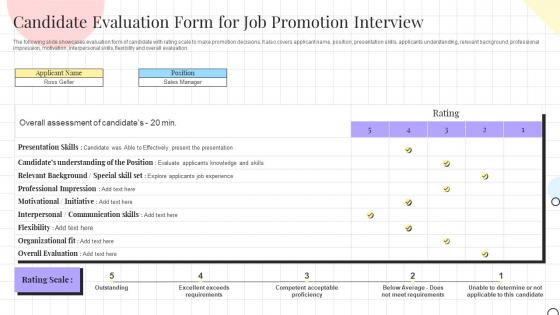
The following slide showcases evaluation form of candidate with rating scale to make promotion decisions. It also covers applicant name, position, presentation skills, applicants understanding, relevant background, professional impression, motivation, interpersonal skills, flexibility and overall evaluation.
People who downloaded this PowerPoint presentation also viewed the following :
Candidate Evaluation Form For Job Promotion Interview with all 6 slides:
Use our Candidate Evaluation Form For Job Promotion Interview to effectively help you save your valuable time. They are readymade to fit into any presentation structure.





FAQs for Candidate Evaluation Form For
So definitely include the obvious stuff - technical skills, core competencies for the role, cultural fit. Communication and problem-solving are huge too. Oh, and throw in leadership potential even if it's not a management gig since people move up eventually. Honestly, I'd add a "red flags" section because sometimes you just get a weird vibe and that matters. Use consistent rating scales so everyone's comparing apples to apples. The best part though? End with a straight yes/no "would you hire them" question. Forces people to actually make a decision instead of playing it safe with middle ratings.
Honestly, start with what actually matters for the job - make your questions super specific instead of that fuzzy "culture fit" stuff that's basically meaningless. Use a 1-5 rating system with clear descriptions so people aren't just going off vibes. Get multiple people scoring independently, then compare notes after. Catches way more blind spots that way. Oh, and if you can swing it, try reviewing resumes without seeing names or photos first - removes some unconscious bias right off the bat. The whole point is making your process work against bias instead of accidentally encouraging it. Your evaluation form should do the heavy lifting here.
Honestly, behavioral stuff is where you'll see real results - way better than just checking if someone knows Excel or whatever. Those "tell me about a time when" questions are gold. Set up your form with scenario questions and rate people on problem-solving, teamwork, that kind of thing. Make sure everyone's rating the same behaviors the same way though. Define what "good" looks like upfront so you're not just winging it. I've seen too many places where one interviewer loves someone and another hates them for totally different reasons. Structure keeps everyone honest.
Yeah, definitely customize those forms for each role. Generic evaluations are pretty much useless - you want questions that actually match what people will be doing. Why ask a marketing person about coding skills, right? Keep maybe 30-40% standardized for basics like communication and culture fit. Then make the rest role-specific. Honestly, I'd start by writing down the 5 most important skills for each position first. Makes it way easier to build relevant questions from there. You'll get so much better data when candidates can actually showcase what matters for their job.
For soft skills, I'd definitely go with behavioral questions - have them walk you through specific situations where they showed teamwork or solved problems. Rate their answers on how clear and detailed they get. Role-playing works great too, especially if it's a customer service gig. Make sure you create rubrics so everyone's judging candidates the same way (learned that the hard way). Skip the "what would you do" hypotheticals - they're pretty useless honestly. Focus on real examples they give you. Document what you actually observe during the interview and score it against whatever criteria you set up beforehand.
Google Sheets works really well for this - everyone can drop their scores in at the same time. Panel interviews are solid too, just have people fill out forms right after while it's fresh. I've seen teams use SurveyMonkey for anonymous feedback, but honestly that gets awkward when there's only like 3 people evaluating. You could also do a quick debrief meeting and just capture everything in a shared doc as you go. Main thing is everyone's gotta use the same rating criteria or you'll be comparing apples to oranges.
So first thing - grab someone from HR or leadership who really gets your company culture (they always have the strongest opinions anyway). Map your evaluation questions directly to whatever values you guys actually live by. Like if teamwork matters, ask about collaboration scenarios specifically. Look at your current questions honestly - would they help you spot people who'd crush it at YOUR place, not just anywhere? Here's what I'd do: take a few people you hired recently who are killing it and see if they would've scored well on your form. That'll tell you everything.
Oh man, you definitely need a scoring system. Takes all the guesswork out of it - like instead of "they seemed nice" you're actually rating specific skills on a 1-5 scale or whatever. Super helpful when multiple people are interviewing because otherwise everyone just uses their own weird criteria. Makes comparing candidates way less of a headache too. Honestly the paper trail alone is worth it when you need to give feedback or justify why you picked someone. I'd start simple though - just key competencies on a basic scale.
Honestly, going digital will save you so much headache. Automated scoring means no more manually adding up numbers, and you can actually compare candidates fairly instead of relying on Bob's illegible scribbles (seriously, that guy's handwriting is impossible). Digital forms pull data straight from your ATS and send automatic reminders to interviewers. Plus you'll get instant reports showing which interview questions actually matter for predicting who succeeds. The tracking over time is pretty useful too. I'd start by just converting your current form to digital first - don't get fancy right away. Once everyone's comfortable, then add the automated workflows and other bells and whistles.
Dude, you absolutely need to ask candidates if they have questions. Shows you actually want a conversation instead of just interrogating them. They'll ask about the role, company vibe, or stuff they're worried about. Honestly, what they ask tells you SO much - like someone asking about career growth vs. just money? Totally different mindset. I always save 5-10 minutes at the end for this. And actually listen to what they say instead of just going through the motions.
Track demographics through each interview stage so you can spot where people drop off. Make your interviewers ask themselves "what assumptions am I making here?" instead of going with gut feelings - honestly, most bias sneaks in during the whole "culture fit" thing anyway. Get them writing down actual examples on standardized scorecards. Diverse interview panels help too. Oh, and definitely audit your current process first - you might be accidentally filtering people out way earlier than you think. Short sentences mixed with longer ones work better for keeping things consistent.
Skip the fluffy stuff like "cultural fit" - be specific about what you actually want to see. Your form shouldn't be a novel either, people will just skim it. I learned this the hard way when our 3-page evaluation got maybe half filled out. Test it on a couple practice candidates first. You'll spot weird questions or missing pieces. Keep your rating scale the same throughout - don't mix 1-5 with 1-10, it's confusing. Every question should tie back to the actual job, not just wishlist items. Oh, and watch for accidentally biased language that could hurt certain groups.
Honestly? Every 6 months is what I'd do, especially if you're in something that moves fast. Annual reviews are fine I guess, but things shift so quickly now. New skills pop up, old stuff becomes irrelevant - you know how it is. If your new hires keep scoring well but then kinda suck at the actual job, that's your sign right there. Your criteria are off. Set a reminder now before you forget. Get your team involved too since they'll probably catch stuff you miss.
Your evaluation form literally controls your whole hiring game. It makes you figure out what "good" actually looks like before you start interviewing - saves tons of headaches later when you're trying to compare candidates. Are you hiring for skills, personality, or potential? That form decides it all. Consistent criteria also help you catch weird patterns in your process. I've seen companies realize they were accidentally filtering out great people because their questions were trash. Start by looking at your current form - does it actually predict who'll succeed? Most don't, honestly.
Honestly, the key is getting them to actually practice with fake scenarios first. Don't just hand them the form and hope for the best! Walk through what solid evaluation notes look like vs the garbage ones we've all seen. The biggest thing? They need to rate against actual job requirements, not just their random gut reactions. Give them a scoring rubric and do those calibration exercises so nobody's wildly off base. Then - and this part's crucial - sit down with them after their first couple real interviews to see how they're doing. Most managers think they're natural interviewers but... yeah, no.
-
The pricing page of this website is very sorted. I felt no pain while buying the PPTs.
-
Graphics are very appealing to eyes.